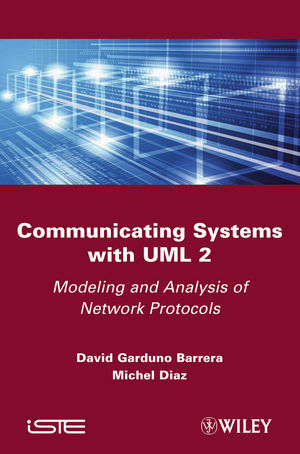
Communicating Systems with UML 2 (eBook)
288 Seiten
John Wiley & Sons (Verlag)
9781118602171 (ISBN)
communication protocols using UML 2. Network protocols are always
presented with a point of view focusing on partial mechanisms and
starting models. This book aims at giving the basis needed for
anybody to model and validate their own protocols. It follows a
practical approach and gives many examples for the description and
analysis of well known basic network mechanisms for
protocols.
The book firstly shows how to describe and validate the main
protocol issues (such as synchronization problems, client-server
interactions, layer organization and behavior, etc.) in an easy and
understandable way. To do so, the book considers and presents the
main traditional network examples (e.g. unidirectional flows,
full-duplex com-munication, error recovering, alternating bit).
Finally, it presents the outputs resulting from a few simulations
of these UML models.
Other books usually only focus either on teaching UML or on
analyzing network protocols, however this book will allow readers
to model network protocols using a new perspective and integrating
these two views, so facilitating their comprehension and
development.
Any university student studying in the field of computing science,
or those working in telecommunications, embedded systems or
networking will find this book a very useful addition.
David Garduno Barrera is a consultant and trainer. Michel Diaz is the Director of Research at CNRS and a senior researcher at LAAS/CNRS in Toulouse, France.
Preface xi
Chapter 1. Why Use UML to Model Network Protocols? 1
1.1. Modeling network protocols 1
1.2. UML as a common language 14
1.3. Chapter summary 28
1.4. Bibliography 28
Chapter 2. Simple Transmission 31
2.1. Introduction 31
2.2. Echo 31
2.3. Unidirectional: simple data sending 42
2.4. Full duplex: simple data sending 52
2.5. Chapter summary 73
2.6. Bibliography 73
Chapter 3. Simple Chat Application 75
3.1. Introduction 75
3.2. Requirements 75
3.3. Analysis 76
3.4. Architecture design 88
3.5. Detailed design 89
3.6. Simple chat simulation 101
3.7. Chapter summary 130
3.8. Bibliography 131
Chapter 4. Non-reliable Transmission Mediums 133
4.1. Introduction 133
4.2. Requirements 134
4.3. Analysis 135
4.4. Architecture design 147
4.5. Detailed design 150
4.6. Validation 160
4.7. Chapter summary 179
4.8. Bibliography 179
Chapter 5. Simple Transport Protocol 181
5.1. Introduction 181
5.2. Requirements 182
5.3. The Alternating Bit Protocol 182
5.4. Analysis 191
5.5. Architecture design 200
5.6. Detailed design 204
5.7. Simulations 217
5.8. Further considerations 235
5.9. Chapter summary 238
5.10. Bibliography 239
Appendix. Detailed Diagrams of the Simple Transport Protocol 241
A.1. State machines for the Application Data Unit Manager (Simple Transport Protocol) 242
A.2. Detailed simulations of the Simple Transport Protocol 245
Index 259
"Students and engineers in computer science and related fields may
find the material of interest." (Book News, 1 October 2011)
| Erscheint lt. Verlag | 7.2.2013 |
|---|---|
| Sprache | englisch |
| Themenwelt | Mathematik / Informatik ► Informatik ► Netzwerke |
| Technik ► Elektrotechnik / Energietechnik | |
| Technik ► Nachrichtentechnik | |
| Schlagworte | Communication Technology - Networks • Electrical & Electronics Engineering • Elektrotechnik u. Elektronik • Kommunikationsnetze |
| ISBN-13 | 9781118602171 / 9781118602171 |
| Informationen gemäß Produktsicherheitsverordnung (GPSR) | |
| Haben Sie eine Frage zum Produkt? |
 EPUB (Adobe DRM)
Kopierschutz: Adobe-DRM
Adobe-DRM ist ein Kopierschutz, der das eBook vor Mißbrauch schützen soll. Dabei wird das eBook bereits beim Download auf Ihre persönliche Adobe-ID autorisiert. Lesen können Sie das eBook dann nur auf den Geräten, welche ebenfalls auf Ihre Adobe-ID registriert sind.
Details zum Adobe-DRM
Dateiformat: EPUB (Electronic Publication)
EPUB ist ein offener Standard für eBooks und eignet sich besonders zur Darstellung von Belletristik und Sachbüchern. Der Fließtext wird dynamisch an die Display- und Schriftgröße angepasst. Auch für mobile Lesegeräte ist EPUB daher gut geeignet.
Systemvoraussetzungen:
PC/Mac: Mit einem PC oder Mac können Sie dieses eBook lesen. Sie benötigen eine
eReader: Dieses eBook kann mit (fast) allen eBook-Readern gelesen werden. Mit dem amazon-Kindle ist es aber nicht kompatibel.
Smartphone/Tablet: Egal ob Apple oder Android, dieses eBook können Sie lesen. Sie benötigen eine
Geräteliste und zusätzliche Hinweise
Buying eBooks from abroad
For tax law reasons we can sell eBooks just within Germany and Switzerland. Regrettably we cannot fulfill eBook-orders from other countries.
aus dem Bereich