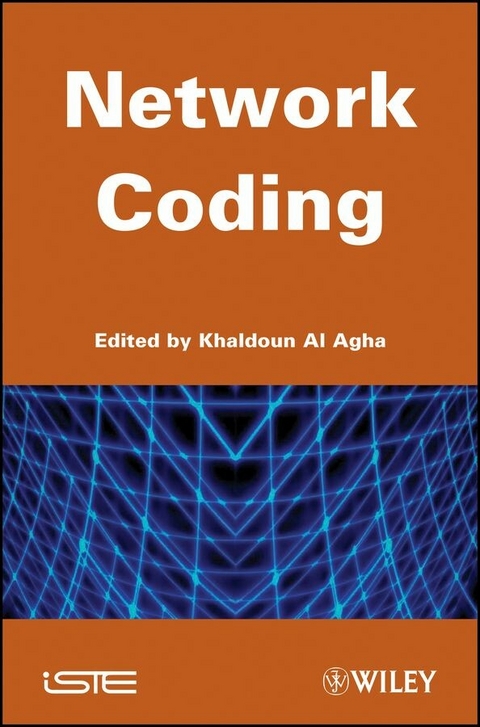
Network Coding (eBook)
304 Seiten
John Wiley & Sons (Verlag)
9781118563106 (ISBN)
from the theoretical level to become a tool used to optimize the
performance of communication networks - wired, cellular, ad
hoc, etc. The idea consists of mixing "packets" of data
together when routing them from source to destination. Since
network coding increases the network performance, it becomes a tool
to enhance the existing protocols and algorithms in a network or
for applications such as peer-to-peer and TCP.
This book delivers an understanding of network coding and provides
a set of studies showing the improvements in security, capacity and
performance of fixed and mobile networks. This is increasingly
topical as industry is increasingly becoming more reliant upon and
applying network coding in multiple applications. Many cases where
network coding is used in routing, physical layer, security,
flooding, error correction, optimization and relaying are given
- all of which are key areas of interest.
Network Coding is the ideal resource for university students
studying coding, and researchers and practitioners in sectors of
all industries where digital communication and its application
needs to be correctly understood and implemented.
Contents
1. Network Coding: From Theory to Practice, Youghourta
Benfattoum, Steven Martin and Khaldoun Al Agha.
2. Fountain Codes and Network Coding for WSNs, Anya Apavatjrut,
Claire Goursaud, Katia Jaffrès-Runser and Jean-Marie
Gorce.
3. Switched Code for Ad Hoc Networks: Optimizing the Diffusion by
Using Network Coding, Nour Kadi and Khaldoun Al Agha.
4. Security by Network Coding, Katia Jaffrès-Runser and
Cédric Lauradoux.
5. Security for Network Coding, Marine Minier, Yuanyuan Zhang and
Wassim Znaïdi.
6. Random Network Coding and Matroids, Maximilien Gadouleau.
7. Joint Network-Channel Coding for the Semi-Orthogonal MARC:
Theoretical Bounds and Practical Design, Atoosa Hatefi, Antoine O.
Berthet and Raphael Visoz.
8. Robust Network Coding, Lana Iwaza, Marco Di Renzo and Michel
Kieffer.
9. Flow Models and Optimization for Network Coding, Eric Gourdin
and Jeremiah Edwards.
Khaldoun Al Agha is Director of the Master Degree of Computer Science NSI - Laboratory LRI at University Paris-South, Orsay, France.
Chapter 1. Network Coding: From Theory to Practice
1
Youghourta BENFATTOUM, Steven MARTIN and Khaldoun AL AGHA
1.1. Introduction 1
1.2. Theoretical approach 2
1.3. Practical approach 10
1.4. Conclusion 23
1.5. Bibliography 24
Chapter 2. Fountain Codes and Network Coding for WSNs
27
Anya APAVATJRUT, Claire GOURSAUD, Katia JAFFRÈS-RUNSER and
Jean-Marie GORCE
2.1. Introduction 27
2.2. Fountain codes 29
2.3. Fountain codes in WSNs 41
2.4. Fountain codes and network code for sensor networks 49
2.5. Conclusion 66
2.6. Bibliography 67
Chapter 3. Switched Code for Ad Hoc Networks: Optimizing the
Diffusion by Using Network Coding 73
Nour KADI and Khaldoun AL AGHA
3.1. Abstract 73
3.2. Introduction 74
3.3. Diffusion in ad hoc networks 77
3.4. Diffusion and network coding 78
3.5. Switched code: incorporate erasure codes with network
coding 83
3.6. Decoding function of switched code 85
3.7. Design and analysis of a new distribution 87
3.8. Conclusion 96
3.9. Bibliography 97
Chapter 4. Security by Network Coding 99
Katia JAFFRÈS-RUNSER and Cédric LAURADOUX
4.1. Introduction 99
4.2. Attack models 100
4.3. Security for a wiretap network 105
4.4. Algebraic security criteria 106
4.5. Conclusion 112
4.6. Bibliography 112
Chapter 5. Security for Network Coding 115
Marine MINIER, Yuanyuan ZHANG and Wassim ZNAÏDI
5.1. Introduction 115
5.2. Attack models 116
5.3. Confidentiality 128
5.4. Integrity and authenticity solutions 130
5.5. Conclusion 142
5.6. Bibliography 143
Chapter 6. Random Network Coding and Matroids 147
Maximilien GADOULEAU
6.1. Protocols for non-coherent communication 148
6.2. Transmission model based on flats of matroid 153
6.3. Parameters for errorless communication 160
6.4. Error-correcting codes for matroids 167
6.5. Matroid codes for network coding 173
6.6. Conclusion 180
6.7. Bibliography 181
Chapter 7. Joint Network-Channel Coding for the
Semi-Orthogonal MARC: Theoretical Bounds and Practical Design
185
Atoosa HATEFI, Antoine O. BERTHET and Raphaël VISOZ
7.1. Introduction 185
7.2. System model 191
7.3. Information-theoretic analysis 195
7.4. Joint network channel coding and decoding 203
7.5. Separate network channel coding and decoding 212
7.6. Numerical results 214
7.7. Conclusion 226
7.8. Appendix. MAC outage performance of high SNR 228
7.9. Bibliography 230
Chapter 8. Robust Network Coding 235
Lana IWAZA, Marco Di RENZO and Michel KIEFFER
8.1. Coherent network error-correction codes 237
8.2 Codes for noncoherent networks, random codes 240
8.3. Codes for noncoherent networks, subspace codes 242
8.4. Joint network-channel coding/decoding 245
8.5. Joint source-network coding/decoding 249
8.6. Conclusion 256
8.7. Acknowledgments 257
8.8. Bibliography 257
Chapter 9. Flow Models and Optimization for Network Coding
265
Eric GOURDIN and Jeremiah EDWARDS
9.1. Introduction 265
9.2. Some reminders on flow problems in graphs 267
9.3. Flow models for multicast traffic 272
9.4. Flow models for network coding 277
9.5. Conclusion 284
9.6. Bibliography 285
List of Authors 289
Index 291
| Erscheint lt. Verlag | 27.12.2012 |
|---|---|
| Sprache | englisch |
| Themenwelt | Mathematik / Informatik ► Informatik ► Netzwerke |
| Technik ► Elektrotechnik / Energietechnik | |
| Technik ► Nachrichtentechnik | |
| Schlagworte | Communication Technology - Networks • Electrical & Electronics Engineering • Elektrotechnik u. Elektronik • Kommunikationsnetze • Netzwerk |
| ISBN-13 | 9781118563106 / 9781118563106 |
| Informationen gemäß Produktsicherheitsverordnung (GPSR) | |
| Haben Sie eine Frage zum Produkt? |
 EPUB (Adobe DRM)
Kopierschutz: Adobe-DRM
Adobe-DRM ist ein Kopierschutz, der das eBook vor Mißbrauch schützen soll. Dabei wird das eBook bereits beim Download auf Ihre persönliche Adobe-ID autorisiert. Lesen können Sie das eBook dann nur auf den Geräten, welche ebenfalls auf Ihre Adobe-ID registriert sind.
Details zum Adobe-DRM
Dateiformat: EPUB (Electronic Publication)
EPUB ist ein offener Standard für eBooks und eignet sich besonders zur Darstellung von Belletristik und Sachbüchern. Der Fließtext wird dynamisch an die Display- und Schriftgröße angepasst. Auch für mobile Lesegeräte ist EPUB daher gut geeignet.
Systemvoraussetzungen:
PC/Mac: Mit einem PC oder Mac können Sie dieses eBook lesen. Sie benötigen eine
eReader: Dieses eBook kann mit (fast) allen eBook-Readern gelesen werden. Mit dem amazon-Kindle ist es aber nicht kompatibel.
Smartphone/Tablet: Egal ob Apple oder Android, dieses eBook können Sie lesen. Sie benötigen eine
Geräteliste und zusätzliche Hinweise
Buying eBooks from abroad
For tax law reasons we can sell eBooks just within Germany and Switzerland. Regrettably we cannot fulfill eBook-orders from other countries.
aus dem Bereich