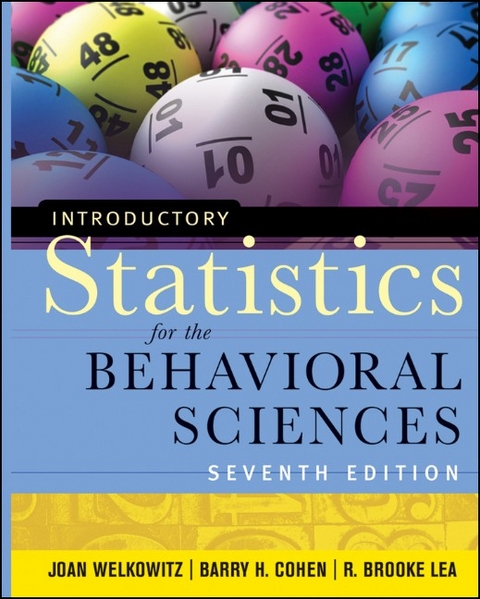
Introductory Statistics for the Behavioral Sciences (eBook)
Wiley (Verlag)
978-1-118-14971-3 (ISBN)
A comprehensive and user-friendly introduction to statistics for behavioral science students-revised and updated
Refined over seven editions by master teachers, this book gives instructors and students alike clear examples and carefully crafted exercises to support the teaching and learning of statistics for both manipulating and consuming data.
One of the most popular and respected statistics texts in the behavioral sciences, the Seventh Edition of Introductory Statistics for the Behavioral Sciences has been fully revised. The new edition presents all the topics students in the behavioral sciences need in a uniquely accessible and easy-to-understand format, aiding in the comprehension and implementation of the statistical analyses most commonly used in the behavioral sciences.
The Seventh Edition features:
-
A continuous narrative that clearly explains statistics while tracking a common data set throughout, making the concepts unintimidating and memorable, and providing a framework that connects all of the topics and allows for easy comparison of different statistical analyses
-
Coverage of important aspects of research design throughout the text, such as the 'correlation is not causality' principle
-
Updated and annotated SPSS output at the end of each chapter with step-by-step instructions
-
Updated examples and exercises
-
An expanded website, at www.wiley.com/go/welkowitz, with test bank, chapter quizzes, and PowerPoint slides for instructors, as well as a second website for students with additional basic math coverage, math review exercises, a study guide, a set of additional SPSS exercises, and more downloadable data sets
JOAN WELKOWITZ, PhD, (deceased) was professor of psychology at New York University. She directed the graduate clinical program for ten years. She taught courses in methodology and statistics at both the graduate and undergraduate levels for more than twenty-five years and?was the primary author of Introductory Statistics for the Behavioral Sciences.
BARRY H. COHEN, PhD, is the Director of the master's program in psychology at New York University, where he has been teaching statistics for more than twenty years. He is the coauthor of two other successful statistics books from Wiley-Explaining Psychological Statistics, Third Edition, and Essentials of Statistics for the Social and Behavioral Sciences.
R. BROOKE LEA, PhD, is professor and chair of the Psychology Department at Macalester College, St. Paul, Minnesota.?His research publications concern the comprehension processes that occur during reading of text and poetry.
A comprehensive and user-friendly introduction to statistics for behavioral science students revised and updated Refined over seven editions by master teachers, this book gives instructors and students alike clear examples and carefully crafted exercises to support the teaching and learning of statistics for both manipulating and consuming data. One of the most popular and respected statistics texts in the behavioral sciences, the Seventh Edition of Introductory Statistics for the Behavioral Sciences has been fully revised. The new edition presents all the topics students in the behavioral sciences need in a uniquely accessible and easy-to-understand format, aiding in the comprehension and implementation of the statistical analyses most commonly used in the behavioral sciences. The Seventh Edition features: A continuous narrative that clearly explains statistics while tracking a common data set throughout, making the concepts unintimidating and memorable, and providing a framework that connects all of the topics and allows for easy comparison of different statistical analyses Coverage of important aspects of research design throughout the text, such as the "e;correlation is not causality"e; principle Updated and annotated SPSS output at the end of each chapter with step-by-step instructions Updated examples and exercises An expanded website, at www.wiley.com/go/welkowitz, with test bank, chapter quizzes, and PowerPoint slides for instructors, as well as a second website for students with additional basic math coverage, math review exercises, a study guide, a set of additional SPSS exercises, and more downloadable data sets
JOAN WELKOWITZ, PhD, (deceased) was professor of psychology at New York University. She directed the graduate clinical program for ten years. She taught courses in methodology and statistics at both the graduate and undergraduate levels for more than twenty-five years and?was the primary author of Introductory Statistics for the Behavioral Sciences. BARRY H. COHEN, PhD, is the Director of the master's program in psychology at New York University, where he has been teaching statistics for more than twenty years. He is the coauthor of two other successful statistics books from Wiley--Explaining Psychological Statistics, Third Edition, and Essentials of Statistics for the Social and Behavioral Sciences. R. BROOKE LEA, PhD, is professor and chair of the Psychology Department at Macalester College, St. Paul, Minnesota.?His research publications concern the comprehension processes that occur during reading of text and poetry.
Introductory Statistics for the Behavioral Sciences 3
Contents 9
Preface 17
Acknowledgments 21
Glossary of Symbols 23
Part I: Descriptive Statistics 29
Chapter 1 Introduction 31
Why Study Statistics? 32
Descriptive and Inferential Statistics 33
Populations, Samples, Parameters, and Statistics 34
Measurement Scales 35
Independent and Dependent Variables 38
Summation Notation 40
Ihno’s Study 44
Summary 46
Exercises 47
Thought Questions 51
Computer Exercises 51
Bridge to SPSS 52
Chapter 2 Frequency Distributions and Graphs 54
The Purpose of Descriptive Statistics 55
Regular Frequency Distributions 56
Cumulative Frequency Distributions 58
Grouped Frequency Distributions 59
Real and Apparent Limits 61
Interpreting a Raw Score 62
Definition of Percentile Rank and Percentile 62
Computational Procedures 63
Deciles, Quartiles, and the Median 66
Graphic Representations 67
Shapes of Frequency Distributions 71
Summary 73
Exercises 75
Thought Questions 77
Computer Exercises 77
Bridge to SPSS 78
Chapter 3 Measures of Central Tendency and Variability 81
Introduction 82
The Mode 84
The Median 84
The Mean 86
The Concept of Variability 90
The Range 93
The Standard Deviation and Variance 94
Summary 101
Exercises 103
Thought Questions 104
Computer Exercises 105
Bridge to SPSS 106
Chapter 4 Standardized Scores and the Normal Distribution 109
Interpreting a Raw Score Revisited 110
Rules for Changing ? and ? 112
Standard Scores (z Scores) 113
T Scores, SAT Scores, and IQ Scores 116
The Normal Distribution 118
Table of the Standard Normal Distribution 121
Illustrative Examples 123
Summary 129
Exercises 131
Thought Questions 133
Computer Exercises 134
Bridge to SPSS 134
Part II: Basic Inferential Statistics 137
Chapter 5 Introduction to Statistical Inference 139
Introduction 141
The Goals of Inferential Statistics 142
Sampling Distributions 142
The Standard Error of the Mean 147
The z Score for Sample Means 150
Null Hypothesis Testing 152
Assumptions Required by the Statistical Test for the Mean of a Single Population 160
Summary 161
Exercises 163
Thought Questions 165
Computer Exercises 166
Bridge to SPSS 166
Appendix: The Null Hypothesis Testing Controversy 167
Chapter 6 The One-Sample t Test and Interval Estimation 170
Introduction 171
The Statistical Test for the Mean of a Single Population When ? Is Not Known: The t Distributions 172
Interval Estimation 176
The Standard Error of a Proportion 180
Summary 183
Exercises 184
Thought Questions 185
Computer Exercises 186
Bridge to SPSS 186
Chapter 7 Testing Hypotheses About the Difference Between the Means of Two Populations 188
The Standard Error of the Difference 190
Estimating the Standard Error of the Difference 194
The t Test for Two Sample Means 195
Confidence Intervals for ?1 ? ?2 200
The Assumptions Underlying the Proper Use of the t Test for Two Sample Means 203
Measuring the Size of an Effect 204
The t Test for Matched Samples 206
Summary 213
Exercises 215
Thought Questions 218
Computer Exercises 219
Bridge to SPSS 219
Chapter 8 Nonparametric Tests for the Difference Between Two Means 222
Introduction 223
The Difference Between the Locations of Two Independent Samples: The Rank-Sum Test 227
The Difference Between the Locations of Two Matched Samples: The Wilcoxon Test 233
Summary 238
Exercises 240
Thought Questions 243
Computer Exercises 244
Bridge to SPSS 244
Chapter 9 Linear Correlation 246
Introduction 247
Describing the Linear Relationship Between Two Variables 250
Interpreting the Magnitude of a Pearson r 257
When Is It Important That Pearson’s r Be Large? 262
Testing the Significance of the Correlation Coefficient 264
The Relationship Between Two Ranked Variables: The Spearman Rank-Order Correlation Coefficient 267
Summary 270
Exercises 272
Thought Questions 275
Computer Exercises 276
Bridge to SPSS 276
Appendix: Equivalence of the Various Formulas for r 279
Chapter 10 Prediction and Linear Regression 281
Introduction 282
Using Linear Regression to Make Predictions 282
Measuring Prediction Error: The Standard Error of Estimate 291
The Connection Between Correlation and the t Test 293
Estimating the Proportion of Variance Accounted for in the Population 299
Summary 301
Exercises 303
Thought Questions 305
Computer Exercises 305
Bridge to SPSS 306
Chapter 11 Introduction to Power Analysis 309
Introduction 310
Concepts of Power Analysis 311
The Significance Test of the Mean of a Single Population 313
The Significance Test of the Proportion of a Single Population 318
The Significance Test of a Pearson r 320
Testing the Difference Between Independent Means 321
Testing the Difference Between the Means of Two Matched Populations 325
Choosing a Value for d for a Power Analysis Involving Independent Means 327
Using Power Analysis Concepts to Interpret the Results of Null Hypothesis Tests 329
Summary 332
Exercises 334
Thought Questions 336
Computer Exercises 337
Bridge to SPSS 338
Part III: Analysis of Variance Methods 341
Chapter 12 One-Way Analysis of Variance 343
Introduction 345
The General Logic of ANOVA 346
Computational Procedures 349
Testing the F Ratio for Statistical Significance 354
Calculating the One-Way ANOVA From Means and Standard Deviations 356
Comparing the One-Way ANOVA With the t Test 357
A Simplified ANOVA Formula for Equal Sample Sizes 358
Effect Size for the One-Way ANOVA 359
Some Comments on the Use of ANOVA 361
A Nonparametric Alternative to the One-Way ANOVA: The Kruskal-Wallis H Test 364
Summary 367
Exercises 371
Thought Questions 374
Computer Exercises 374
Bridge to SPSS 374
Appendix: Proof That the Total Sum of Squares Is Equal to the Sum of the Between-Group and the Within-Group Sum of Squares 376
Chapter 13 Multiple Comparisons 377
Introduction 378
Fisher’s Protected t Tests and the Least Significant Difference (LSD) 379
Tukey’s Honestly Significant Difference (HSD) 383
Other Multiple Comparison Procedures 388
Planned and Complex Comparisons 390
Nonparametric Multiple Comparisons: The Protected Rank-Sum Test 393
Summary 394
Exercises 396
Thought Questions 397
Computer Exercises 398
Bridge to SPSS 398
Chapter 14 Introduction to Factorial Design: Two-Way Analysis of Variance 400
Introduction 401
Computational Procedures 402
The Meaning of Interaction 412
Following Up a Significant Interaction 415
Measuring Effect Size in a Factorial ANOVA 418
Summary 420
Exercises 423
Thought Questions 426
Computer Exercises 427
Bridge to SPSS 427
Chapter 15 Repeated-Measures ANOVA 430
Introduction 431
Calculating the One-Way RM ANOVA 431
Rationale for the RM ANOVA Error Term 436
Assumptions and Other Considerations Involving the RM ANOVA 436
The RM Versus RB Design: An Introduction to the Issues of Experimental Design 439
The Two-Way Mixed Design 443
Summary 451
Exercises 456
Thought Questions 458
Computer Exercises 458
Bridge to SPSS 459
Part IV: Nonparametric Statistics for Categorical Data 463
Chapter 16 Probability of Discrete Events and the Binomial Distribution 465
Introduction 466
Probability 467
The Binomial Distribution 470
The Sign Test for Matched Samples 476
Summary 478
Exercises 479
Thought Questions 481
Computer Exercises 481
Bridge to SPSS 482
Chapter 17 Chi-Square Tests 485
Chi Square and the Goodness of Fit: One-Variable Problems 486
Chi Square as a Test of Independence: Two-Variable Problems 492
Measures of Strength of Association in Two-Variable Tables 498
Summary 500
Exercises 502
Thought Questions 504
Computer Exercises 505
Bridge to SPSS 506
Appendix 509
Statistical Tables 511
Answers to Odd-Numbered Exercises 527
Data From Ihno’s Experiment 539
Glossary of Terms 543
References 553
Index 555
| Erscheint lt. Verlag | 6.12.2011 |
|---|---|
| Sprache | englisch |
| Themenwelt | Geisteswissenschaften ► Psychologie |
| Mathematik / Informatik ► Mathematik ► Statistik | |
| Schlagworte | barry cohen, joan welkowitz, intro stats for behavioral sciences, introductory statistics for the behavioral sciences, beginner statistics • Psychological Methods, Research & Statistics • Psychologie • Psychologische Methoden, Forschung u. Statistik • Psychology • Statistik |
| ISBN-10 | 1-118-14971-8 / 1118149718 |
| ISBN-13 | 978-1-118-14971-3 / 9781118149713 |
| Informationen gemäß Produktsicherheitsverordnung (GPSR) | |
| Haben Sie eine Frage zum Produkt? |
 PDF (Adobe DRM)
Kopierschutz: Adobe-DRM
Adobe-DRM ist ein Kopierschutz, der das eBook vor Mißbrauch schützen soll. Dabei wird das eBook bereits beim Download auf Ihre persönliche Adobe-ID autorisiert. Lesen können Sie das eBook dann nur auf den Geräten, welche ebenfalls auf Ihre Adobe-ID registriert sind.
Details zum Adobe-DRM
Dateiformat: PDF (Portable Document Format)
Mit einem festen Seitenlayout eignet sich die PDF besonders für Fachbücher mit Spalten, Tabellen und Abbildungen. Eine PDF kann auf fast allen Geräten angezeigt werden, ist aber für kleine Displays (Smartphone, eReader) nur eingeschränkt geeignet.
Systemvoraussetzungen:
PC/Mac: Mit einem PC oder Mac können Sie dieses eBook lesen. Sie benötigen eine
eReader: Dieses eBook kann mit (fast) allen eBook-Readern gelesen werden. Mit dem amazon-Kindle ist es aber nicht kompatibel.
Smartphone/Tablet: Egal ob Apple oder Android, dieses eBook können Sie lesen. Sie benötigen eine
Geräteliste und zusätzliche Hinweise
Buying eBooks from abroad
For tax law reasons we can sell eBooks just within Germany and Switzerland. Regrettably we cannot fulfill eBook-orders from other countries.
aus dem Bereich