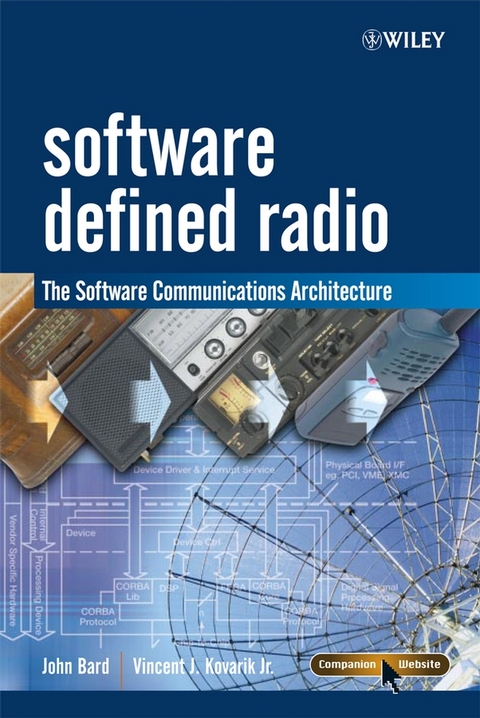
Software Defined Radio: The Software Communications Architecture focuses on the issues and benefits associated with developing a radio system in compliance with the SCA specification. This book provides a comprehensive, practical introduction to building a SCA-compliant system taking the reader through the historical and conceptual background to help filling in the gaps between the intent of the SCA specification and the practice.
Key features:
- Presents a practical approach to the Software Communications Architecture
- Provides an example-oriented understanding of the usage of the SCA and thus allows the reader to extend the concepts and practice to more complicated multi-processor distributed environments.
- Covers the Operating Environment: a Core framework, CORBA middleware, POSIX operating systems and Domain profiles.
- Features an accompanying website with appendices, and links to further information on the SCA.
This invaluable reference will provide applications programmers, designers, professional researchers, wireless manufacturers and operators with an indispensable guide to the Software Communications Architecture. Advanced undergraduate and postgraduate students on mobile and wireless communications courses will also find this to be an excellent guide to the topic.
John Bard and Vincent J. Kovarik Jr are the authors of Software Defined Radio: The Software Communications Architecture, published by Wiley.
The Software Communications Architecture (SCA) establishes an implementation-independent framework for the development of Joint Tactical Radio System software configurable radios. It specifies the Operating Environment, services and interfaces that applications use. Software Defined Radio: The Software Communications Architecture focuses on the issues and benefits associated with developing a radio system in compliance with the SCA specification. This book provides a comprehensive, practical introduction to building a SCA-compliant system taking the reader through the historical and conceptual background to help filling in the gaps between the intent of the SCA specification and the practice. Key features: Presents a practical approach to the Software Communications Architecture Provides an example-oriented understanding of the usage of the SCA and thus allows the reader to extend the concepts and practice to more complicated multi-processor distributed environments. Covers the Operating Environment: a Core framework, CORBA middleware, POSIX operating systems and Domain profiles. Features an accompanying website with appendices, and links to further information on the SCA. This invaluable reference will provide applications programmers, designers, professional researchers, wireless manufacturers and operators with an indispensable guide to the Software Communications Architecture. Advanced undergraduate and postgraduate students on mobile and wireless communications courses will also find this to be an excellent guide to the topic.
John Bard and Vincent J. Kovarik Jr are the authors of Software Defined Radio: The Software Communications Architecture, published by Wiley.
Acknowledgments.
Foreword.
Preface.
Audience.
Scope.
Conventions Used in this Book.
Organization.
Additional Material and Author Contact.
PART I The Operating Environment (OE).
1 Introduction.
1.1 Software Radios.
1.2 The Software Communications Architecture.
1.3 The Operating Environment.
1.4 The SCA Specification Structure.
1.5 Summary.
2 Operational Scenarios.
2.1 Startup.
2.2 Shutdown.
2.3 Application (Un)Installation.
2.4 Instantiate Application.
2.5 Control Application.
2.6 System Configuration.
3 General Requirements and Services.
3.1 Non-Functional Requirements.
3.2 Name Service.
3.3 Event Service.
3.4 Log Service.
3.5 FileSystem.
3.6 File.
4 Foundation Interfaces and Data Types.
4.1 TestableObject.
4.2 PortSupplier.
4.3 LifeCycle.
4.4 PropertySet.
.5 Resource.
4.6 ResourceFactory.
4.7 Port.
5 Devices and the Device Manager.
5.1 Introduction.
5.2 Device.
5.3 LoadableDevice.
5.4 ExecutableDevice.
5.5 AggregateDevice.
5.6 DeviceManager.
6 Domain Management.
6.1 DomainManager.
6.2 FileManager.
6.3 The ApplicationFactory.
6.4 Application.
7 Operating Environment Security.
7.1 Core Framework Security Requirements.
8 Certification.
8.1 Certification Process.
8.2 Operating Environment Certification.
8.3 Waveform Assessment and Certification.
PART II The Domain Profile.
9 The Domain Profile.
9.1 Overview.
9.2 SCA Domain Profile XML.
9.3 Domain Profile Data Types.
10 Base Descriptor Files.
10.1 Properties Descriptor.
10.2 softpkg.
10.3 Software Component Descriptor.
10.4 Device Package Descriptor.
11 Device Configuration Descriptor.
11.1 Overview.
11.2 deviceconfiguration.
12 The Domain Manager Descriptor.
12.1 Overview.
13 The Software Assembly Descriptor.
13.1 Overview.
PART III Building an SCA-Compliant System.
14 The POSIX Operating System.
14.1 An Operating Environment.
14.2 Linux 2.6 Kernel.
15 POSIX Threads.
15.1 The Thread Object.
15.2 Un-named Semaphores.
15.3 Mutex Variables.
15.4 Thread Attributes.
15.5 Conditional Variables.
15.6 Less Interesting Thread Calls.
16 All ORBS are not Created Equal.
16.1 CORBA Basics.
16.2 The Object Management Group.
16.3 'C' ORB versus C++ ORBs.
16.4 Initial Services.
16.5 The Interface Repository.
16.6 Minimum CORBA.
16.7 The Portable Object Adapter (POA).
16.8 Real-time CORBA.
16.9 Overview of Available ORBs.
17 The Services.
17.1 Interoperable Naming Service.
17.2 Event Service.
17.3 Log Service.
18 Exploring the Domain.
18.1 Application Factory Attributes.
18.2 Application Attributes.
18.3 DeviceManager Attributes.
18.4 Device Attributes.
18.5 AggregateDevice Attributes.
18.6 DomainManager Attributes.
18.7 Properties.
18.8 Manipulating Ports.
18.9 Summary.
19 An SCA-compliant Application.
19.1 Hello World Legacy Application.
19.2 Legacy Hello World SPD.
19.3 HMI Applications.
19.4 Shutting Down.
19.5 An SCA-compliant Hello World Application.
Appendix A Mandatory POSIX Calls.
Appendix B References to Part III.
Index.
| Erscheint lt. Verlag | 4.4.2007 |
|---|---|
| Reihe/Serie | Wiley Series in Software Radio |
| Wiley Series in Software Radio | Wiley Series in Software Radio |
| Sprache | englisch |
| Themenwelt | Mathematik / Informatik ► Informatik ► Software Entwicklung |
| Technik ► Elektrotechnik / Energietechnik | |
| Technik ► Nachrichtentechnik | |
| Schlagworte | Applications • Book • communications architecture • configurable • Development • Drahtlose Kommunikation • Electrical & Electronics Engineering • Elektrotechnik u. Elektronik • Environment • focuses • Framework • implementationindependent • Issues • Joint • Mobile & Wireless Communications • Radio • Radios • SCA • Software • System • Tactical |
| ISBN-13 | 9780470865194 / 9780470865194 |
| Informationen gemäß Produktsicherheitsverordnung (GPSR) | |
| Haben Sie eine Frage zum Produkt? |
 PDF (Adobe DRM)
Kopierschutz: Adobe-DRM
Adobe-DRM ist ein Kopierschutz, der das eBook vor Mißbrauch schützen soll. Dabei wird das eBook bereits beim Download auf Ihre persönliche Adobe-ID autorisiert. Lesen können Sie das eBook dann nur auf den Geräten, welche ebenfalls auf Ihre Adobe-ID registriert sind.
Details zum Adobe-DRM
Dateiformat: PDF (Portable Document Format)
Mit einem festen Seitenlayout eignet sich die PDF besonders für Fachbücher mit Spalten, Tabellen und Abbildungen. Eine PDF kann auf fast allen Geräten angezeigt werden, ist aber für kleine Displays (Smartphone, eReader) nur eingeschränkt geeignet.
Systemvoraussetzungen:
PC/Mac: Mit einem PC oder Mac können Sie dieses eBook lesen. Sie benötigen eine
eReader: Dieses eBook kann mit (fast) allen eBook-Readern gelesen werden. Mit dem amazon-Kindle ist es aber nicht kompatibel.
Smartphone/Tablet: Egal ob Apple oder Android, dieses eBook können Sie lesen. Sie benötigen eine
Geräteliste und zusätzliche Hinweise
Buying eBooks from abroad
For tax law reasons we can sell eBooks just within Germany and Switzerland. Regrettably we cannot fulfill eBook-orders from other countries.
aus dem Bereich