


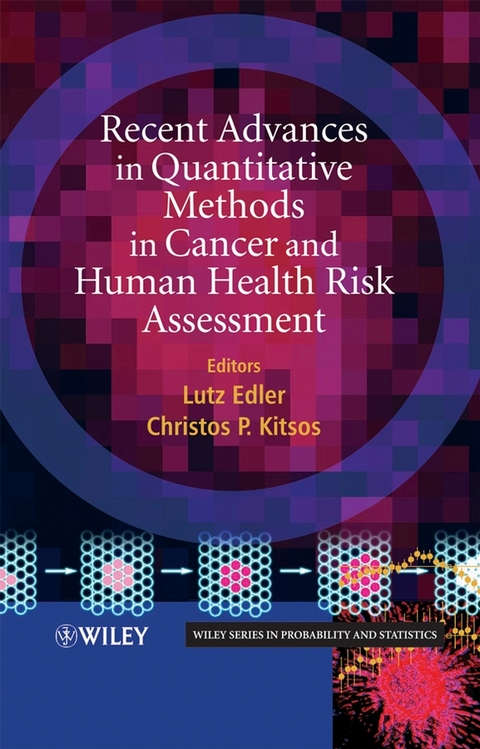
Recent Advances in Quantitative Methods in Cancer and Human Health Risk Assessment (eBook)
John Wiley & Sons (Verlag)
978-0-470-85766-3 (ISBN)
Recent Advances in Quantitative Methods in Cancer and Human Health Risk Assessment is a comprehensive text that accounts for the wealth of new biological data as well as new biological, toxicological, and medical approaches adopted in risk assessment. It provides an authoritative compendium of state-of-the-art methods proposed and used, featuring contributions from eminent authors with varied experience from academia, government, and industry.
- Provides a comprehensive summary of currently available quantitative methods for risk assessment of both cancer and non-cancer problems.
- Describes the applications and the limitations of current mathematical modelling and statistical analysis methods (classical and Bayesian).
- Includes an extensive introduction and discussion to each chapter.
- Features detailed studies of risk assessments using biologically-based modelling approaches.
- Discusses the varying computational aspects of the methods proposed.
- Provides a global perspective on human health risk assessment by featuring case studies from a wide range of countries.
- Features an extensive bibliography with links to relevant background information within each chapter.
Recent Advances in Quantitative Methods in Cancer and Human Health Risk Assessment will appeal to researchers and practitioners in public health & epidemiology, and postgraduate students alike. It will also be of interest to professionals working in risk assessment agencies.
Lutz Edler is the editor of Recent Advances in Quantitative Methods in Cancer and Human Health Risk Assessment, published by Wiley.
Christos Kitsos is the editor of Recent Advances in Quantitative Methods in Cancer and Human Health Risk Assessment, published by Wiley.
Human health risk assessment involves the measuring of risk of exposure to disease, with a view to improving disease prevention. Mathematical, biological, statistical, and computational methods play a key role in exposure assessment, hazard assessment and identification, and dose-response modelling. Recent Advances in Quantitative Methods in Cancer and Human Health Risk Assessment is a comprehensive text that accounts for the wealth of new biological data as well as new biological, toxicological, and medical approaches adopted in risk assessment. It provides an authoritative compendium of state-of-the-art methods proposed and used, featuring contributions from eminent authors with varied experience from academia, government, and industry. Provides a comprehensive summary of currently available quantitative methods for risk assessment of both cancer and non-cancer problems. Describes the applications and the limitations of current mathematical modelling and statistical analysis methods (classical and Bayesian). Includes an extensive introduction and discussion to each chapter. Features detailed studies of risk assessments using biologically-based modelling approaches. Discusses the varying computational aspects of the methods proposed. Provides a global perspective on human health risk assessment by featuring case studies from a wide range of countries. Features an extensive bibliography with links to relevant background information within each chapter. Recent Advances in Quantitative Methods in Cancer and Human Health Risk Assessment will appeal to researchers and practitioners in public health & epidemiology, and postgraduate students alike. It will also be of interest to professionals working in risk assessment agencies.
Lutz Edler is the editor of Recent Advances in Quantitative Methods in Cancer and Human Health Risk Assessment, published by Wiley. Christos Kitsos is the editor of Recent Advances in Quantitative Methods in Cancer and Human Health Risk Assessment, published by Wiley.
Recent Advances in Quantitative Methods in Cancer and Human Health Risk Assessment 3
Contents 9
Contributors 21
Preface 27
Introduction 31
I CANCER AND HUMAN HEALTH RISK ASSESSMENT Introductory remarks 33
1. Principles of Cancer Risk Assessment: The Risk Assessment Paradigm 37
1.1 The risk assessment paradigm 37
1.2 Hazard identification 39
1.3 Dose-response assessment 40
1.3.1 Different objectives, different data sets, different approaches 40
1.3.2 Extrapolations in dose-response assessment 41
1.3.3 Safety assessment 43
1.3.4 Modelling to estimate risk at low doses 46
1.3.5 Uncertainty and human variation 53
II BIOLOGICAL ASPECTS OF CARCINOGENESIS Introductory remarks 57
2. Molecular Epidemiology in Cancer Research 61
2.1 Introduction 61
2.2 From carcinogen exposure to cancer 62
2.3 Biomarkers 62
2.3.1 Biomarkers of exposure 63
2.3.2 Biomarkers of susceptibility 64
2.3.3 Biomarkers of effect 65
2.4 Validation of biomarkers 65
2.4.1 Study design 66
2.4.2 Genetic and statistical analysis 66
2.4.3 Sample size requirements 67
2.4.4 Sources of potential bias 67
2.5 Factors influencing cancer risk 67
2.5.1 Environmental factors 68
2.5.2 Genetic factors 68
2.5.3 Carcinogen metabolism 68
2.5.4 DNA repair 69
2.5.5 Cell cycle control 69
2.5.6 Immune status 69
2.6 New tools in molecular epidemiology 70
2.6.1 Microarrays and toxicogenomics 70
2.6.2 Proteomics 71
2.6.3 Promising directions for cancer diagnosis and cancer biomarker discovery 71
2.7 Conclusions 72
3. Genetic Polymorphisms in Metabolising Enzymes as Lung Cancer Risk Factors 75
3.1 Introduction 75
3.1.1 Studies investigating genetic polymorphisms as lung cancer risk factors 76
3.2 Methodological aspects 78
3.2.1 Planning of the study 78
3.2.2 Laboratory analyses 82
3.2.3 Statistical analyses 84
3.3 Examples 88
3.3.1 N-Acetyltransferases (NAT1 and NAT2) and lung cancer risk 88
3.3.2 Glutathione-S-transferases and lung cancer risk 89
3.3.3 Myeloperoxidase and lung cancer risk 89
3.3.4 CYP3A4 and CYP3A5 and lung cancer risk 90
3.4 Discussion 91
Acknowledgements 94
4. Biological Carcinogenesis: Theories and Models 95
4.1 Introduction 95
4.2 Models of human carcinogenesis 96
4.2.1 Prostate cancer 97
4.2.2 Colorectal cancer 100
4.2.3 Endometrial cancer 103
4.3 The multistage mouse skin carcinogenesis model 105
4.4 Epilogue 109
5. Biological and Mathematical Aspects of Multistage Carcinogenesis 111
5.1 Introduction 111
5.2 Features of multistage carcinogenesis 112
5.2.1 Colorectal cancer 112
5.2.2 The role of genomic instability in colon cancer 114
5.2.3 Barrett’s esophagus 115
5.2.4 Intermediate lesions 116
5.3 Generalized TSCE model 117
5.3.1 Model building 117
5.3.2 Mathematical development and the hazard function 119
5.4 Modeling cancer incidence 122
5.4.1 Age–cohort–period models 122
5.4.2 Age-specific incidence 122
5.4.3 Colorectal cancer in the SEER registry 123
5.4.4 Analysis of occupational cohort data 126
5.5 Summary 126
6. Risk Assessment and Chemical and Radiation Hormesis: A Short Commentary and Bibliographic Review 129
6.1 Introduction 129
6.2 The concept of hormesis 131
6.3 Chemical hormesis 132
6.3.1 The -shaped and -shaped dose-response curve 133
6.3.2 Critical issues in low-dose extrapolation 135
6.3.3 The evaluation of dose-response relationship 137
6.4 Radiation hormesis 138
6.5 Concluding remarks 140
III MODELING FOR CANCER RISK ASSESSMENT Introductory remarks 143
7. Modeling Exposure and Target Organ Concentrations 147
7.1 Introduction 147
7.1.1 Physiologically based pharmacokinetic models 147
7.1.2 Model formulation 149
7.1.3 Data sources 150
7.2 Data from molecular biology 151
7.2.1 Metabonomics 151
7.3 The next generation of physiological models 153
7.4 Discussion and conclusions 155
Acknowledgements 156
8. Stochastic Carcinogenesis Models 157
8.1 Introduction 157
8.1.1 Classification of carcinogens 158
8.1.2 Foci of altered hepatocytes 158
8.1.3 Stereological aspects in the evaluation of liver focal lesions 158
8.2 Stochastic models for hepatocarcinogenesis 161
8.2.1 The multistage model with clonal expansion 161
8.2.2 The color-shift model 163
8.3 Model-based evaluation of liver focal lesion data 163
8.3.1 Model-based approach to study the mode of action of chemicals 163
8.3.2 Model-based approach to study the process of formation and growth of liver foci 164
8.4 Conclusions 167
9. A Unified Modeling Approach: From Exposure to Disease Endpoints 169
9.1 Background 169
9.2 Conventional approach to modeling carcinogenesis 171
9.3 State space modeling using sampling techniques 172
9.4 Self-organizing algorithm for state space modeling 174
9.5 Some examples of state space models 175
9.5.1 State space model for cell labeling 175
9.5.2 State space model of carcinogenesis 179
9.6 A computing procedure for the three-stage model 184
9.7 Discussion 186
Appendix: Simulation programs 188
10. Modeling Lung Cancer Screening 193
10.1 Introduction 193
10.2 Screening and Other Relevant Studies 194
10.2.1 Czechoslovak study 194
10.2.2 Memorial Sloan-Kettering cancer center (MSKCC) and Johns Hopkins Medical Institution (JHMI) studies 194
10.2.3 Mayo Lung Project (MLP) 194
10.2.4 MD Anderson case–control study 195
10.2.5 Early Lung Cancer Action Project 195
10.2.6 New York Early Lung Cancer Action Project 196
10.2.7 International Early Lung Cancer Action Program 196
10.2.8 National Lung Screening Trial (NLST) 196
10.3 Principles of modeling of lung cancer screening 197
10.3.1 Natural history of disease 197
10.3.2 Critical parameters 198
10.3.3 Mortality versus case fatality versus survival 199
10.4 Review of modeling approaches 200
10.4.1 Statistical model of lung cancer progression, detection and treatment 200
10.4.2 Simulation modeling of the Mayo Lung Project 200
10.4.3 Modeling of the long-term follow-up of Mayo Lung Project participants 201
10.4.4 Modeling the outcome of the Czechoslovak screening study 201
10.4.5 Upper bound on reduction in cancer mortality due to periodic screening, based on observational data 202
10.4.6 Markov model of helical CT-screened and non-screened cohort 202
10.4.7 Cost-effectiveness study of baseline low-dose CT screening for lung cancer 203
10.5 Modeling the impact of new screening modalities on reduction of mortality from lung cancer 203
10.5.1 Modeling the NLST trial 203
10.5.2 Modeling the effects of long-term mass screening by CT scan 204
10.6 Comparison of models and concluding remarks 205
11. Optimal Regimens of Cancer Screening 209
11.1 Optimal screening 209
11.2 A comprehensive model of cancer natural history 212
11.2.1 Tumor latency 213
11.2.2 Tumor growth 213
11.2.3 Screening schedules 214
11.2.4 Tumor detection 214
11.3 Formula for the screening efficiency functional 216
11.4 The data and parameter estimation 218
11.5 Numerical experiments 219
11.6 Discussion 222
Acknowledgement 223
IV STATISTICAL APPROACHES FOR CARCINOGENESIS STUDIES Introductory remarks 225
12. Analysis of Survival Data with Non-proportional Hazards and Crossings of Survival Functions 229
12.1 Introduction 229
12.2 Models 230
12.3 Parametric and semiparametric estimation 231
12.3.1 Parametric estimation 231
12.3.2 Semiparametric estimation 232
12.3.3 Modified partial likelihood estimator 234
12.4 Goodness-of-fit for the Cox model against the cross-effects models 235
12.5 Examples 237
12.5.1 Lung cancer prognosis 238
12.5.2 Gastric cancer 238
12.5.3 Lung cancer radiotherapy 238
12.6 Concluding remarks 239
Appendix: Proof of Theorem 12.1 239
13. Dose-response Modeling 243
13.1 Introduction 243
13.2 Elements of the dose-response assessment 245
13.2.1 Exposure and dose 246
13.2.2 Response 247
13.2.3 Biomarkers 248
13.3 Dose-response models 249
13.3.1 Qualitative dose-response analysis 250
13.3.2 Quantitative dose-response analysis 251
13.3.3 Threshold-type dose-response models 259
13.4 Dose-response models in risk assessment 259
13.4.1 Model search 260
13.4.2 Low-dose extrapolation 261
13.4.3 Linear versus nonlinear low-dose extrapolation 261
13.4.4 Point of departure 262
13.5 Dose-Response modeling of 2,3,7,8-tetrachlorodibenzo-p-dioxin 263
13.5.1 Biological basis and mechanisms of action 264
13.5.2 Toxicokinetic dose-response models 264
13.5.3 Laboratory animal responses 265
13.5.4 Human response 266
13.5.5 Further aspects 268
13.6 Concluding remarks 268
14. Benchmark Dose Approach 271
14.1 Introduction 271
14.2 Use by regulatory agencies 273
14.3 Calculation methods 274
14.3.1 Types of models 274
14.3.2 Fitting to data 276
14.3.3 Goodness of fit 276
14.3.4 Lower confidence limit 277
14.3.5 Experimental design, dose selection and response metrics 279
14.4 Literature survey 281
14.5 Software and calculation example 283
15. Uncertainty Analysis: The Bayesian Approach 287
15.1 Introduction 287
15.2 Representations of uncertainty 288
15.3 Causes of uncertainty 289
15.4 Types of uncertainty 290
15.4.1 Model uncertainty 290
15.4.2 Parameter uncertainty 292
15.4.3 Decision framework uncertainty 292
15.5 Quantifying uncertainty 292
15.5.1 Parameter uncertainty 293
15.5.2 Model uncertainty 293
15.5.3 Decision framework uncertainty 295
15.5.4 Sensitivity analysis 295
15.6 Reducing uncertainty 295
15.6.1 Data preparation 295
15.6.2 Accounting for variability to reduce uncertainty: multilevel modelling 295
15.7 Conclusion 297
Acknowledgements 298
16. Optimal Designs for Bioassays in Carcinogenesis 299
16.1 Introduction 299
16.2 On the optimal design theory 299
16.2.1 Binary outcome designs 301
16.2.2 Continuous outcome designs 303
16.2.3 Definition of the optimal design 303
16.3 The Michaelis–Menten model 304
16.3.1 D-optimal design of the Michaelis–Menten model 306
16.3.2 Applications of the D-optimal design 308
16.4 Dose extrapolation designs 309
16.4.1 The Weibull model 310
16.5 Discussion 311
Acknowledgements 311
V SPECIFIC MODELING APPROACHES FOR HEALTH RISK ASSESSMENT Introductory remarks 313
17. Cancer Risk Assessment for Mixtures 315
17.1 Introduction 315
17.2 Basic principles 317
17.2.1 Synergism 318
17.2.2 Additivity 319
17.2.3 Modeling additivity 321
17.2.4 Further concepts 322
17.2.5 The additive model reconsidered 322
17.2.6 Probabilistic point of view 324
17.3 Design of mixture experiments 324
17.3.1 The 2(k) factorial design 325
17.3.2 The 2(k-q) fractional factorial experiment 326
17.3.3 Rotatable designs 326
17.3.4 q-component mixture model: response surface analysis 326
17.3.5 Simplex lattice and simplex centroid designs 329
17.3.6 Response trace plots 329
17.4 Discussion 330
18. Designs and Models for Mixtures: Assessing Cumulative Risk 331
18.1 Introduction 331
18.2 Experimental designs and models for whole mixture 333
18.3 Dose-response modeling for component-based approach 337
18.3.1 Relative potency factor method 337
18.3.2 A dose addition model for mixtures 340
18.4 Component-based risk assessment for quantitative response data 344
18.5 Discussion 347
19. Estimating the Natural History of Breast Cancer from Bivariate Data on Age and Tumor Size at Diagnosis 349
19.1 Introduction 349
19.2 The model 351
19.3 Estimation of model parameters 354
19.4 Data analysis 355
Acknowledgements 359
VI CASE STUDIES 361
20. Statistical Issues in the Search for Biomarkers of Colorectal Cancer Using Microarray Experiments 365
20.1 Introduction 365
20.2 Experiments, data and statistical issues 367
20.2.1 Preprocessing the data 368
20.2.2 Data structure and notation 369
20.2.3 Statistical issues 370
20.3 Results 370
20.3.1 Detecting differentially expressed genes based on the matched pair data set 371
20.3.2 Classifying the test set: validating the chosen set of differentially expressed genes 371
20.3.3 Hotelling’s T(2) statistic 372
20.3.4 A t-based statistic t(3) 373
20.4 Discussion 373
Acknowledgements 375
21. Optimal Experimental Designs for Prediction of Morbidity after Lung Resection 377
21.1 Medical problem 377
21.2 Prediction model and advantage of designing the experiment 379
21.3 Optimal experimental design approach 380
21.4 Solution 383
22. Logistic Regression Methods and their Implementation 387
22.1 Introduction 387
22.2 Neurophysiological example 389
22.2.1 System description 389
22.2.2 System modeling 390
22.3 Logistic regression 392
22.3.1 Definitions 392
22.3.2 Maximum likelihood estimation 393
22.3.3 Fallacies of asymptotic maximum likelihood estimation 393
22.3.4 Exact logistic regression 395
22.3.5 Advantages of exact logistic regression 397
22.3.6 Numerical aspects 397
22.4 Neurophysiological example revisited 398
22.5 Discussion 401
23. The use of Logistic Regression, Discriminant Analysis and Classification Trees in Predicting Persisting Remission in Childhood Leukemia 403
23.1 Introduction 403
23.2 Patients 405
23.3 Methods 407
23.3.1 Selection of variables 407
23.3.2 Classification procedures 408
23.3.3 Assessment of classification errors 408
23.3.4 Approaches to missing values 408
23.4 Results 409
23.4.1 Classification C 409
23.4.2 Classification A 413
23.4.3 Classification B 413
23.5 Discussion 413
23.6 Concluding remarks 414
24. Non-melanoma Skin and Lung Cancer Incidence in Relation to Arsenic Exposure: 20 Years of Observation 415
24.1 Introduction 415
24.2 Material and methods 416
24.2.1 Study base 416
24.2.2 Statistics 416
24.2.3 Exposure assessment 418
24.3 Results 418
24.4 Discussion 423
24.5 Conclusion 426
Acknowledgements 426
25. Thyroid Cancer Incidence Rates in Zaragoza 427
25.1 Introduction 427
25.2 Materials and methods 428
25.3 Results 429
25.4 Discussion 430
References 433
Index 483
WILEY SERIES IN PROBABILITY AND STATISTICS 497
"...a convenient collection of quantitative research in cancer
and risk assessment that is both rigorous and up-to-date."
(Journal of the American Statistical Association, September
2006)
"...a useful collection of recent works in the field."
(E-STREAMS, August 2006)
"...the book can be highly recommended not only to all
researchers...but also to lecturers..." (Biometrics, Vol 61,
December 2005)
| Erscheint lt. Verlag | 13.12.2005 |
|---|---|
| Reihe/Serie | Wiley Series in Probability and Statistics |
| Wiley Series in Probability and Statistics | Wiley Series in Probability and Statistics |
| Sprache | englisch |
| Themenwelt | Mathematik / Informatik ► Mathematik ► Statistik |
| Mathematik / Informatik ► Mathematik ► Wahrscheinlichkeit / Kombinatorik | |
| Medizin / Pharmazie ► Allgemeines / Lexika | |
| Studium ► Querschnittsbereiche ► Epidemiologie / Med. Biometrie | |
| Schlagworte | accounts • APPROACHES • Assessment • Biostatistics • Biostatistik • Cancer • Chemie • Chemistry • Compendium • Comprehensive • Computational • disease prevention • exposure • Hazard • Health • Key • Medical • Medical Science • Medizin • Methods • Oncology & Radiotherapy • Onkologie u. Strahlentherapie • Quantitative • Recent Advances • Risk • Role • Statistics • Statistik • Toxicology • Toxikologie • View • Wealth |
| ISBN-10 | 0-470-85766-8 / 0470857668 |
| ISBN-13 | 978-0-470-85766-3 / 9780470857663 |
| Informationen gemäß Produktsicherheitsverordnung (GPSR) | |
| Haben Sie eine Frage zum Produkt? |
 PDF (Adobe DRM)
Kopierschutz: Adobe-DRM
Adobe-DRM ist ein Kopierschutz, der das eBook vor Mißbrauch schützen soll. Dabei wird das eBook bereits beim Download auf Ihre persönliche Adobe-ID autorisiert. Lesen können Sie das eBook dann nur auf den Geräten, welche ebenfalls auf Ihre Adobe-ID registriert sind.
Details zum Adobe-DRM
Dateiformat: PDF (Portable Document Format)
Mit einem festen Seitenlayout eignet sich die PDF besonders für Fachbücher mit Spalten, Tabellen und Abbildungen. Eine PDF kann auf fast allen Geräten angezeigt werden, ist aber für kleine Displays (Smartphone, eReader) nur eingeschränkt geeignet.
Systemvoraussetzungen:
PC/Mac: Mit einem PC oder Mac können Sie dieses eBook lesen. Sie benötigen eine
eReader: Dieses eBook kann mit (fast) allen eBook-Readern gelesen werden. Mit dem amazon-Kindle ist es aber nicht kompatibel.
Smartphone/Tablet: Egal ob Apple oder Android, dieses eBook können Sie lesen. Sie benötigen eine
Geräteliste und zusätzliche Hinweise
Buying eBooks from abroad
For tax law reasons we can sell eBooks just within Germany and Switzerland. Regrettably we cannot fulfill eBook-orders from other countries.


