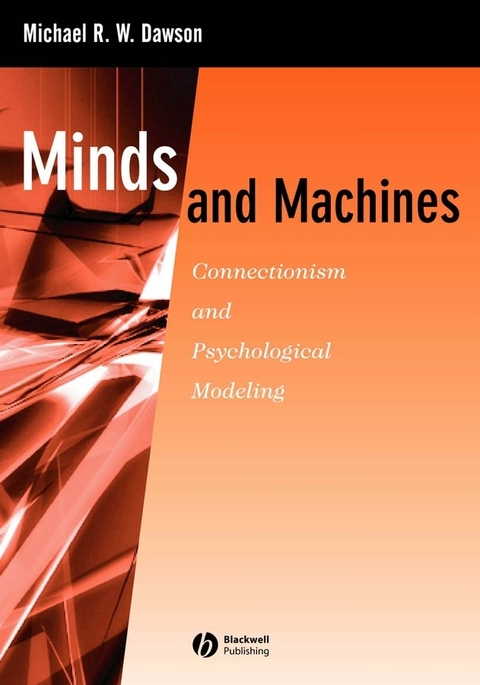
Minds and Machines (eBook)
John Wiley & Sons (Verlag)
978-0-470-75298-2 (ISBN)
- Introduces connectionist models as tools that are both synthetic and representational and which can be used as the basis for conducting synthetic psychology.
- Includes distinctively varied account of modeling, historical overview of the synthetic approach, and unique perspectives on connectionism.
- Investigates basic properties of connectionism in the context of synthetic psychology, including detailed accounts of how the internal structure can be interpreted.
- Provides supplementary material online at www.bcp.psych.ualberta.ca/-mike/Book2/ which includes free software for conducting connectionist simulations and instructions for building simple robots.
Michael R. W. Dawson is a member of the Department of Psychology and the Biological Computation Project at the University of Alberta, Canada. His primary research interests concern the foundations of cognitive science, learning and representation in connectionist networks, and computational models of motion perception. He is the author of Understanding Cognitive Science (Blackwell Publishers, 1998).
Minds and Machines: Connectionism and Psychological Modeling examines different kinds of models and investigates some of the basic properties of connectionism in the context of synthetic psychology, including detailed accounts of how the internal structure of connectionist networks can be interpreted. Introduces connectionist models as tools that are both synthetic and representational and which can be used as the basis for conducting synthetic psychology. Includes distinctively varied account of modeling, historical overview of the synthetic approach, and unique perspectives on connectionism. Investigates basic properties of connectionism in the context of synthetic psychology, including detailed accounts of how the internal structure can be interpreted. Provides supplementary material online at www.bcp.psych.ualberta.ca/~mike/Book2/ which includes free software for conducting connectionist simulations and instructions for building simple robots.
Michael R. W. Dawson is a member of the Department of Psychology and the Biological Computation Project at the University of Alberta, Canada. His primary research interests concern the foundations of cognitive science, learning and representation in connectionist networks, and computational models of motion perception. He is the author of Understanding Cognitive Science (Blackwell Publishers, 1998).
List of Figures.
List of Tables.
1. The Kids in the Hall.
Synthetic Versus Analytic Traditions. .
2. Advantages and Disadvantages of Modeling.
What Is A Model?.
Advantages and Disadvantages of Models. .
3. Models of Data.
An Example of a Model of Data.
Properties of Models of Data. .
4. Mathematical Models.
An Example Mathematical Model.
Mathematical Models vs. Models of Data. .
5. Computer Simulations.
A Sample Computer Simulation.
Connectionist Models.
Properties of Computer Simulations. .
6. First Steps Toward Synthetic Psychology.
Introduction.
Building a Thoughtless Walker.
Step 1: Synthesis.
Step 2: Emergence.
Step 3: Analysis.
Issues Concerning Synthetic Psychology. .
7. Uphill Analysis, Downhill Synthesis.
Introduction.
From Homeostats to Tortoises.
Ashby's Homeostat.
Vehicles.
Synthesis and Emergence: Some Modern Examples.
The Law of Uphill Analysis and Downhill Synthesis. .
8. Connectionism As Synthetic Psychology.
Introduction.
Beyond Sensory Reflexes.
Connectionism, Synthesis, and Representation.
Summary and Conclusions. .
9. Building Associations.
From Associationism To Connectionism.
Building An Associative Memory.
Beyond the Limitations of Hebb Learning.
Associative Memory and Synthetic Psychology. .
10. Making Decisions.
The Limits of Linearity.
A Fundamental Nonlinearity.
Building a Perceptron: A Nonlinear Associative Memory.
The Psychology of Perceptrons.
The Need for Layers. .
11. Sequences of Decisions.
The Logic of Layers.
Training Multilayered Networks.
A Simple Case Study: Exclusive Or.
A Second Case Study: Classifying Musical Chords.
A Third Case Study: From Connectionism to Selectionism.
.
12. From Synthesis To Analysis.
Representing Musical Chords in a Pdp Network.
Interpreting the Internal Structure of Value Unit Networks.
Network Interpretation and Synthetic Psychology. .
13. From Here To Synthetic Psychology.
References.
Index
| Erscheint lt. Verlag | 15.4.2008 |
|---|---|
| Sprache | englisch |
| Themenwelt | Geisteswissenschaften ► Psychologie ► Allgemeine Psychologie |
| Geisteswissenschaften ► Psychologie ► Verhaltenstherapie | |
| Informatik ► Theorie / Studium ► Künstliche Intelligenz / Robotik | |
| Schlagworte | Approach • Basis • Book • Cognitive Psychology • Connectionism • Connectionist Models • ConText • Data • Different • examines three • Geistesphilosophie • generate • important • Kinds • Kognitive Psychologie • Models • Philosophie • Philosophy • Philosophy of mind • Predictions • Properties • Psychologie • Psychology • Synthetic • Tools • Validity |
| ISBN-10 | 0-470-75298-X / 047075298X |
| ISBN-13 | 978-0-470-75298-2 / 9780470752982 |
| Informationen gemäß Produktsicherheitsverordnung (GPSR) | |
| Haben Sie eine Frage zum Produkt? |
 PDF (Adobe DRM)
Kopierschutz: Adobe-DRM
Adobe-DRM ist ein Kopierschutz, der das eBook vor Mißbrauch schützen soll. Dabei wird das eBook bereits beim Download auf Ihre persönliche Adobe-ID autorisiert. Lesen können Sie das eBook dann nur auf den Geräten, welche ebenfalls auf Ihre Adobe-ID registriert sind.
Details zum Adobe-DRM
Dateiformat: PDF (Portable Document Format)
Mit einem festen Seitenlayout eignet sich die PDF besonders für Fachbücher mit Spalten, Tabellen und Abbildungen. Eine PDF kann auf fast allen Geräten angezeigt werden, ist aber für kleine Displays (Smartphone, eReader) nur eingeschränkt geeignet.
Systemvoraussetzungen:
PC/Mac: Mit einem PC oder Mac können Sie dieses eBook lesen. Sie benötigen eine
eReader: Dieses eBook kann mit (fast) allen eBook-Readern gelesen werden. Mit dem amazon-Kindle ist es aber nicht kompatibel.
Smartphone/Tablet: Egal ob Apple oder Android, dieses eBook können Sie lesen. Sie benötigen eine
Geräteliste und zusätzliche Hinweise
Buying eBooks from abroad
For tax law reasons we can sell eBooks just within Germany and Switzerland. Regrettably we cannot fulfill eBook-orders from other countries.
aus dem Bereich