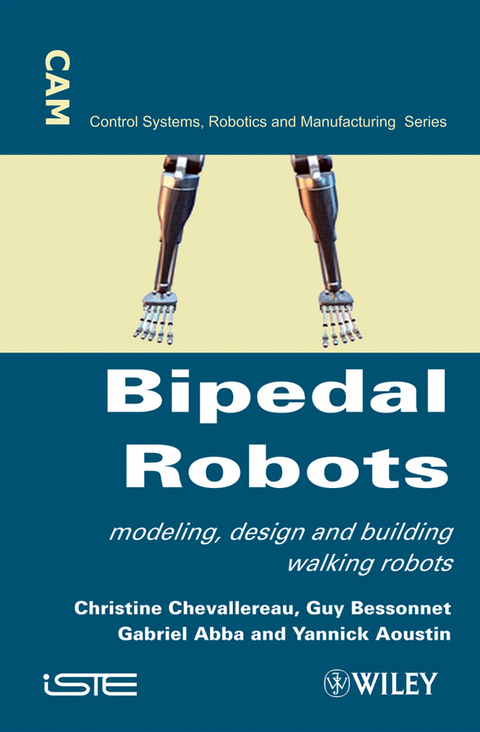
Bipedal Robots (eBook)
John Wiley & Sons (Verlag)
978-0-470-39426-7 (ISBN)
Christine Chevallereau is the author of Bipedal Robots: Modeling, Design and Walking Synthesis, published by Wiley. Guy Bessonnet is the author of Bipedal Robots: Modeling, Design and Walking Synthesis, published by Wiley. Gabriel Abba is the author of Bipedal Robots: Modeling, Design and Walking Synthesis, published by Wiley. Yannick Aoustin is the author of Bipedal Robots: Modeling, Design and Walking Synthesis, published by Wiley.
Chapter 1. Bipedal Robots and Walking.
1.1. Introduction.
1.2. Biomechanical approach.
1.3. Human walking.
1.4. Bipedal walking robots: state of the art.
1.5. Different applications.
1.6. Conclusion.
1.7. Bibliography.
Chapter 2. Kinematic and Dynamic Models for Walking.
2.1. Introduction.
2.2. The kinematics of walking.
2.3. The dynamics of walking.
2.4. Dynamic constraints.
2.5. Complementary feasibility constraints.
2.6. Conclusion.
2.7. Bibliography.
Chapter 3. Design Tools for Making Bipedal Robots.
3.1. Introduction.
3.2. Study of influence of robot body masses.
3.3. Mechanical design: the architectures carried out.
3.4. Actuators.
3.5. Sensors.
3.6. Conclusion.
3.7. Appendix.
3.8. Bibliography.
Chapter 4. Walking Pattern Generators.
4.1. Introduction.
4.2. Passive and quasi-passive dynamic walking.
4.3. Static balance walking.
4.4. Dynamic synthesis of walking.
4.5. Walking synthesis via parametric optimization.
4.6. Conclusion.
4.7. Bibliography.
Chapter 5. Control
5.1. Introduction.
5.2. Hybrid systems and stability study.
5.3. Taking into account the unilateralism of the contact constraint.
5.4. Online modification of references.
5.5. Taking an under-actuated phase into account.
5.6. Taking the double support phase into account.
5.7. Intuitive and neural network methods.
5.8. Passive movements.
5.9. Conclusion.
5.10. Bibliography.
Index.
| Erscheint lt. Verlag | 11.1.2010 |
|---|---|
| Sprache | englisch |
| Themenwelt | Informatik ► Theorie / Studium ► Künstliche Intelligenz / Robotik |
| Technik ► Elektrotechnik / Energietechnik | |
| Technik ► Maschinenbau | |
| Schlagworte | Applications • ART • biomechanical • bipedal • Cinema • Data • Electrical & Electronics Engineering • Elektrotechnik u. Elektronik • France • Generalized • Generalized coordinates • History • Kinematics • Locomotion System • Models • Robotics • Robotik • robots • sagittal • Situation • source • State • STEP • Studies • tendencies • Toy • Trajectory • Walking |
| ISBN-10 | 0-470-39426-9 / 0470394269 |
| ISBN-13 | 978-0-470-39426-7 / 9780470394267 |
| Informationen gemäß Produktsicherheitsverordnung (GPSR) | |
| Haben Sie eine Frage zum Produkt? |
 PDF (Adobe DRM)
Kopierschutz: Adobe-DRM
Adobe-DRM ist ein Kopierschutz, der das eBook vor Mißbrauch schützen soll. Dabei wird das eBook bereits beim Download auf Ihre persönliche Adobe-ID autorisiert. Lesen können Sie das eBook dann nur auf den Geräten, welche ebenfalls auf Ihre Adobe-ID registriert sind.
Details zum Adobe-DRM
Dateiformat: PDF (Portable Document Format)
Mit einem festen Seitenlayout eignet sich die PDF besonders für Fachbücher mit Spalten, Tabellen und Abbildungen. Eine PDF kann auf fast allen Geräten angezeigt werden, ist aber für kleine Displays (Smartphone, eReader) nur eingeschränkt geeignet.
Systemvoraussetzungen:
PC/Mac: Mit einem PC oder Mac können Sie dieses eBook lesen. Sie benötigen eine
eReader: Dieses eBook kann mit (fast) allen eBook-Readern gelesen werden. Mit dem amazon-Kindle ist es aber nicht kompatibel.
Smartphone/Tablet: Egal ob Apple oder Android, dieses eBook können Sie lesen. Sie benötigen eine
Geräteliste und zusätzliche Hinweise
Buying eBooks from abroad
For tax law reasons we can sell eBooks just within Germany and Switzerland. Regrettably we cannot fulfill eBook-orders from other countries.
aus dem Bereich