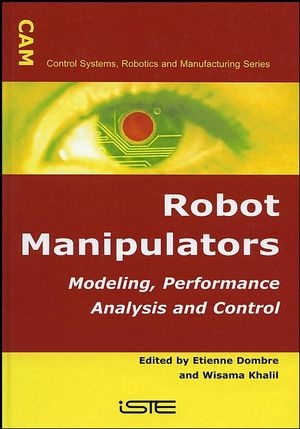
Robot Manipulators (eBook)
398 Seiten
John Wiley & Sons (Verlag)
978-0-470-39449-6 (ISBN)
control of robot manipulators.
* Chapter 1 gives unified tools to derive direct and
inverse geometric, kinematic and dynamic models of serial robots
and addresses the issue of identification of the geometric and
dynamic parameters of these models.
* Chapter 2 describes the main features of serial robots,
the different architectures and the methods used to obtain direct
and inverse geometric, kinematic and dynamic models, paying special
attention to singularity analysis.
* Chapter 3 introduces global and local tools for
performance analysis of serial robots.
* Chapter 4 presents an original optimization technique
for point-to-point trajectory generation accounting for robot
dynamics.
* Chapter 5 presents standard control techniques in the
joint space and task space for free motion (PID, computed torque,
adaptive dynamic control and variable structure control) and
constrained motion (compliant force-position control).
* In Chapter 6, the concept of vision-based control is
developed and Chapter 7 is devoted to specific issue of
robots with flexible links. Efficient recursive Newton-Euler
algorithms for both inverse and direct modeling are presented, as
well as control methods ensuring position setting and vibration
damping.
Etienne Dombre is Director of Research at the National Centre for Scientific Research (CNRS) and is a researcher within the Laboratoire de Recherche en 'Informatique, Robotique et Microélectronique de Montpellier at the University of Montpellier, France. Wisama Khalil is Professor at the Ecole Centrale de Nantes, France, and is a researcher at the Institute of Research in Communication and Cybernetics.
Chapter 1. Modeling and Identification of Serial
Robots (Wisama KHALIL and Etienne DOMBRE).
1.1. Introduction.
1.2. Geometric modeling.
1.3. Kinematic modeling.
1.4. Calibration of geometric parameters.
1.5. Dynamic modeling.
1.6. Identification of dynamic parameters.
1.7. Conclusion.
1.8. Bibliography.
Chapter 2. Modeling of Parallel
Robots (Jean-Pierre MERLET and François
PIERROT).
2.1. Introduction.
2.2. Machine types.
2.3. Inverse geometric and kinematic models.
2.4. Direct geometric model.
2.5. Bibliography.
Chapter 3. Performance Analysis of
Robots (Philippe WENGER).
3.1. Introduction.
3.2. Accessibility.
3.3. Workspace of a robot manipulator.
3.4. Concept of aspect.
3.5. Concept of connectivity.
3.6. Local performances.
3.7. Conclusion.
3.8. Bibliography.
Chapter 4. Trajectory Generation (Moussa HADDAD,
Taha CHETTIBI, Wisama KHALIL and Halim LEHTIHET).
4.1. Introduction.
4.2. Point-to-point trajectory in the joint space under
kinematic constraints.
4.3. Point-to-point trajectory in the task-space under kinematic
constraints.
4.4. Trajectory generation under kinodynamic constraints.
.4.5. Examples.
.4.6. Conclusion.
4.7. Bibliography.
Appendix: Stochastic Optimization Techniques.
Chapter 5. Position and Force Control of a Robot in a Free or
Constrained Space (Pierre DAUCHEZ and Philippe
FRAISSE).
5.1. Introduction.
5.2. Free space control.
5.3. Control in a constrained space.
5.4. Conclusion.
5.5. Bibliography.
Chapter 6. Visual Servoing (François
CHAUMETTE).
6.1. Introduction.
6.2. Modeling visual features.
6.3. Task function and control scheme.
6.4. Other exteroceptive sensors.
6.5. Conclusion.
6.6. Bibliography.
Chapter 7. Modeling and Control of Flexible
Robots (Frédéric BOYER, Wisama KHALIL,
Mouhacine BENOSMAN and George LEVEY).
7.1. Introduction.
7.2. Modeling of flexible robots.
7.3. Control of flexible robot manipulators.
7.4. Conclusion.
7.5. Bibliography.
List of Authors.
Index.
| Erscheint lt. Verlag | 12.1.2010 |
|---|---|
| Sprache | englisch |
| Themenwelt | Informatik ► Theorie / Studium ► Künstliche Intelligenz / Robotik |
| Technik ► Elektrotechnik / Energietechnik | |
| Technik ► Maschinenbau | |
| Schlagworte | Control Systems Technology • Electrical & Electronics Engineering • Elektrotechnik u. Elektronik • Regelungstechnik • Robotics • Robotik |
| ISBN-10 | 0-470-39449-8 / 0470394498 |
| ISBN-13 | 978-0-470-39449-6 / 9780470394496 |
| Informationen gemäß Produktsicherheitsverordnung (GPSR) | |
| Haben Sie eine Frage zum Produkt? |
 PDF (Adobe DRM)
Kopierschutz: Adobe-DRM
Adobe-DRM ist ein Kopierschutz, der das eBook vor Mißbrauch schützen soll. Dabei wird das eBook bereits beim Download auf Ihre persönliche Adobe-ID autorisiert. Lesen können Sie das eBook dann nur auf den Geräten, welche ebenfalls auf Ihre Adobe-ID registriert sind.
Details zum Adobe-DRM
Dateiformat: PDF (Portable Document Format)
Mit einem festen Seitenlayout eignet sich die PDF besonders für Fachbücher mit Spalten, Tabellen und Abbildungen. Eine PDF kann auf fast allen Geräten angezeigt werden, ist aber für kleine Displays (Smartphone, eReader) nur eingeschränkt geeignet.
Systemvoraussetzungen:
PC/Mac: Mit einem PC oder Mac können Sie dieses eBook lesen. Sie benötigen eine
eReader: Dieses eBook kann mit (fast) allen eBook-Readern gelesen werden. Mit dem amazon-Kindle ist es aber nicht kompatibel.
Smartphone/Tablet: Egal ob Apple oder Android, dieses eBook können Sie lesen. Sie benötigen eine
Geräteliste und zusätzliche Hinweise
Buying eBooks from abroad
For tax law reasons we can sell eBooks just within Germany and Switzerland. Regrettably we cannot fulfill eBook-orders from other countries.
aus dem Bereich