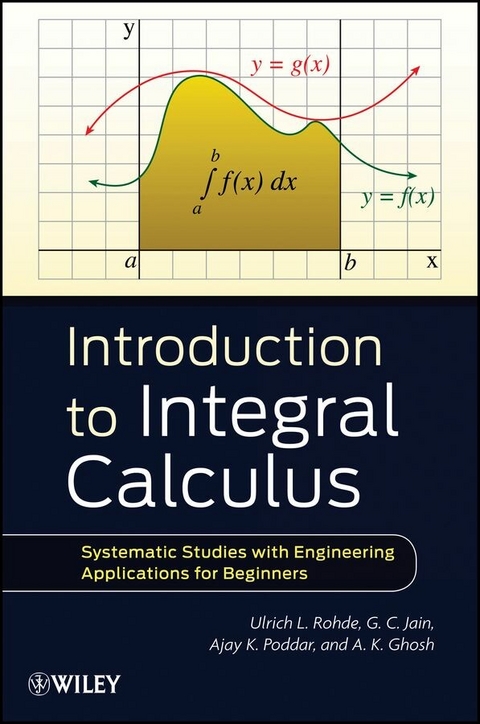
Introduction to Integral Calculus (eBook)
428 Seiten
John Wiley & Sons (Verlag)
978-1-118-13033-9 (ISBN)
needed to solve current problems in engineering and the physical
sciences
I ntegration is an important function of calculus, and
Introduction to Integral Calculus combines fundamental concepts
with scientific problems to develop intuition and skills for
solving mathematical problems related to engineering and the
physical sciences. The authors provide a solid introduction to
integral calculus and feature applications of integration,
solutions of differential equations, and evaluation methods. With
logical organization coupled with clear, simple explanations, the
authors reinforce new concepts to progressively build skills and
knowledge, and numerous real-world examples as well as intriguing
applications help readers to better understand the connections
between the theory of calculus and practical problem solving.
The first six chapters address the prerequisites needed to
understand the principles of integral calculus and explore such
topics as anti-derivatives, methods of converting integrals into
standard form, and the concept of area. Next, the authors review
numerous methods and applications of integral calculus,
including:
* Mastering and applying the first and second fundamental theorems
of calculus to compute definite integrals
* Defining the natural logarithmic function using calculus
* Evaluating definite integrals
* Calculating plane areas bounded by curves
* Applying basic concepts of differential equations to solve
ordinary differential equations
With this book as their guide, readers quickly learn to solve a
broad range of current problems throughout the physical sciences
and engineering that can only be solved with calculus. Examples
throughout provide practical guidance, and practice problems and
exercises allow for further development and fine-tuning of various
calculus skills. Introduction to Integral Calculus is an excellent
book for upper-undergraduate calculus courses and is also an ideal
reference for students and professionals who would like to gain a
further understanding of the use of calculus to solve problems in a
simplified manner.
ULRICH L. ROHDE, PhD, ScD, Dr-Ing, is Chairman of Synergy Microwave Corporation, President of Communications Consulting Corporation, and a Partner of Rohde & Schwarz. A Fellow of the IEEE, Professor Rohde holds several patents and has published more than 200 scientific papers. G. C. JAIN, B.Sc., is a retired scientist from the Defense Research and Development Organization in India. AJAY K. PODDAR, PhD, is Chief Scientist at Synergy Microwave Corporation. A Senior Member of the IEEE, Dr. Poddar holds several dozen patents and has published more than 180 scientific papers. A. K. GHOSH, PhD, is Professor in the Department of Aerospace Engineering at the IIT Kanpur, India. He has published more than 120 scientific papers.
FOREWORD ix
PREFACE xiii
BIOGRAPHIES xxi
INTRODUCTION xxiii
ACKNOWLEDGMENT xxv
1 Antiderivative(s) [or Indefinite Integral(s)] 1
1.1 Introduction 1
1.2 Useful Symbols, Terms, and Phrases Frequently Needed 6
1.3 Table(s) of Derivatives and their corresponding Integrals
7
1.4 Integration of Certain Combinations of Functions 10
1.5 Comparison Between the Operations of Differentiation and
Integration 15
2 Integration Using Trigonometric Identities 17
2.1 Introduction 17
2.2 Some Important Integrals Involving sin x and cos x 34
2.3 Integrals of the Form ? (d/( a sin
+ b cos x)), where a, b
epsilon r 37
3a Integration by Substitution: Change of Variable of
Integration 43
3b Further Integration by Substitution: Additional Standard
Integrals 67
4a Integration by Parts 97
4b Further Integration by Parts: Where the Given Integral
Reappears on Right-Hand Side 117
5 Preparation for the Definite Integral: The Concept of Area
139
5.1 Introduction 139
5.2 Preparation for the Definite Integral 140
5.3 The Definite Integral as an Area 143
5.4 Definition of Area in Terms of the Definite Integral 151
5.5 Riemann Sums and the Analytical Definition of the Definite
Integral 151
6a The Fundamental Theorems of Calculus 165
6b The Integral Function D x 1 1 t dt, (x > 0)
Identified as ln x or loge x 183
7a Methods for Evaluating Definite Integrals 197
7b Some Important Properties of Definite Integrals 213
8a Applying the Definite Integral to Compute the Area of a
Plane Figure 249
8b To Find Length(s) of Arc(s) of Curve(s), the Volume(s) of
Solid(s) of Revolution, and the Area(s) of Surface(s) of Solid(s)
of Revolution 295
9a Differential Equations: Related Concepts and Terminology
321
9a.4 Definition: Integral Curve 332
9b Methods of Solving Ordinary Differential Equations of the
First Order and of the First Degree 361
INDEX 399
"Introduction to Integral Calculus is an excellent book
for upper-undergraduate calculus courses and is also an ideal
reference for students and professionals who would like to gain a
further understanding of the use of calculus to solve problems in a
simplified manner." (Zentralblatt MATH,
2012)
"Long on examples but often short of exercises, this work
might best be used as a reference source. Summing Up:
Recommended. Lower-and upper-division
undergraduates." (Choice, 1 September 2012)
| Erscheint lt. Verlag | 20.1.2012 |
|---|---|
| Sprache | englisch |
| Themenwelt | Mathematik / Informatik ► Mathematik ► Analysis |
| Technik | |
| Schlagworte | Analysis • Analysis f. mehrere Variable • Applied Mathematics in Engineering • Applied Mathmatics in Engineering • Calculus • Mathematics • Mathematik • Mathematik in den Ingenieurwissenschaften • Multivariate Calculus |
| ISBN-10 | 1-118-13033-2 / 1118130332 |
| ISBN-13 | 978-1-118-13033-9 / 9781118130339 |
| Informationen gemäß Produktsicherheitsverordnung (GPSR) | |
| Haben Sie eine Frage zum Produkt? |
 EPUB (Adobe DRM)
Kopierschutz: Adobe-DRM
Adobe-DRM ist ein Kopierschutz, der das eBook vor Mißbrauch schützen soll. Dabei wird das eBook bereits beim Download auf Ihre persönliche Adobe-ID autorisiert. Lesen können Sie das eBook dann nur auf den Geräten, welche ebenfalls auf Ihre Adobe-ID registriert sind.
Details zum Adobe-DRM
Dateiformat: EPUB (Electronic Publication)
EPUB ist ein offener Standard für eBooks und eignet sich besonders zur Darstellung von Belletristik und Sachbüchern. Der Fließtext wird dynamisch an die Display- und Schriftgröße angepasst. Auch für mobile Lesegeräte ist EPUB daher gut geeignet.
Systemvoraussetzungen:
PC/Mac: Mit einem PC oder Mac können Sie dieses eBook lesen. Sie benötigen eine
eReader: Dieses eBook kann mit (fast) allen eBook-Readern gelesen werden. Mit dem amazon-Kindle ist es aber nicht kompatibel.
Smartphone/Tablet: Egal ob Apple oder Android, dieses eBook können Sie lesen. Sie benötigen eine
Geräteliste und zusätzliche Hinweise
Buying eBooks from abroad
For tax law reasons we can sell eBooks just within Germany and Switzerland. Regrettably we cannot fulfill eBook-orders from other countries.
aus dem Bereich