Rough-Fuzzy Pattern Recognition (eBook)
John Wiley & Sons (Verlag)
978-1-118-11971-6 (ISBN)
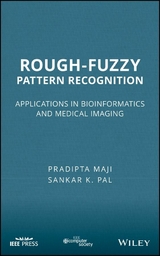
Emphasizing applications in bioinformatics and medical image processing, this text offers a clear framework that enables readers to take advantage of the latest rough-fuzzy computing techniques to build working pattern recognition models. The authors explain step by step how to integrate rough sets with fuzzy sets in order to best manage the uncertainties in mining large data sets. Chapters are logically organized according to the major phases of pattern recognition systems development, making it easier to master such tasks as classification, clustering, and feature selection.
Rough-Fuzzy Pattern Recognition examines the important underlying theory as well as algorithms and applications, helping readers see the connections between theory and practice. The first chapter provides an introduction to pattern recognition and data mining, including the key challenges of working with high-dimensional, real-life data sets. Next, the authors explore such topics and issues as:
Soft computing in pattern recognition and data mining
A Mathematical framework for generalized rough sets, incorporating the concept of fuzziness in defining the granules as well as the set
Selection of non-redundant and relevant features of real-valued data sets
Selection of the minimum set of basis strings with maximum information for amino acid sequence analysis
Segmentation of brain MR images for visualization of human tissues
Numerous examples and case studies help readers better understand how pattern recognition models are developed and used in practice. This text—covering the latest findings as well as directions for future research—is recommended for both students and practitioners working in systems design, pattern recognition, image analysis, data mining, bioinformatics, soft computing, and computational intelligence.
Pradipta Maji, PhD, is Assistant Professor in the Machine Intelligence Unit of the Indian Statistical Institute. His research explores pattern recognition, bioinformatics, medical image processing, cellular automata, and soft computing.
Sankar K. Pal, PhD, is Director and Distinguished Scientist of the Indian Statistical Institute. He is also a J. C. Bose Fellow of the Government of India. Dr. Pal founded both the Machine Intelligence Unit and the Center for Soft Computing Research at the Indian Statistical Institute. He is a Fellow of the IEEE, IAPR, IFSA, TWAS, and Indian National Science Academy.
PRADIPTA MAJI, PHD, is Assistant Professor in the Machine Intelligence Unit of the Indian Statistical Institute. His research explores pattern recognition, bioinformatics, medical image processing, cellular automata, and soft computing. SANKAR K. PAL, PHD, is Director and Distinguished Scientist of the Indian Statistical Institute. He is also a J. C. Bose Fellow of the Government of India. Dr. Pal founded both the Machine Intelligence Unit and the Center for Soft Computing Research at the Indian Statistical Institute. He is a Fellow of the IEEE, IAPR, IFSA, TWAS, and Indian National Science Academy.
Foreword xiii
Preface xv
About the Authors xix
1 Introduction to Pattern Recognition and Data Mining1
1.1 Introduction, 1
1.2 Pattern Recognition, 3
1.3 Data Mining, 6
1.4 Relevance of Soft Computing, 9
1.5 Scope and Organization of the Book, 10
2 Rough-Fuzzy Hybridization and Granular Computing 21
2.1 Introduction, 21
2.2 Fuzzy Sets, 22
2.3 Rough Sets, 23
2.4 Emergence of Rough-Fuzzy Computing, 26
2.5 Generalized Rough Sets, 29
2.6 Entropy Measures, 30
2.7 Conclusion and Discussion, 36
3 Rough-Fuzzy Clustering: Generalized c-MeansAlgorithm 47
3.1 Introduction, 47
3.2 Existing c-Means Algorithms, 49
3.4 Generalization of Existing c-Means Algorithms, 61
3.5 Quantitative Indices for Rough-Fuzzy Clustering, 65
3.6 Performance Analysis, 68
3.7 Conclusion and Discussion, 80
4 Rough-Fuzzy Granulation and Pattern Classification85
4.1 Introduction, 85
4.2 Pattern Classification Model, 87
4.3 Quantitative Measures, 95
4.4 Description of Data Sets, 97
4.5 Experimental Results, 100
4.6 Conclusion and Discussion, 112
5 Fuzzy-Rough Feature Selection using f -InformationMeasures 117
5.1 Introduction, 117
5.2 Fuzzy-Rough Sets, 120
5.3 Information Measure on Fuzzy Approximation Spaces, 121
5.4 f -Information and Fuzzy Approximation Spaces,125
5.5 f -Information for Feature Selection, 129
5.6 Quantitative Measures, 133
5.7 Experimental Results, 135
5.8 Conclusion and Discussion, 156
6 Rough Fuzzy c-Medoids and Amino Acid SequenceAnalysis 161
6.1 Introduction, 161
6.2 Bio-Basis Function and String Selection Methods, 164
6.3 Fuzzy-Possibilistic c-Medoids Algorithm, 168
6.4 Rough-Fuzzy c-Medoids Algorithm, 172
6.5 Relational Clustering for Bio-Basis String Selection,176
6.6 Quantitative Measures, 178
6.7 Experimental Results, 181
6.8 Conclusion and Discussion, 196
7 Clustering Functionally Similar Genes from Microarray Data201
7.1 Introduction, 201
7.2 Clustering Gene Expression Data, 203
7.3 Quantitative and Qualitative Analysis, 207
7.4 Description of Data Sets, 209
7.5 Experimental Results, 212
7.6 Conclusion and Discussion, 217
8 Selection of Discriminative Genes from Microarray Data225
8.1 Introduction, 225
8.2 Evaluation Criteria for Gene Selection, 227
8.3 Approximation of Density Function, 230
8.4 Gene Selection using Information Measures, 234
8.5 Experimental Results, 235
8.6 Conclusion and Discussion, 250
9 Segmentation of Brain Magnetic Resonance Images 257
9.1 Introduction, 257
9.2 Pixel Classification of Brain MR Images, 259
9.3 Segmentation of Brain MR Images, 264
9.4 Experimental Results, 277
9.5 Conclusion and Discussion, 283
References, 283
Index 287
| Erscheint lt. Verlag | 20.12.2011 |
|---|---|
| Reihe/Serie | Wiley Series in Bioinformatics |
| Wiley Series in Bioinformatics | Wiley Series in Bioinformatics |
| Sprache | englisch |
| Themenwelt | Informatik ► Theorie / Studium ► Künstliche Intelligenz / Robotik |
| Technik ► Elektrotechnik / Energietechnik | |
| Technik ► Umwelttechnik / Biotechnologie | |
| Schlagworte | Bildgebende Verfahren i. d. Biomedizin • Bioinformatics • Bioinformatics & Computational Biology • Bioinformatik • Bioinformatik u. Computersimulationen in der Biowissenschaften • biomedical engineering • Biomedical Imaging • Biomedizintechnik • Biowissenschaften • Electrical & Electronics Engineering • Elektrotechnik u. Elektronik • Life Sciences • Medical Image Processing • Mustererkennung • Pattern Analysis • pattern recognition models • pattern recognition system • Rough-fuzzy computing • rough-fuzzy computing techniques |
| ISBN-10 | 1-118-11971-1 / 1118119711 |
| ISBN-13 | 978-1-118-11971-6 / 9781118119716 |
| Informationen gemäß Produktsicherheitsverordnung (GPSR) | |
| Haben Sie eine Frage zum Produkt? |
 EPUB (Adobe DRM)
Kopierschutz: Adobe-DRM
Adobe-DRM ist ein Kopierschutz, der das eBook vor Mißbrauch schützen soll. Dabei wird das eBook bereits beim Download auf Ihre persönliche Adobe-ID autorisiert. Lesen können Sie das eBook dann nur auf den Geräten, welche ebenfalls auf Ihre Adobe-ID registriert sind.
Details zum Adobe-DRM
Dateiformat: EPUB (Electronic Publication)
EPUB ist ein offener Standard für eBooks und eignet sich besonders zur Darstellung von Belletristik und Sachbüchern. Der Fließtext wird dynamisch an die Display- und Schriftgröße angepasst. Auch für mobile Lesegeräte ist EPUB daher gut geeignet.
Systemvoraussetzungen:
PC/Mac: Mit einem PC oder Mac können Sie dieses eBook lesen. Sie benötigen eine
eReader: Dieses eBook kann mit (fast) allen eBook-Readern gelesen werden. Mit dem amazon-Kindle ist es aber nicht kompatibel.
Smartphone/Tablet: Egal ob Apple oder Android, dieses eBook können Sie lesen. Sie benötigen eine
Geräteliste und zusätzliche Hinweise
Buying eBooks from abroad
For tax law reasons we can sell eBooks just within Germany and Switzerland. Regrettably we cannot fulfill eBook-orders from other countries.
aus dem Bereich