


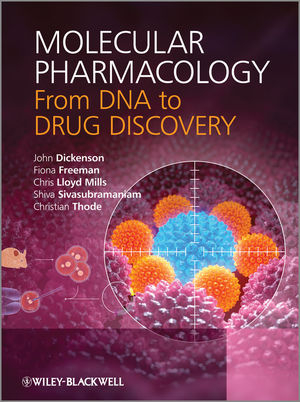
Molecular Pharmacology (eBook)
John Wiley & Sons (Verlag)
978-1-118-45197-7 (ISBN)
This textbook provides a fresh, comprehensive and accessible introduction to the rapidly expanding field of molecular pharmacology. Adopting a drug target-based, rather than the traditional organ/system based, approach this innovative guide reflects the current advances and research trend towards molecular based drug design, derived from a detailed understanding of chemical responses in the body. Drugs are then tailored to fit a treatment profile, rather than the traditional method of 'trial and error' drug discovery which focuses on testing chemicals on animals or cell cultures and matching their effects to treatments.
Providing an invaluable resource for advanced under-graduate and MSc/PhD students, new researchers to the field and practitioners for continuing professional development, Molecular Pharmacology explores; recent advances and developments in the four major human drug target families (G-protein coupled receptors, ion channels, nuclear receptors and transporters), cloning of drug targets, transgenic animal technology, gene therapy, pharmacogenomics and looks at the role of calcium in the cell.
- Current - focuses on cutting edge techniques and approaches, including new methods to quantify biological activities in different systems and ways to interpret and understand pharmacological data.
- Cutting Edge - highlights advances in pharmacogenomics and explores how an individual's genetic makeup influences their response to therapeutic drugs and the potential for harmful side effects.
- Applied - includes numerous, real-world examples and a detailed case-study based chapter which looks at current and possible future treatment strategies for cystic fibrosis. This case study considers the relative merits of both drug therapy for specific classes of mutation and gene therapy to correct the underlying defect.
- Accessible - contains a comprehensive glossary, suggestions for further reading at the end of each chapter and an associated website that provides a complete set of figures from within the book.
John Dickenson, Fiona Freeman, Chris Lloyd Mills, Shiva Sivasubramaniam and Christian Thode, all at Nottingham Trent University.
This textbook provides a fresh, comprehensive and accessible introduction to the rapidly expanding field of molecular pharmacology. Adopting a drug target-based, rather than the traditional organ/system based, approach this innovative guide reflects the current advances and research trend towards molecular based drug design, derived from a detailed understanding of chemical responses in the body. Drugs are then tailored to fit a treatment profile, rather than the traditional method of trial and error drug discovery which focuses on testing chemicals on animals or cell cultures and matching their effects to treatments. Providing an invaluable resource for advanced under-graduate and MSc/PhD students, new researchers to the field and practitioners for continuing professional development, Molecular Pharmacology explores; recent advances and developments in the four major human drug target families (G-protein coupled receptors, ion channels, nuclear receptors and transporters), cloning of drug targets, transgenic animal technology, gene therapy, pharmacogenomics and looks at the role of calcium in the cell. Current - focuses on cutting edge techniques and approaches, including new methods to quantify biological activities in different systems and ways to interpret and understand pharmacological data. Cutting Edge - highlights advances in pharmacogenomics and explores how an individual s genetic makeup influences their response to therapeutic drugs and the potential for harmful side effects. Applied - includes numerous, real-world examples and a detailed case-study based chapter which looks at current and possible future treatment strategies for cystic fibrosis. This case study considers the relative merits of both drug therapy for specific classes of mutation and gene therapy to correct the underlying defect. Accessible - contains a comprehensive glossary, suggestions for further reading at the end of each chapter and an associated website that provides a complete set of figures from within the book.
John Dickenson, Fiona Freeman, Chris Lloyd Mills, Shiva Sivasubramaniam and Christian Thode, all at Nottingham Trent University.
"Overall, it could be the basis of an excellent course for
junior pharmacologists in basic science research who need a greater
focus on the mechanisms of drug action rather than an encyclopedic
survey of clinical drug use." (Doody's, 26
July 2013)
| Erscheint lt. Verlag | 30.11.2012 |
|---|---|
| Sprache | englisch |
| Themenwelt | Informatik ► Weitere Themen ► Bioinformatik |
| Medizin / Pharmazie ► Gesundheitsfachberufe | |
| Medizin / Pharmazie ► Medizinische Fachgebiete ► Pharmakologie / Pharmakotherapie | |
| Naturwissenschaften ► Biologie ► Genetik / Molekularbiologie | |
| Naturwissenschaften ► Biologie ► Mikrobiologie / Immunologie | |
| Technik | |
| Schlagworte | accessible • Biowissenschaften • Body • Chemical • chemicals • Chemie • Chemistry • Current • Drug • drug design • Drugs • drug targetbased • Expanding • Field • Guide • Innovative • Introduction • Life Sciences • Medical Science • Medizin • molecular • Molecular Biology • Molecular Pharmacology • Molekularbiologie • Molekulare Pharmakologie • Molekularpharmakologie • pharmacology • Pharmacology & Pharmaceutical Medicine • Pharmakologie • Pharmakologie u. Pharmazeutische Medizin • Profile • rapidly • responses • towards • Traditional • Treatment • Trial |
| ISBN-10 | 1-118-45197-X / 111845197X |
| ISBN-13 | 978-1-118-45197-7 / 9781118451977 |
| Informationen gemäß Produktsicherheitsverordnung (GPSR) | |
| Haben Sie eine Frage zum Produkt? |
 PDF (Adobe DRM)
Kopierschutz: Adobe-DRM
Adobe-DRM ist ein Kopierschutz, der das eBook vor Mißbrauch schützen soll. Dabei wird das eBook bereits beim Download auf Ihre persönliche Adobe-ID autorisiert. Lesen können Sie das eBook dann nur auf den Geräten, welche ebenfalls auf Ihre Adobe-ID registriert sind.
Details zum Adobe-DRM
Dateiformat: PDF (Portable Document Format)
Mit einem festen Seitenlayout eignet sich die PDF besonders für Fachbücher mit Spalten, Tabellen und Abbildungen. Eine PDF kann auf fast allen Geräten angezeigt werden, ist aber für kleine Displays (Smartphone, eReader) nur eingeschränkt geeignet.
Systemvoraussetzungen:
PC/Mac: Mit einem PC oder Mac können Sie dieses eBook lesen. Sie benötigen eine
eReader: Dieses eBook kann mit (fast) allen eBook-Readern gelesen werden. Mit dem amazon-Kindle ist es aber nicht kompatibel.
Smartphone/Tablet: Egal ob Apple oder Android, dieses eBook können Sie lesen. Sie benötigen eine
Geräteliste und zusätzliche Hinweise
Buying eBooks from abroad
For tax law reasons we can sell eBooks just within Germany and Switzerland. Regrettably we cannot fulfill eBook-orders from other countries.


