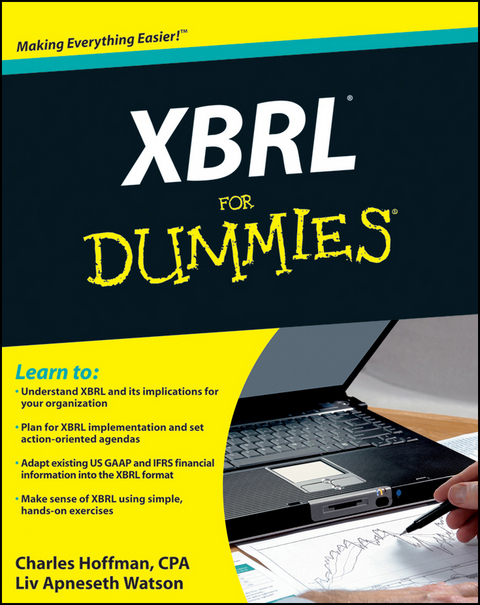
XBRL For Dummies (eBook)
432 Seiten
Wiley (Verlag)
978-0-470-58319-7 (ISBN)
Charles Hoffman is considered the father of XBRL. He iscoeditor of the US GAAP Taxonomy Architecture and was named one ofthe 100 most influential people in accounting by AccountingTechnology. Liv Apneseth Watson is among the founders of XBRLInternational and was vice chairman of XBRL International.
Introduction 1
Part I: The Very Least You Need to Know about XBRL 7
Chapter 1: Wrapping Your Head Around XBRL 9
Chapter 2: Taking to Heart the Essential Concepts of XBRL 31
Chapter 3: Glancing at XBRL's Parts 49
Chapter 4: An XBRL Primer 69
Chapter 5: Pinning Down How XBRL Affects You 97
Part II: Embracing XBRL for Classic Challenges and NewPossibilities 109
Chapter 6: Exchanging Business Information 111
Chapter 7: Feeding the Business Information-Supply Chain 131
Chapter 8: Seeing the Transformation of Business InformationExchange 145
Part III: Successfully Pursuing and Executing an XBRL Project155
Chapter 9: Exploring the Common Uses of XBRL 157
Chapter 10: Making Your Own Business Case for XBRL 171
Chapter 11: Evaluating Different Approaches to ImplementingXBRL185
Chapter 12: Considering How to Implement Your XBRL Solution195
Chapter 13: Complying with the SEC Mandate 217
Part IV: Working with XBRL Taxonomies and Instances225
Chapter 14: Finding Tools and Services to Make XBRL Work 227
Chapter 15: Creating and Using XBRL 249
Chapter 16: Differentiating XBRL Modules 277
Chapter 17: Digging Deeper into XBRL Taxonomies 299
Chapter 18: Understanding the XBRL Instance 325
Chapter 19: Predicting What XBRL Will Become 347
Part V: The Part of Tens 359
Chapter 20: Ten (or So) Ways to Flatten the XBRL Learning Curve361
Chapter 21: (Nearly) Ten Keys to Understanding How XBRL Works369
Chapter 22: Top Ten Technical Odds and Ends 377
Index 391
| Erscheint lt. Verlag | 3.11.2009 |
|---|---|
| Sprache | englisch |
| Themenwelt | Sachbuch/Ratgeber ► Beruf / Finanzen / Recht / Wirtschaft ► Wirtschaft |
| Mathematik / Informatik ► Informatik | |
| Recht / Steuern ► Wirtschaftsrecht | |
| Wirtschaft ► Betriebswirtschaft / Management ► Rechnungswesen / Bilanzen | |
| Schlagworte | Accounting • Accounting Technology • Rechnungswesen • Rechnungswesen / Technologie |
| ISBN-10 | 0-470-58319-3 / 0470583193 |
| ISBN-13 | 978-0-470-58319-7 / 9780470583197 |
| Informationen gemäß Produktsicherheitsverordnung (GPSR) | |
| Haben Sie eine Frage zum Produkt? |
 PDF (Adobe DRM)
Kopierschutz: Adobe-DRM
Adobe-DRM ist ein Kopierschutz, der das eBook vor Mißbrauch schützen soll. Dabei wird das eBook bereits beim Download auf Ihre persönliche Adobe-ID autorisiert. Lesen können Sie das eBook dann nur auf den Geräten, welche ebenfalls auf Ihre Adobe-ID registriert sind.
Details zum Adobe-DRM
Dateiformat: PDF (Portable Document Format)
Mit einem festen Seitenlayout eignet sich die PDF besonders für Fachbücher mit Spalten, Tabellen und Abbildungen. Eine PDF kann auf fast allen Geräten angezeigt werden, ist aber für kleine Displays (Smartphone, eReader) nur eingeschränkt geeignet.
Systemvoraussetzungen:
PC/Mac: Mit einem PC oder Mac können Sie dieses eBook lesen. Sie benötigen eine
eReader: Dieses eBook kann mit (fast) allen eBook-Readern gelesen werden. Mit dem amazon-Kindle ist es aber nicht kompatibel.
Smartphone/Tablet: Egal ob Apple oder Android, dieses eBook können Sie lesen. Sie benötigen eine
Geräteliste und zusätzliche Hinweise
Buying eBooks from abroad
For tax law reasons we can sell eBooks just within Germany and Switzerland. Regrettably we cannot fulfill eBook-orders from other countries.
aus dem Bereich