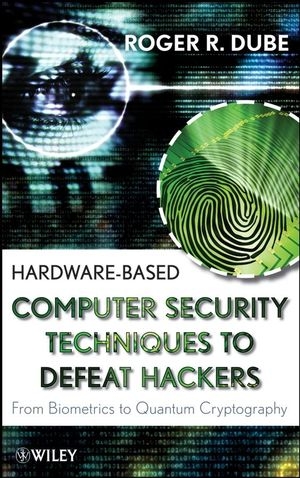
Hardware-based Computer Security Techniques to Defeat Hackers (eBook)
264 Seiten
John Wiley & Sons (Verlag)
978-0-470-42547-3 (ISBN)
easy-to-read toolbox format
Protecting valuable personal information against theft is a
mission-critical component of today's electronic business
community. In an effort to combat this serious and growing problem,
the Intelligence and Defense communities have successfully employed
the use of hardware-based security devices.
This book provides a road map of the hardware-based security
devices that can defeat--and prevent--attacks by hackers.
Beginning with an overview of the basic elements of computer
security, the book covers:
* Cryptography
* Key generation and distribution
* The qualities of security solutions
* Secure co-processors
* Secure bootstrap loading
* Secure memory management and trusted execution technology
* Trusted Platform Module (TPM)
* Field Programmable Gate Arrays (FPGAs)
* Hardware-based authentification
* Biometrics
* Tokens
* Location technologies
Hardware-Based Computer Security Techniques to Defeat
Hackers includes a chapter devoted entirely to showing readers
how they can implement the strategies and technologies discussed.
Finally, it concludes with two examples of security systems put
into practice.
The information and critical analysis techniques provided in
this user-friendly book are invaluable for a range of
professionals, including IT personnel, computer engineers, computer
security specialists, electrical engineers, software engineers, and
industry analysts.
Roger R. Dube, PhD, obtained his bachelor's degree in experimental physics from Cornell University and his PhD from Princeton University. He has held positions in both academia and the private sector. He has published in top peer-reviewed scientific publications and written numerous successful research and development proposals (securing in excess of $27 million in grants and contract vehicles since 2004). He is currently the President and Chief Scientist of Digital Authentication Technologies (DAT), a computer security company with products based on Dr. Dube's patents. The technology has been successfully field-tested and deployed at the U.S. Joint Forces Command in Norfolk, Virginia, as well as at SAIC and Criterion Labs, and is currently being considered for use by various industries worldwide. Dr. Dube also holds a joint position at Rochester Institute of Techology (RIT) as a Professor in the Center for Imaging Science.
1. The Elements of Computer Security.
2. Cryptography Approaches and Attacks.
3. Key Generation and Distribution Approaches and Attacks.
4. The Qualities of Workable Security Solutions.
5. Secure Coprocessors.
6. Secure bootstrap Loading.
7. Secure Memory Management and Trusted Execution
Technology.
8. The Trusted Platform Module.
9. Field-Programmable Gate Arrays.
10. Hardware-Based Authentication.
11. A Closer Look At Biometrics.
12. Tokens: Something You Have.
13. Location Technologies.
14. Putting It All Together.
Glossary.
Index.
style="font-size: 10pt; color: #58482f; font-family: "Times New Roman","serif";">"The
experienced editors have written an easily comprehended book that
is international in scope, and covers the last 25 years in computer
and telecommunications developments and the Web." (style="mso-bidi-font-style: normal;">CHOICE, April
2010)
| Erscheint lt. Verlag | 1.10.2008 |
|---|---|
| Sprache | englisch |
| Themenwelt | Informatik ► Netzwerke ► Sicherheit / Firewall |
| Informatik ► Theorie / Studium ► Kryptologie | |
| Technik ► Elektrotechnik / Energietechnik | |
| Schlagworte | Computer Architecture • Computerarchitektur • Computer Engineering • Computer Science • Computersicherheit • Computertechnik • Electrical & Electronics Engineering • Elektrotechnik u. Elektronik • Informatik • Software engineering • Software-Engineering |
| ISBN-10 | 0-470-42547-4 / 0470425474 |
| ISBN-13 | 978-0-470-42547-3 / 9780470425473 |
| Informationen gemäß Produktsicherheitsverordnung (GPSR) | |
| Haben Sie eine Frage zum Produkt? |
 PDF (Adobe DRM)
Kopierschutz: Adobe-DRM
Adobe-DRM ist ein Kopierschutz, der das eBook vor Mißbrauch schützen soll. Dabei wird das eBook bereits beim Download auf Ihre persönliche Adobe-ID autorisiert. Lesen können Sie das eBook dann nur auf den Geräten, welche ebenfalls auf Ihre Adobe-ID registriert sind.
Details zum Adobe-DRM
Dateiformat: PDF (Portable Document Format)
Mit einem festen Seitenlayout eignet sich die PDF besonders für Fachbücher mit Spalten, Tabellen und Abbildungen. Eine PDF kann auf fast allen Geräten angezeigt werden, ist aber für kleine Displays (Smartphone, eReader) nur eingeschränkt geeignet.
Systemvoraussetzungen:
PC/Mac: Mit einem PC oder Mac können Sie dieses eBook lesen. Sie benötigen eine
eReader: Dieses eBook kann mit (fast) allen eBook-Readern gelesen werden. Mit dem amazon-Kindle ist es aber nicht kompatibel.
Smartphone/Tablet: Egal ob Apple oder Android, dieses eBook können Sie lesen. Sie benötigen eine
Geräteliste und zusätzliche Hinweise
Buying eBooks from abroad
For tax law reasons we can sell eBooks just within Germany and Switzerland. Regrettably we cannot fulfill eBook-orders from other countries.
aus dem Bereich