


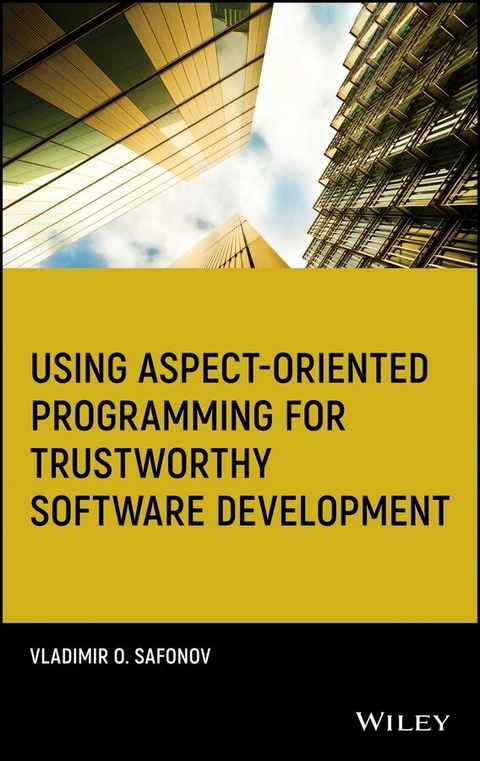
Using Aspect-Oriented Programming for Trustworthy Software Development (eBook)
John Wiley & Sons (Verlag)
978-0-470-28310-3 (ISBN)
This landmark publication fills a gap in the literature by not only describing the basic concepts of trustworthy computing (TWC) and aspect-oriented programming (AOP), but also exploring their critical interrelationships. The author clearly demonstrates how typical TWC tasks such as security checks, in-and-out conditions, and multi-threaded safety can be implemented using AOP.
Following an introduction, the book covers:
Trustworthy computing, software engineering, and computer science
Aspect-oriented programming and Aspect.NET
Principles and case studies that apply AOP to TWC
Coverage includes Aspect.NET, the AOP framework developed by the author for the Microsoft.NET platform, currently used in seventeen countries. The author discusses the basics of Aspect.NET architecture, its advantages compared to other AOP tools, and its functionality. The book has extensive practical examples and case studies of trustworthy software design and code using the Aspect.NET framework. In addition, the book explores other software technologies and tools for using AOP for trustworthy software development, including Java and AspectJ.
This book also includes a valuable chapter dedicated to ERATO, the author's teaching method employed in this book, which has enabled thousands of students to quickly grasp and apply complex concepts in computing and software engineering, while the final chapter presents an overall perspective on the current state of AOP and TWC with a view toward the future.
Software engineers, architects, developers, programmers, and students should all turn to this book to learn this tested and proven method to create more secure, private, and reliable computing.
Vladimir O. Safonov, PhD, is Professor of the Computer Science Department at St. Petersburg University and the head of the university's Java Technology Laboratory. With some thirty years of experience leading major software projects, developing software, and teaching software technologies, Professor Safonov is one of the leading innovators in computer science and software engineering in Russia. He holds four U.S. software patents and four Russian software patents and has published five books and over eighty papers. He is also a Microsoft Research 2005/2006 RFP winner for TWC and Secure Software Development.
Learn how to successfully implement trustworthy computing tasks using aspect-oriented programming This landmark publication fills a gap in the literature by not only describing the basic concepts of trustworthy computing (TWC) and aspect-oriented programming (AOP), but also exploring their critical interrelationships. The author clearly demonstrates how typical TWC tasks such as security checks, in-and-out conditions, and multi-threaded safety can be implemented using AOP. Following an introduction, the book covers: Trustworthy computing, software engineering, and computer science Aspect-oriented programming and Aspect.NET Principles and case studies that apply AOP to TWC Coverage includes Aspect.NET, the AOP framework developed by the author for the Microsoft.NET platform, currently used in seventeen countries. The author discusses the basics of Aspect.NET architecture, its advantages compared to other AOP tools, and its functionality. The book has extensive practical examples and case studies of trustworthy software design and code using the Aspect.NET framework. In addition, the book explores other software technologies and tools for using AOP for trustworthy software development, including Java and AspectJ. This book also includes a valuable chapter dedicated to ERATO, the author's teaching method employed in this book, which has enabled thousands of students to quickly grasp and apply complex concepts in computing and software engineering, while the final chapter presents an overall perspective on the current state of AOP and TWC with a view toward the future. Software engineers, architects, developers, programmers, and students should all turn to this book to learn this tested and proven method to create more secure, private, and reliable computing.
VLADIMIR O. SAFONOV, PHD, has is Professor of the Computer Science Department at St. Petersburg University and the head of the university's Java Technology Laboratory. With some thirty years of experience leading major software projects, developing software, and teaching software technologies, Professor Safonov is one of the leading innovators in computer science and software engineering in Russia. He holds four U.S. software patents and four Russian software patents and has published five books and over eighty papers. He is also a Microsoft Research 2005/2006 RFP winner for TWC and Secure Software Development.
| Erscheint lt. Verlag | 23.5.2008 |
|---|---|
| Reihe/Serie | Quantitative Software Engineering Series |
| Quantitative Software Engineering Series | Quantitative Software Engineering Series |
| Sprache | englisch |
| Themenwelt | Mathematik / Informatik ► Informatik ► Programmiersprachen / -werkzeuge |
| Mathematik / Informatik ► Informatik ► Software Entwicklung | |
| Schlagworte | AOP • aspectoriented • author • Book • Checks • Computer Science • Conditions • critical interrelationships • demonstrates • GAP • implement • implemented • Informatik • Introduction • landmark publication • Literature • Programmierung u. Software-Entwicklung • Programming & Software Development • Safety • Software engineering • Software-Engineering • Softwareentwicklung • Software Management • Software-Management • successfully • Tasks • Trustworthy • typical twc tasks |
| ISBN-10 | 0-470-28310-6 / 0470283106 |
| ISBN-13 | 978-0-470-28310-3 / 9780470283103 |
| Informationen gemäß Produktsicherheitsverordnung (GPSR) | |
| Haben Sie eine Frage zum Produkt? |
 PDF (Adobe DRM)
Kopierschutz: Adobe-DRM
Adobe-DRM ist ein Kopierschutz, der das eBook vor Mißbrauch schützen soll. Dabei wird das eBook bereits beim Download auf Ihre persönliche Adobe-ID autorisiert. Lesen können Sie das eBook dann nur auf den Geräten, welche ebenfalls auf Ihre Adobe-ID registriert sind.
Details zum Adobe-DRM
Dateiformat: PDF (Portable Document Format)
Mit einem festen Seitenlayout eignet sich die PDF besonders für Fachbücher mit Spalten, Tabellen und Abbildungen. Eine PDF kann auf fast allen Geräten angezeigt werden, ist aber für kleine Displays (Smartphone, eReader) nur eingeschränkt geeignet.
Systemvoraussetzungen:
PC/Mac: Mit einem PC oder Mac können Sie dieses eBook lesen. Sie benötigen eine
eReader: Dieses eBook kann mit (fast) allen eBook-Readern gelesen werden. Mit dem amazon-Kindle ist es aber nicht kompatibel.
Smartphone/Tablet: Egal ob Apple oder Android, dieses eBook können Sie lesen. Sie benötigen eine
Geräteliste und zusätzliche Hinweise
Buying eBooks from abroad
For tax law reasons we can sell eBooks just within Germany and Switzerland. Regrettably we cannot fulfill eBook-orders from other countries.
aus dem Bereich


