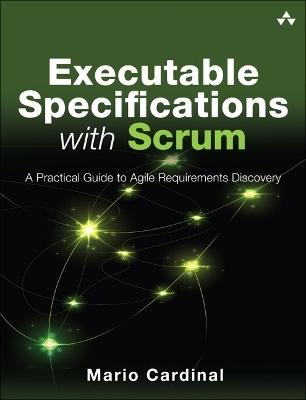
Executable Specifications with Scrum
Addison-Wesley Educational Publishers Inc (Verlag)
9780321784131 (ISBN)
- Titel ist leider vergriffen;
keine Neuauflage - Artikel merken
Long-time agile coach and enterprise architect Mario Cardinal shows how to create executable specifications and use them to test software behavior against requirements. Cardinal shows how to trawl requirements incrementally, step-by-step, using a vision-centric and emergent iterative practice that is designed for agility. Writing for analysts, architects, developers, and managers, Cardinal makes a strong case for the iterative discovery of requirements. Then, he moves from theory to practice, fully explaining the technical mechanisms and empirical techniques you need to gain full value from executable specifications.
You’ll learn to connect specifications with software under construction, link requirements to architecture, and automate requirements verification within the Scrum framework. Above all, Cardinal will help you solve the paramount challenge of software development: not only to solve the problem right, but also to solve the right problem.
You will learn how to
• Establish more effective agile roles for analysts and architects
• Integrate and simplify the best techniques from FIT, ATDD, and BDD
• Identify “core certainties” on which your project team should rely to ensure requirements discovery
• Manage uncertainty by discovering stakeholder desires through short feedback loops
• Specify as you go while writing small chunks of requirements
• Use storyboarding and paper prototyping to improve conversations with stakeholders
• Express stakeholder desires that are requirements with user stories
• Refine your user stories, and plan more effective Scrum sprints
• Confirm user stories by scripting behaviors with scenarios
• Transform scenarios into automated tests that easily confirm your software’s expected behavior as designs emerge and specifications evolve
• Ensure higher-quality software by specifying nonfunctional requirements
Known for many years as an agile coach specialized in software architecture, Mario Cardinal is the co-founder of Slingboards Lab, a young start-up that brings sticky notes to smartphones, tablets and the web for empowering teams to better collaborate. A visionary and an entrepreneur, he likes to seize the opportunities that emerge from the unexpected. His friends like to describe him as someone who can extract the essence of a complicated situation, sort out the core ideas from the incidental distractions, and provide a summary that is easy to understand. For the ninth consecutive year, he has received the Most Valuable Professional (MVP) award from Microsoft. MVP status is awarded to credible technology experts who are among the very best community members willing to share their experience to help others realize their potential.
Preface xvi
Chapter 1 Solving the Right Problem 1
Distinguishing the Requirements from the Solution 4
Recognizing the Impact of Uncertainty 5
Tackling Uncertainty 7
Summary 10
References 10
Chapter 2 Relying on a Stable Foundation 13
Defining What Will Hardly Change 14
Creating a Healthy Team 14
Requiring the Involvement of All Stakeholders 16
Expressing a Shared Vision 17
Distinguishing a Meaningful Common Goal 20
Identifying a Set of High-Level Features 21
Validating the “Can-Exist” Assumption 22
Summary 23
References 23
Chapter 3 Discovering Through Short Feedback Loops and Stakeholders’ Desirements 25
Applying the Trial-and-Error Method 25
Using Short Feedback Loops 29
Targeting Feedback Along the Expected Benefits 31
Focusing on the Stakeholders’ Desirements 31
Summary 34
References 34
Chapter 4 Expressing Desirements with User Stories 35
Describing Desirements by Using User Stories 35
Discovering Desirements by Exploring Roles and Benefits 38
Establishing a Ubiquitous Language 40
Recording Desirements by Using a Product Backlog 41
Summary 43
References 44
Chapter 5 Refining User Stories by Grooming the Product Backlog 45
Managing the Product Backlog 46
Collaborating to Groom the Product Backlog 48
Ranking User Stories with a Dot Voting Method 49
Illustrating User Stories with Storyboards 52
Sizing User Stories Using Comparison 56
Splitting User Stories Along Business Values 60
Tracking User Stories with a Collaboration Board 62
Delivering a Coherent Set of User Stories 68
Planning Work with User Stories 70
Summary 71
References 72
Chapter 6 Confirming User Stories with Scenarios 73
Scripting User Stories with Scenarios 74
Expressing Scenarios with Formality 76
Scripting Scenarios Using the FIT Tabular Format 77
Scripting Scenarios Using Given-When-Then Syntax 79
Choosing Between FIT Tabular Format or Given-When-Then Syntax 80
Formalizing a Ubiquitous Language 81
Splitting Scenarios into Commands or Queries 83
Confirming Collaboratively in a Two-Step Process 85
Removing Technical Considerations from Scenarios 89
Evolving Scenarios from Sprint to Sprint 91
Organizing Scenarios by Feature 92
Documenting Scenarios by Feature 93
Avoiding Duplication and Merging Conflicts 94
Summary 95
References 96
Chapter 7 Automating Confirmation with Acceptance Tests 97
Evolving Scenarios into Acceptance Tests 98
Automating Scenarios Using the Red-Green-Refactor Cycle 101
Translating the Scenario into an Acceptance Test 104
Transposing Using an Internal DSL 104
Creating a Test 107
Coding the DSL into the Newly Created Test 108
Connecting the Newly Created Test with the Interface 110
Exercising the Interface 112
Chaining Context Between the Steps of the Scenario 113
Making the Test Fail 114
Implementing the Interface 115
Replacing Unit Testing with Context-Specification Testing 116
Making the Test Pass 117
Evolving the Acceptance Test 117
Running Acceptance Tests Side-by-Side with Continuous Integration 118
Enhancing Scenarios with Test Results 119
Summary 121
References 122
Chapter 8 Addressing Nonfunctional Requirements 123
Improving External Quality Using Restrictions 125
Translating Nonfunctional Requirements into Restrictions 127
Reducing the Functional Scope to a Single Scenario 129
Setting Measurable Quality Objectives 131
Testing Restrictions with Proven Practices 135
Ensuring Internal Quality Using Sound Engineering Practices 137
Improving Software Construction with Explicit Practices 137
Mastering Practices with Collaborative Construction 140
Summary 142
References 143
Chapter 9 Conclusion 145
Recapitulating the Book 146
Summarizing the Process 148
Drawing Attention to Individual Roles 149
Glossary 153
Index 159
| Erscheint lt. Verlag | 8.8.2013 |
|---|---|
| Verlagsort | New Jersey |
| Sprache | englisch |
| Maße | 180 x 232 mm |
| Gewicht | 320 g |
| Themenwelt | Mathematik / Informatik ► Informatik ► Software Entwicklung |
| ISBN-13 | 9780321784131 / 9780321784131 |
| Zustand | Neuware |
| Informationen gemäß Produktsicherheitsverordnung (GPSR) | |
| Haben Sie eine Frage zum Produkt? |
aus dem Bereich