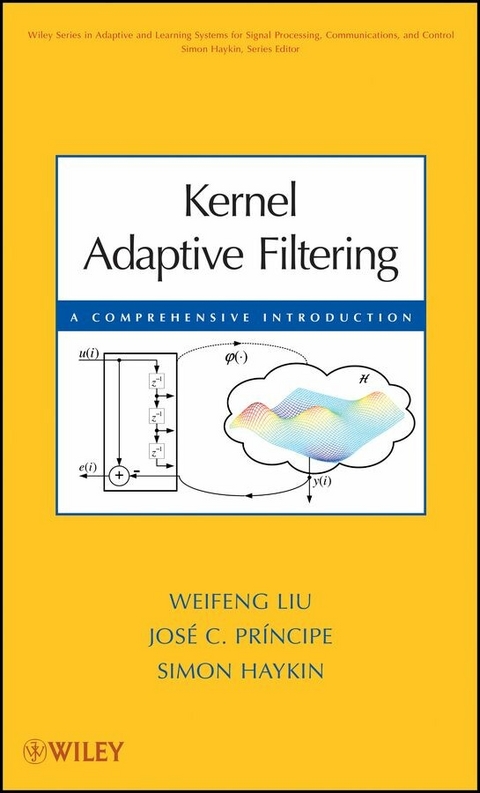
Kernel Adaptive Filtering (eBook)
John Wiley & Sons (Verlag)
978-1-118-21121-2 (ISBN)
There is increased interest in kernel learning algorithms in neural networks and a growing need for nonlinear adaptive algorithms in advanced signal processing, communications, and controls. Kernel Adaptive Filtering is the first book to present a comprehensive, unifying introduction to online learning algorithms in reproducing kernel Hilbert spaces. Based on research being conducted in the Computational Neuro-Engineering Laboratory at the University of Florida and in the Cognitive Systems Laboratory at McMaster University, Ontario, Canada, this unique resource elevates the adaptive filtering theory to a new level, presenting a new design methodology of nonlinear adaptive filters.
Covers the kernel least mean squares algorithm, kernel affine projection algorithms, the kernel recursive least squares algorithm, the theory of Gaussian process regression, and the extended kernel recursive least squares algorithm
Presents a powerful model-selection method called maximum marginal likelihood
Addresses the principal bottleneck of kernel adaptive filters—their growing structure
Features twelve computer-oriented experiments to reinforce the concepts, with MATLAB codes downloadable from the authors' Web site
Concludes each chapter with a summary of the state of the art and potential future directions for original research
Kernel Adaptive Filtering is ideal for engineers, computer scientists, and graduate students interested in nonlinear adaptive systems for online applications (applications where the data stream arrives one sample at a time and incremental optimal solutions are desirable). It is also a useful guide for those who look for nonlinear adaptive filtering methodologies to solve practical problems.
Weifeng Liu, PhD, is a senior engineer of the Demand Forecasting Team at Amazon.com Inc. His research interests include kernel adaptive filtering, online active learning, and solving real-life large-scale data mining problems.
José C. Principe is Distinguished Professor of Electrical and Biomedical Engineering at the University of Florida, Gainesville, where he teaches advanced signal processing and artificial neural networks modeling. He is BellSouth Professor and founder and Director of the University of Florida Computational Neuro-Engineering Laboratory.
Simon Haykin is Distinguished University Professor at McMaster University, Canada.He is world-renowned for his contributions to adaptive filtering applied to radar and communications. Haykin's current research passion is focused on cognitive dynamic systems, including applications on cognitive radio and cognitive radar.
Weifeng Liu, PhD, is a senior engineer of the Demand Forecasting Team at Amazon.com Inc. His research interests include kernel adaptive filtering, online active learning, and solving real-life large-scale data mining problems. José C. Principe is Distinguished Professor of Electrical and Biomedical Engineering at the University of Florida, Gainesville, where he teaches advanced signal processing and artificial neural networks modeling. He is BellSouth Professor and founder and Director of the University of Florida Computational Neuro-Engineering Laboratory. Simon Haykin is Distinguished University Professor at McMaster University, Canada.He is world-renowned for his contributions to adaptive filtering applied to radar and communications. Haykin's current research passion is focused on cognitive dynamic systems, including applications on cognitive radio and cognitive radar.
PREFACE.
ACKNOWLEDGMENTS.
NOTATION.
ABBREVIATIONS AND SYMBOLS.
1 BACKGROUND AND PREVIEW.
1.1 Supervised, Sequential, and Active Learning.
1.2 Linear Adaptive Filters.
1.3 Nonlinear Adaptive Filters.
1.4 Reproducing Kernel Hilbert Spaces.
1.5 Kernel Adaptive Filters.
1.6 Summarizing Remarks.
Endnotes.
2 KERNEL LEAST-MEAN-SQUARE ALGORITHM.
2.1 Least-Mean-Square Algorithm.
2.2 Kernel Least-Mean-Square Algorithm.
2.3 Kernel and Parameter Selection.
2.4 Step-Size Parameter.
2.5 Novelty Criterion.
2.6 Self-Regularization Property of KLMS.
2.7 Leaky Kernel Least-Mean-Square Algorithm.
2.8 Normalized Kernel Least-Mean-Square Algorithm.
2.9 Kernel ADALINE.
2.10 Resource Allocating Networks.
2.11 Computer Experiments.
2.12 Conclusion.
Endnotes.
3 KERNEL AFFINE PROJECTION ALGORITHMS.
3.1 Affine Projection Algorithms.
3.2 Kernel Affine Projection Algorithms.
3.3 Error Reusing.
3.4 Sliding Window Gram Matrix Inversion.
3.5 Taxonomy for Related Algorithms.
3.6 Computer Experiments.
3.7 Conclusion.
Endnotes.
4 KERNEL RECURSIVE LEAST-SQUARES ALGORITHM.
4.1 Recursive Least-Squares Algorithm.
4.2 Exponentially Weighted Recursive Least-Squares
Algorithm.
4.3 Kernel Recursive Least-Squares Algorithm.
4.4 Approximate Linear Dependency.
4.5 Exponentially Weighted Kernel Recursive Least-Squares
Algorithm.
4.6 Gaussian Processes for Linear Regression.
4.7 Gaussian Processes for Nonlinear Regression.
4.8 Bayesian Model Selection.
4.9 Computer Experiments.
4.10 Conclusion.
Endnotes.
5 EXTENDED KERNEL RECURSIVE LEAST-SQUARES ALGORITHM.
5.1 Extended Recursive Least Squares Algorithm.
5.2 Exponentially Weighted Extended Recursive Least Squares
Algorithm.
5.3 Extended Kernel Recursive Least Squares Algorithm.
5.4 EX-KRLS for Tracking Models.
5.5 EX-KRLS with Finite Rank Assumption.
5.6 Computer Experiments.
5.7 Conclusion.
Endnotes.
6 DESIGNING SPARSE KERNEL ADAPTIVE FILTERS.
6.1 Definition of Surprise.
6.2 A Review of Gaussian Process Regression.
6.3 Computing Surprise.
6.4 Kernel Recursive Least Squares with Surprise Criterion.
6.5 Kernel Least Mean Square with Surprise Criterion.
6.6 Kernel Affine Projection Algorithms with Surprise
Criterion.
6.7 Computer Experiments.
6.8 Conclusion.
Endnotes.
EPILOGUE.
APPENDIX.
A MATHEMATICAL BACKGROUND.
A.1 Singular Value Decomposition.
A.2 Positive-Definite Matrix.
A.3 Eigenvalue Decomposition.
A.4 Schur Complement.
A.5 Block Matrix Inverse.
A.6 Matrix Inversion Lemma.
A.7 Joint, Marginal, and Conditional Probability.
A.8 Normal Distribution.
A.9 Gradient Descent.
A.10 Newton's Method.
B. APPROXIMATE LINEAR DEPENDENCY AND SYSTEM STABILITY.
REFERENCES.
INDEX.
| Erscheint lt. Verlag | 20.9.2011 |
|---|---|
| Reihe/Serie | Adaptive and Cognitive Dynamic Systems: Signal Processing, Learning, Communications and Control |
| Adaptive and Cognitive Dynamic Systems: Signal Processing, Learning, Communications and Control | Adaptive and Cognitive Dynamic Systems: Signal Processing, Learning, Communications and Control |
| Sprache | englisch |
| Themenwelt | Mathematik / Informatik ► Informatik |
| Technik ► Elektrotechnik / Energietechnik | |
| Technik ► Nachrichtentechnik | |
| Schlagworte | Adaptive • Adaptives System • algorithms • Applied Mathematics in Science • Book • Comprehensive • Electrical & Electronics Engineering • Elektrotechnik u. Elektronik • First • Florida • Hilbert • Interest • Introduction • Kernel • learning • Mathematics • Mathematik • Mathematik in den Naturwissenschaften • Neural networks • Neuroengineering • Neuronale Netze • Nichtlineares System • Online • Perspective • Processing • reproducing • Signal • Signal Processing • Signalverarbeitung |
| ISBN-10 | 1-118-21121-9 / 1118211219 |
| ISBN-13 | 978-1-118-21121-2 / 9781118211212 |
| Informationen gemäß Produktsicherheitsverordnung (GPSR) | |
| Haben Sie eine Frage zum Produkt? |
 PDF (Adobe DRM)
Größe: 1,6 MB
Kopierschutz: Adobe-DRM
Adobe-DRM ist ein Kopierschutz, der das eBook vor Mißbrauch schützen soll. Dabei wird das eBook bereits beim Download auf Ihre persönliche Adobe-ID autorisiert. Lesen können Sie das eBook dann nur auf den Geräten, welche ebenfalls auf Ihre Adobe-ID registriert sind.
Details zum Adobe-DRM
Dateiformat: PDF (Portable Document Format)
Mit einem festen Seitenlayout eignet sich die PDF besonders für Fachbücher mit Spalten, Tabellen und Abbildungen. Eine PDF kann auf fast allen Geräten angezeigt werden, ist aber für kleine Displays (Smartphone, eReader) nur eingeschränkt geeignet.
Systemvoraussetzungen:
PC/Mac: Mit einem PC oder Mac können Sie dieses eBook lesen. Sie benötigen eine
eReader: Dieses eBook kann mit (fast) allen eBook-Readern gelesen werden. Mit dem amazon-Kindle ist es aber nicht kompatibel.
Smartphone/Tablet: Egal ob Apple oder Android, dieses eBook können Sie lesen. Sie benötigen eine
Geräteliste und zusätzliche Hinweise
Buying eBooks from abroad
For tax law reasons we can sell eBooks just within Germany and Switzerland. Regrettably we cannot fulfill eBook-orders from other countries.
 EPUB (Adobe DRM)
Kopierschutz: Adobe-DRM
Adobe-DRM ist ein Kopierschutz, der das eBook vor Mißbrauch schützen soll. Dabei wird das eBook bereits beim Download auf Ihre persönliche Adobe-ID autorisiert. Lesen können Sie das eBook dann nur auf den Geräten, welche ebenfalls auf Ihre Adobe-ID registriert sind.
Details zum Adobe-DRM
Dateiformat: EPUB (Electronic Publication)
EPUB ist ein offener Standard für eBooks und eignet sich besonders zur Darstellung von Belletristik und Sachbüchern. Der Fließtext wird dynamisch an die Display- und Schriftgröße angepasst. Auch für mobile Lesegeräte ist EPUB daher gut geeignet.
Systemvoraussetzungen:
PC/Mac: Mit einem PC oder Mac können Sie dieses eBook lesen. Sie benötigen eine
eReader: Dieses eBook kann mit (fast) allen eBook-Readern gelesen werden. Mit dem amazon-Kindle ist es aber nicht kompatibel.
Smartphone/Tablet: Egal ob Apple oder Android, dieses eBook können Sie lesen. Sie benötigen eine
Geräteliste und zusätzliche Hinweise
Buying eBooks from abroad
For tax law reasons we can sell eBooks just within Germany and Switzerland. Regrettably we cannot fulfill eBook-orders from other countries.
aus dem Bereich