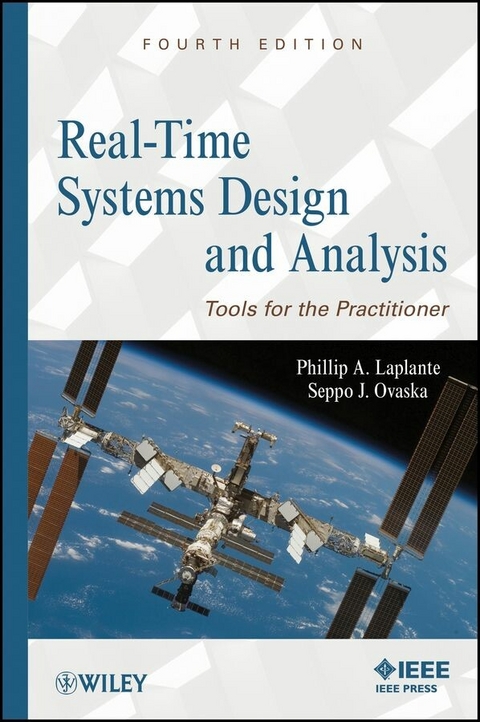
Real-Time Systems Design and Analysis (eBook)
John Wiley & Sons (Verlag)
9781118136577 (ISBN)
From power plants to medicine to avionics, the world increasingly depends on computer systems that can compute and respond to various excitations in real time. The Fourth Edition of Real-Time Systems Design and Analysis gives software designers the knowledge and the tools needed to create real-time software using a holistic, systems-based approach. The text covers computer architecture and organization, operating systems, software engineering, programming languages, and compiler theory, all from the perspective of real-time systems design.
The Fourth Edition of this renowned text brings it thoroughly up to date with the latest technological advances and applications. This fully updated edition includes coverage of the following concepts:
-
Multidisciplinary design challenges
-
Time-triggered architectures
-
Architectural advancements
-
Automatic code generation
-
Peripheral interfacing
-
Life-cycle processes
The final chapter of the text offers an expert perspective on the future of real-time systems and their applications.
The text is self-contained, enabling instructors and readers to focus on the material that is most important to their needs and interests. Suggestions for additional readings guide readers to more in-depth discussions on each individual topic. In addition, each chapter features exercises ranging from simple to challenging to help readers progressively build and fine-tune their ability to design their own real-time software programs.
Now fully up to date with the latest technological advances and applications in the field, Real-Time Systems Design and Analysis remains the top choice for students and software engineers who want to design better and faster real-time systems at minimum cost.
PHILLIP A. LAPLANTE, PhD, PE, is Professor of Software Engineering at Penn State, where he specializes in software and systems engineering, project management, and software testing and security. Dr. Laplante spent several years as a software engineer and project manager working on avionics, computer-aided design, and software test systems. He has authored or edited twenty-seven books and has published more than 200 scholarly articles.
SEPPO J. OVASKA, DSc, is Professor of Industrial Electronics at Aalto University, Finland. He has served as a visiting scholar at Utah State University, Virginia Tech, and the University of Passau, Germany, and has published more than 100 articles in peer-reviewed journals. Prior to his academic career, Dr. Ovaska developed control systems for high-rise elevators; those contributions led to nine international patents.
The leading text in the field explains step by step how to write software that responds in real time From power plants to medicine to avionics, the world increasingly depends on computer systems that can compute and respond to various excitations in real time. The Fourth Edition of Real-Time Systems Design and Analysis gives software designers the knowledge and the tools needed to create real-time software using a holistic, systems-based approach. The text covers computer architecture and organization, operating systems, software engineering, programming languages, and compiler theory, all from the perspective of real-time systems design. The Fourth Edition of this renowned text brings it thoroughly up to date with the latest technological advances and applications. This fully updated edition includes coverage of the following concepts: Multidisciplinary design challenges Time-triggered architectures Architectural advancements Automatic code generation Peripheral interfacing Life-cycle processes The final chapter of the text offers an expert perspective on the future of real-time systems and their applications. The text is self-contained, enabling instructors and readers to focus on the material that is most important to their needs and interests. Suggestions for additional readings guide readers to more in-depth discussions on each individual topic. In addition, each chapter features exercises ranging from simple to challenging to help readers progressively build and fine-tune their ability to design their own real-time software programs. Now fully up to date with the latest technological advances and applications in the field, Real-Time Systems Design and Analysis remains the top choice for students and software engineers who want to design better and faster real-time systems at minimum cost.
PHILLIP A. LAPLANTE, PhD, PE, is Professor of Software Engineering at Penn State, where he specializes in software and systems engineering, project management, and software testing and security. Dr. Laplante spent several years as a software engineer and project manager working on avionics, computer-aided design, and software test systems. He has authored or edited twenty-seven books and has published more than 200 scholarly articles. SEPPO J. OVASKA, DSc, is Professor of Industrial Electronics at Aalto University, Finland. He has served as a visiting scholar at Utah State University, Virginia Tech, and the University of Passau, Germany, and has published more than 100 articles in peer-reviewed journals. Prior to his academic career, Dr. Ovaska developed control systems for high-rise elevators; those contributions led to nine international patents.
Chapter 1. Fundamentals of Real-Time Systems.
Chapter 2. Hardware for Real-Time Systems.
Chapter 3. Real-Time Operating Systems.
Chapter 4. Programming Languages for Real-Time Systems.
Chapter 5. Requirements-Engineering Methodologies.
Chapter 6. Software Design Approaches.
Chapter 7. Performance Analysis Techniques.
Chapter 8. Additional Considerations for the Practitioner.
Chapter 9. Future Visions on Real-Time Systems.
PREFACE
This book is an introductory text about real-time systems—systems where timeliness is a crucial part of the correctness of the system. Real-time software designers must be familiar with computer architecture and organization, operating systems and related services, programming languages, systems and software engineering, as well as performance analysis and optimization techniques. The text provides a pragmatic discussion of these subjects from the perspective of the real-time systems designer. Because this is a staggering task, depth is occasionally sacrificed for breadth. Nevertheless, thoughtful suggestions for additional literature are provided where depth has been sacrificed due to the available page budget or other reasons.
This book is intended for junior–senior level and graduate computer science, computer engineering and electrical engineering students, as well as practicing software, systems and computer engineers. It can be used as a graduate level text if it is supplemented with an advanced reader or a focused selection of scholarly articles on a specific topic (which could be gathered from the up-to-date bibliographies of this edition). Our book is especially useful in an industrial setting for new real-time systems designers who need to get “up to speed” very quickly. Earlier editions of this book have been used in this way to teach short courses for several industrial clients. Finally, we intend for the book to be a desk reference of long-lasting value, even for experienced real-time systems designers and project managers.
The reader is assumed to have basic knowledge in programming in one of the more popular languages, but other than this, the prerequisites for this text are minimal. Some familiarity with discrete mathematics is helpful in understanding some of the formalizations, but it is not essential.
Since there are several preferred languages for real-time systems design, such as Ada, C, C++, C#, and increasingly, Java, it would be unjust to focus this book on one language, say C, when the theory and framework should be language independent. However, for uniformity of discussion, certain points are illustrated, as appropriate, in generic assembly language and C.
While the provided program codes are not intended to be ready-to-use, they can be easily adapted with a little tweaking for use in a real system.
This book is organized into nine chapters that are largely self-contained. Thus, the material can be rearranged or omitted depending on the background and interests of the instructor or reader. It is advised, however, that Chapter 1 would be explored first, because it contains an introduction to real-time systems as well as the necessary terminology.
Each of the chapters contains both easy and more challenging exercises that stimulate the reader to confront actual problems. The exercises, however, cannot serve as a substitute for carefully planned laboratory work or practical experience.
The first chapter provides an overview of the nature of real-time systems. Much of the basic vocabulary relating to real-time systems is developed along with a discussion of the main challenges facing the real-time system designer. Besides, a brief historical review is given. The purpose of this chapter is to foreshadow the rest of the book as well as quickly acquaint the reader with pertinent terminology.
The second chapter presents a detailed review of central computer architecture concepts from the perspective of the real-time systems designer. Specifically, the impact of advanced architectural features on real-time performance is discussed. The remainder of the chapter outlines different memory technologies, input/output techniques, and peripheral support for embedded systems. The intent here is to increase the reader’s awareness of the impact of the computer architecture on various design considerations.
Chapter 3 provides the core of the text for those who are building practical real-time systems. This comprehensive chapter describes the three principal real-time kernel services: scheduling/dispatching, intertask communication/synchronization, and memory management. It also covers special problems inherent in these designs, such as deadlock and priority inversion.
Chapter 4 begins with a discussion of specific language features desirable in good software engineering practice in general and real-time systems design in particular. An evaluative review of several widely used programming languages in real-time systems design, with respect to these features, follows. Our intent is to provide explicit criteria for rating a language’s ability to support real-time systems and to alert the user to the possible drawbacks of using each language in real-time applications.
In Chapter 5, the nature of requirements engineering is first discussed. Then a collection of rigorous techniques in real-time system specification is presented with illustrative examples. Such rigorous methods are particularly useful when automatic design and code-generation approaches are to be used later in the development life cycle. Next, structured and object-oriented methodologies are discussed as alternative paradigms for requirements writing. At the end of this chapter, an extensive case study is provided.
Chapter 6 surveys several commonly applied design specification techniques used in both structured and object-oriented design. An emphasis on their applicability to real-time systems is made throughout. No single technique is a silver bullet, and the reader is encouraged to adopt his or her own formulation of specification techniques for the given application. A comprehensive design case study is also provided.
Chapter 7 discusses performance analysis techniques based on diverse estimation approaches. The proposed toolset is fully usable even before it is possible to perform any direct measurements. Moreover, a pragmatic discussion on the use of classical queuing theory for analyzing real-time systems is provided. Input/output performance issues are considered with an emphasis on buffer-size calculation. Finally, a focused analysis of memory utilization in real-time systems is presented.
Chapter 8 discusses additional software engineering considerations, including the use of software metrics and techniques for improving the fault-tolerance and overall reliability of real-time systems. Later in the chapter, different techniques for improving reliability through rigorous testing are discussed. Systems integration and performance optimization issues are also considered.
In Chapter 9, we look to the future of real-time systems hardware, software, and applications. Much of this chapter is speculative, and we had great fun imagining things yet to come and the way things ought to be with respect to real-time systems technology. This chapter forms a fruitful basis for class discussions, debates, and student projects.
When our book is used in a university course, typically students are asked to build a real-time multitasking system of their choice. Usually, it is a game on a PC, but some students can be expected to build embedded hardware controllers of moderate complexity. The authors’ assignment to the reader would be to build such a game or simulation, using at least the coroutine model. The application should be useful or at least pleasing, so some sort of a game is a good choice. The mini-project should take no more than 20 hours and cover all phases of the software life cycle model discussed in the text. Hence, those readers who have never built a real-time system will have the benefit of the instructive experience.
Real-time systems engineering is based on more than 50 years of experience and global contributions by numerous individuals and organizations. Rather than clutter the text with endless citations for the origin of each idea, the authors chose to cite only the key ideas where the reader would want to seek out the source for further reading. Some of the text is adapted from two other books written by the first author on software engineering and computer architecture, Laplante (2003) and Gilreath and Laplante (2003), respectively. Where this has been done, it is so noted.
Many solid theoretical treatments of real-time systems exist, and where applicable, they are noted. Nonetheless, these books or journal articles are sometimes too theoretical for practicing software engineers and students who are often impatient to wade through the derivations for the resultant payoff. They want results that they can use now in the trenches, and they want to see how they can be used, not just know that they exist. In this text, an attempt is made to distill the most valuable of the theoretical results, combined with practical experience and insight to provide a toolkit for the practitioner.
This book contains extensive bibliographies at the end of each chapter. Where verbatim phrases were used, and where a figure came from another source, the authors tried to cite it appropriately. However, if any were inadvertently overlooked, the authors wish to correct the unfortunate error. Please notify the authors if you find any errors of omission, commission, citation, and so forth by e-mail, at plaplante@psu.edu or seppo.ovaska@aalto.fi, and they will be corrected at the next possible opportunity.
Since 1992, thousands of copies of the first three editions of this book have been sold to the college text and professional markets throughout the world. The only thing more gratifying than its adoption at such prestigious universities as Carnegie Mellon University, the University of Illinois at Urbana-Champaign, Princeton University, the United States Air Force Academy, Polytechnic...
| Erscheint lt. Verlag | 24.10.2011 |
|---|---|
| Sprache | englisch |
| Themenwelt | Mathematik / Informatik ► Informatik ► Theorie / Studium |
| Technik ► Elektrotechnik / Energietechnik | |
| Schlagworte | Components & Devices • Computer Science • Echtzeitssystem • Electrical & Electronics Engineering • Elektrotechnik u. Elektronik • examples of real-time systems • Informatik • Komponenten u. Bauelemente • overview of compiler theory • overview of computer architecture and organization • overview of operating systems • overview of programming languages • overview of software engineering • Software Design • Software-Design • Systems Engineering & Management • Systemtechnik • Systemtechnik u. -management • understanding real-time systems |
| ISBN-13 | 9781118136577 / 9781118136577 |
| Informationen gemäß Produktsicherheitsverordnung (GPSR) | |
| Haben Sie eine Frage zum Produkt? |
 EPUB (Adobe DRM)
Größe: 8,3 MB
Kopierschutz: Adobe-DRM
Adobe-DRM ist ein Kopierschutz, der das eBook vor Mißbrauch schützen soll. Dabei wird das eBook bereits beim Download auf Ihre persönliche Adobe-ID autorisiert. Lesen können Sie das eBook dann nur auf den Geräten, welche ebenfalls auf Ihre Adobe-ID registriert sind.
Details zum Adobe-DRM
Dateiformat: EPUB (Electronic Publication)
EPUB ist ein offener Standard für eBooks und eignet sich besonders zur Darstellung von Belletristik und Sachbüchern. Der Fließtext wird dynamisch an die Display- und Schriftgröße angepasst. Auch für mobile Lesegeräte ist EPUB daher gut geeignet.
Systemvoraussetzungen:
PC/Mac: Mit einem PC oder Mac können Sie dieses eBook lesen. Sie benötigen eine
eReader: Dieses eBook kann mit (fast) allen eBook-Readern gelesen werden. Mit dem amazon-Kindle ist es aber nicht kompatibel.
Smartphone/Tablet: Egal ob Apple oder Android, dieses eBook können Sie lesen. Sie benötigen eine
Geräteliste und zusätzliche Hinweise
Buying eBooks from abroad
For tax law reasons we can sell eBooks just within Germany and Switzerland. Regrettably we cannot fulfill eBook-orders from other countries.
 PDF (Adobe DRM)
Kopierschutz: Adobe-DRM
Adobe-DRM ist ein Kopierschutz, der das eBook vor Mißbrauch schützen soll. Dabei wird das eBook bereits beim Download auf Ihre persönliche Adobe-ID autorisiert. Lesen können Sie das eBook dann nur auf den Geräten, welche ebenfalls auf Ihre Adobe-ID registriert sind.
Details zum Adobe-DRM
Dateiformat: PDF (Portable Document Format)
Mit einem festen Seitenlayout eignet sich die PDF besonders für Fachbücher mit Spalten, Tabellen und Abbildungen. Eine PDF kann auf fast allen Geräten angezeigt werden, ist aber für kleine Displays (Smartphone, eReader) nur eingeschränkt geeignet.
Systemvoraussetzungen:
PC/Mac: Mit einem PC oder Mac können Sie dieses eBook lesen. Sie benötigen eine
eReader: Dieses eBook kann mit (fast) allen eBook-Readern gelesen werden. Mit dem amazon-Kindle ist es aber nicht kompatibel.
Smartphone/Tablet: Egal ob Apple oder Android, dieses eBook können Sie lesen. Sie benötigen eine
Geräteliste und zusätzliche Hinweise
Buying eBooks from abroad
For tax law reasons we can sell eBooks just within Germany and Switzerland. Regrettably we cannot fulfill eBook-orders from other countries.
aus dem Bereich