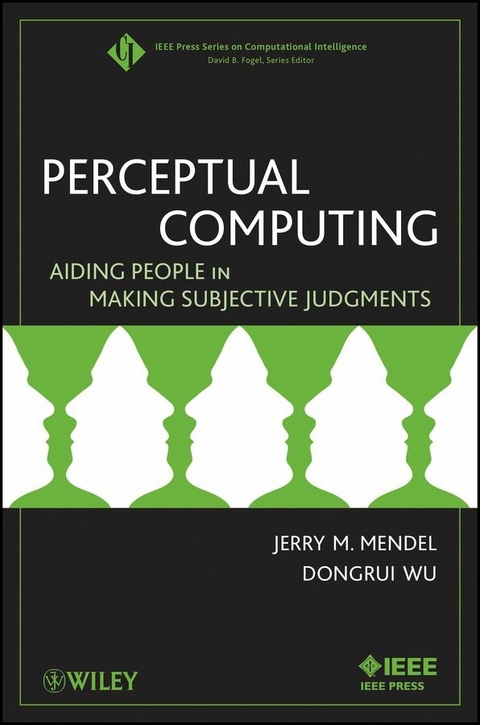
Perceptual Computing (eBook)
John Wiley & Sons (Verlag)
978-0-470-59963-1 (ISBN)
Lotfi Zadeh, the father of fuzzy logic, coined the phrase 'computing with words' (CWW) to describe a methodology in which the objects of computation are words and propositions drawn from a natural language. Perceptual Computing explains how to implement CWW to aid in the important area of making subjective judgments, using a methodology that leads to an interactive device—a 'Perceptual Computer'—that propagates random and linguistic uncertainties into the subjective judgment in a way that can be modeled and observed by the judgment maker.
This book focuses on the three components of a Perceptual Computer—encoder, CWW engines, and decoder—and then provides detailed applications for each. It uses interval type-2 fuzzy sets (IT2 FSs) and fuzzy logic as the mathematical vehicle for perceptual computing, because such fuzzy sets can model first-order linguistic uncertainties whereas the usual kind of fuzzy sets cannot. Drawing upon the work on subjective judgments that Jerry Mendel and his students completed over the past decade, Perceptual Computing shows readers how to:
Map word-data with its inherent uncertainties into an IT2 FS that captures these uncertainties
Use uncertainty measures to quantify linguistic uncertainties
Compare IT2 FSs by using similarity and rank
Compute the subsethood of one IT2 FS in another such set
Aggregate disparate data, ranging from numbers to uniformly weighted intervals to nonuniformly weighted intervals to words
Aggregate multiple-fired IF-THEN rules so that the integrity of word IT2 FS models is preserved
Free MATLAB-based software is also available online so readers can apply the methodology of perceptual computing immediately, and even try to improve upon it. Perceptual Computing is an important go-to for researchers and students in the fields of artificial intelligence and fuzzy logic, as well as for operations researchers, decision makers, psychologists, computer scientists, and computational intelligence experts.
Jerry M. Mendel is Professor of Electrical Engineering at the University of Southern California. A Life Fellow of the IEEE and a Distinguished Member of the IEEE Control Systems Society, Mendel is also the recipient of many awards for his diverse research, including the IEEE Centennial Medal, the Fuzzy Systems Pioneer Award from the IEEE Computational Intelligence Society, and the IEEE Third Millennium Medal.
Dongrui Wu is a Postdoctoral Research Associate at the University of Southern California, where he recently obtained his PhD in electrical engineering.
Explains for the first time how "e;computing with words"e; can aid in making subjective judgments Lotfi Zadeh, the father of fuzzy logic, coined the phrase "e;computing with words"e; (CWW) to describe a methodology in which the objects of computation are words and propositions drawn from a natural language. Perceptual Computing explains how to implement CWW to aid in the important area of making subjective judgments, using a methodology that leads to an interactive device a "e;Perceptual Computer"e; that propagates random and linguistic uncertainties into the subjective judgment in a way that can be modeled and observed by the judgment maker. This book focuses on the three components of a Perceptual Computer encoder, CWW engines, and decoder and then provides detailed applications for each. It uses interval type-2 fuzzy sets (IT2 FSs) and fuzzy logic as the mathematical vehicle for perceptual computing, because such fuzzy sets can model first-order linguistic uncertainties whereas the usual kind of fuzzy sets cannot. Drawing upon the work on subjective judgments that Jerry Mendel and his students completed over the past decade, Perceptual Computing shows readers how to: Map word-data with its inherent uncertainties into an IT2 FS that captures these uncertainties Use uncertainty measures to quantify linguistic uncertainties Compare IT2 FSs by using similarity and rank Compute the subsethood of one IT2 FS in another such set Aggregate disparate data, ranging from numbers to uniformly weighted intervals to nonuniformly weighted intervals to words Aggregate multiple-fired IF-THEN rules so that the integrity of word IT2 FS models is preserved Free MATLAB-based software is also available online so readers can apply the methodology of perceptual computing immediately, and even try to improve upon it. Perceptual Computing is an important go-to for researchers and students in the fields of artificial intelligence and fuzzy logic, as well as for operations researchers, decision makers, psychologists, computer scientists, and computational intelligence experts.
Jerry M. Mendel is Professor of Electrical Engineering at the University of Southern California. A Life Fellow of the IEEE and a Distinguished Member of the IEEE Control Systems Society, Mendel is also the recipient of many awards for his diverse research, including the IEEE Centennial Medal, the Fuzzy Systems Pioneer Award from the IEEE Computational Intelligence Society, and the IEEE Third Millennium Medal. Dongrui Wu is a Postdoctoral Research Associate at the University of Southern California, where he recently obtained his PhD in electrical engineering.
Preface.
1 Introduction.
1.1 Perceptual Computing.
1.2 Examples.
1.3 Historical Origins of Perceptual Computing.
1.4 How to Validate the Perceptual Computer.
1.5 The Choice of Fuzzy Set Models for the Per-C.
1.6 Keeping the Per-C as Simple as Possible.
1.7 Coverage of the Book.
1.8 High-Level Synopses of Technical Details.
References.
2 Interval Type-2 Fuzzy Sets.
2.1 A Brief Review of Type-1 Fuzzy Sets.
2.2 Introduction to Interval Type-2 Fuzzy Sets.
2.3 Definitions.
2.4 Wavy-Slice Representation Theorem.
2.5 Set-Theoretic Operations.
2.6 Centroid of an IT2 FS.
2.7 KM Algorithms.
2.8 Cardinality and Average Cardinality of an IT2 FS.
2.9 Final Remark.
Appendix 2A. Derivation of the Union of Two IT2 FSs.
Appendix 2B. Enhanced KM (EKM) Algorithms.
References.
3 Encoding: From a Word to a Model--TheCodebook.
3.1 Introduction.
3.2 Person FOU Approach for a Group of Subjects.
3.3 Collecting Interval End-Point Data.
3.4 Interval End-Points Approach.
3.5 Interval Approach.
3.6 Hedges.
Appendix 3A. Methods for Eliciting T1 MF Information FromSubjects.
Appendix 3B. Derivation of Reasonable Interval Test.
References.
4 Decoding: From FOUs to a Recommendation.
4.1 Introduction.
4.2 Similarity Measure Used as a Decoder.
4.3 Ranking Method Used as a Decoder.
4.4 Classifier Used as a Decoder.
5 Novel Weighted Averages as a CWW Engine.
5.1 Introduction.
5.2 Novel Weighted Averages.
5.3 Interval Weighted Average.
5.4 Fuzzy Weighted Average.
5.5 Linguistic Weighted Average.
5.6 A Special Case of the LWA.
5.7 Fuzzy Extensions of Ordered Weighted Averages.
6 IF-THEN Rules as a CWW Engine--PerceptualReasoning.
6.1 Introduction.
6.2 A Brief Overview of Interval Type-2 Fuzzy Logic Systems.
6.3 Perceptual Reasoning: Computations.
6.4 Perceptual Reasoning: Properties.
7 Assisting in Making Investment Choices--InvestmentJudgment Advisor (IJA).
7.1 Introduction.
7.2 Encoder for the IJA.
7.3 Reduction of the Codebooks to User-Friendly Codebooks.
7.4 CWW Engine for the IJA.
7.5 Decoder for the IJA.
7.6 Examples.
7.7 Interactive Software for the IJA.
7.8 Conclusions.
References.
8 Assisting in Making Social Judgments--Social JudgmentAdvisor (SJA).
8.1 Introduction.
8.2 Design an SJA.
8.3 Using an SJA.
8.4 Discussion.
8.5 Conclusions.
References.
9 Assisting in Hierarchical Decision Making--ProcurementJudgment Advisor (PJA).
9.1 Introduction.
9.2 Missile Evaluation Problem Statement.
9.3 Per-C for Missile Evaluation: Design.
9.4 Per-C for Missile Evaluation: Examples.
9.5 Comparison with Previous Approaches.
9.6 Conclusions.
Appendix 9A: Some Hierarchical Multicriteria Decision-MakingApplications.
References.
10 Assisting in Hierarchical and Distributed DecisionMaking-- Journal Publication Judgment Advisor (JPJA)/
10.1 Introduction.
10.2 The Journal Publication Judgment Advisor (JPJA).
10.3 Per-C for the JPJA.
10.4 Examples.
10.4.5 Complete Reviews.
10.5 Conclusions.
Reference.
11 Conclusions.
11.1 Perceptual Computing Methodology.
11.2 Proposed Guidelines for Calling Something CWW.
Index.
| Erscheint lt. Verlag | 16.7.2010 |
|---|---|
| Reihe/Serie | IEEE Press Series on Computational Intelligence |
| IEEE Press Series on Computational Intelligence | IEEE Press Series on Computational Intelligence |
| Sprache | englisch |
| Themenwelt | Informatik ► Theorie / Studium ► Künstliche Intelligenz / Robotik |
| Technik ► Elektrotechnik / Energietechnik | |
| Schlagworte | Artificial Intelligence • Computer Science • Computer Science - General Interest • Computing With Words • Electrical & Electronics Engineering • Elektrotechnik u. Elektronik • Fuzzy Logic • Fuzzy-Logik • fuzzy set models • Fuzzy-Systeme • Fuzzy Systems • hierarchical decision making • IEEE • ieee book • ieee centennial medal • ieee series • Informatik • Intelligente Systeme u. Agenten • Intelligent Systems & Agents • IT2FS • jerry mendel • Künstliche Intelligenz • Künstliche Intelligenz • perceptual computer • Populäre Themen i. d. Informatik • Populäre Themen i. d. Informatik • procurement judgment advisor • subjective judgment AI • type-1 fuzzy sets • Type-2 Fuzzy Sets • validate perceptual computer |
| ISBN-10 | 0-470-59963-4 / 0470599634 |
| ISBN-13 | 978-0-470-59963-1 / 9780470599631 |
| Informationen gemäß Produktsicherheitsverordnung (GPSR) | |
| Haben Sie eine Frage zum Produkt? |
 PDF (Adobe DRM)
Kopierschutz: Adobe-DRM
Adobe-DRM ist ein Kopierschutz, der das eBook vor Mißbrauch schützen soll. Dabei wird das eBook bereits beim Download auf Ihre persönliche Adobe-ID autorisiert. Lesen können Sie das eBook dann nur auf den Geräten, welche ebenfalls auf Ihre Adobe-ID registriert sind.
Details zum Adobe-DRM
Dateiformat: PDF (Portable Document Format)
Mit einem festen Seitenlayout eignet sich die PDF besonders für Fachbücher mit Spalten, Tabellen und Abbildungen. Eine PDF kann auf fast allen Geräten angezeigt werden, ist aber für kleine Displays (Smartphone, eReader) nur eingeschränkt geeignet.
Systemvoraussetzungen:
PC/Mac: Mit einem PC oder Mac können Sie dieses eBook lesen. Sie benötigen eine
eReader: Dieses eBook kann mit (fast) allen eBook-Readern gelesen werden. Mit dem amazon-Kindle ist es aber nicht kompatibel.
Smartphone/Tablet: Egal ob Apple oder Android, dieses eBook können Sie lesen. Sie benötigen eine
Geräteliste und zusätzliche Hinweise
Buying eBooks from abroad
For tax law reasons we can sell eBooks just within Germany and Switzerland. Regrettably we cannot fulfill eBook-orders from other countries.
aus dem Bereich