


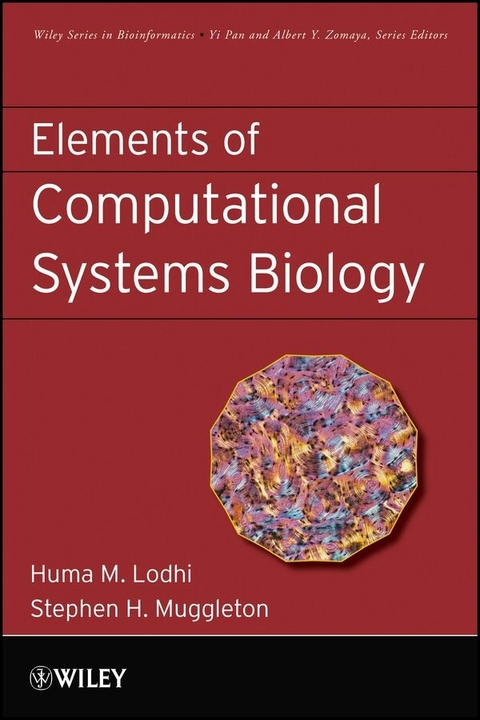
Elements of Computational Systems Biology (eBook)
John Wiley & Sons (Verlag)
978-0-470-55674-0 (ISBN)
Groundbreaking, long-ranging research in this emergent field that enables solutions to complex biological problems
Computational systems biology is an emerging discipline that is evolving quickly due to recent advances in biology such as genome sequencing, high-throughput technologies, and the recent development of sophisticated computational methodologies. Elements of Computational Systems Biology is a comprehensive reference covering the computational frameworks and techniques needed to help research scientists and professionals in computer science, biology, chemistry, pharmaceutical science, and physics solve complex biological problems. Written by leading experts in the field, this practical resource gives detailed descriptions of core subjects, including biological network modeling, analysis, and inference; presents a measured introduction to foundational topics like genomics; and describes state-of-the-art software tools for systems biology.
Offers a coordinated integrated systems view of defining and applying computational and mathematical tools and methods to solving problems in systems biology
Chapters provide a multidisciplinary approach and range from analysis, modeling, prediction, reasoning, inference, and exploration of biological systems to the implications of computational systems biology on drug design and medicine
Helps reduce the gap between mathematics and biology by presenting chapters on mathematical models of biological systems
Establishes solutions in computer science, biology, chemistry, and physics by presenting an in-depth description of computational methodologies for systems biology
Elements of Computational Systems Biology is intended for academic/industry researchers and scientists in computer science, biology, mathematics, chemistry, physics, biotechnology, and pharmaceutical science. It is also accessible to undergraduate and graduate students in machine learning, data mining, bioinformatics, computational biology, and systems biology courses.
HUMA M. LODHI, PhD, MBCS, is a researcher with the Department of Computing, Imperial College London. She has studied at Royal Holloway, University of London and has previously worked as a researcher with the Department of Computer Science, University of Sheffield.
STEPHEN H. MUGGLETON, PhD, FAAAI, is a Professor of Machine Learning, Department of Computing, Imperial College London, and is the Director of Modeling, BBSRC Centre for Integrative Systems Biology, Imperial College London. He is a Fellow of the American Association for Artificial Intelligence and was a professor of machine learning, Department of Computing, University of York.
Both editors have published in leading international conferences and journals.
Groundbreaking, long-ranging research in this emergent field that enables solutions to complex biological problems Computational systems biology is an emerging discipline that is evolving quickly due to recent advances in biology such as genome sequencing, high-throughput technologies, and the recent development of sophisticated computational methodologies. Elements of Computational Systems Biology is a comprehensive reference covering the computational frameworks and techniques needed to help research scientists and professionals in computer science, biology, chemistry, pharmaceutical science, and physics solve complex biological problems. Written by leading experts in the field, this practical resource gives detailed descriptions of core subjects, including biological network modeling, analysis, and inference; presents a measured introduction to foundational topics like genomics; and describes state-of-the-art software tools for systems biology. Offers a coordinated integrated systems view of defining and applying computational and mathematical tools and methods to solving problems in systems biology Chapters provide a multidisciplinary approach and range from analysis, modeling, prediction, reasoning, inference, and exploration of biological systems to the implications of computational systems biology on drug design and medicine Helps reduce the gap between mathematics and biology by presenting chapters on mathematical models of biological systems Establishes solutions in computer science, biology, chemistry, and physics by presenting an in-depth description of computational methodologies for systems biology Elements of Computational Systems Biology is intended for academic/industry researchers and scientists in computer science, biology, mathematics, chemistry, physics, biotechnology, and pharmaceutical science. It is also accessible to undergraduate and graduate students in machine learning, data mining, bioinformatics, computational biology, and systems biology courses.
HUMA M. LODHI, PhD, MBCS, is a researcher with the Department of Computing, Imperial College London. She has studied at Royal Holloway, University of London and has previously worked as a researcher with the Department of Computer Science, University of Sheffield. STEPHEN H. MUGGLETON, PhD, FAAAI, is a Professor of Machine Learning, Department of Computing, Imperial College London, and is the Director of Modeling, BBSRC Centre for Integrative Systems Biology, Imperial College London. He is a Fellow of the American Association for Artificial Intelligence and was a professor of machine learning, Department of Computing, University of York. Both editors have published in leading international conferences and journals.
Preface.
Contributors.
PART I: OVERVIEW.
1 Advances in Computational Systems Biology (Huma M.
Lodhi).
PART II: BIOLOGICAL NETWORK MODELING.
2 Models in Systems Biology: The Parameter Problem and the
Meanings of Robustness (Jeremy Gunawardena).
3 In Silico Analysis of Combined Therapeutics Strategy for
Hearth Failure (Sung-Young Shin, Tae-Hwan Kim, Kwang-Hyun Cho,
and Sang-Mok Choo).
4 Rule-Based Modeling and Model Refinement (Elaine Murphy,
Vincent Danos, Jerome Feret, Jean Krivine, and Russell
Harmer).
5 A (Natural) Computing Perspective on Cellular Processes
(Mateo Cavaliere and Tommaso Mazza).
6 Simulating Filament Dynamics in Cellular Systems (Wilbur E.
Channels and Pablo A. Iglesias).
PART III: BIOLOGICAL NETWORK INFERENCE.
7 Reconstruction of Biological Networks by Supervised Machine
Learning Approaches (Jean-Philippe Vert).
8 Supervised Inference of Metabolic Networks from the
Integration of Genomic Data and Chemical Information (Yoshihiro
Yamanishi).
9 Integrating Abduction and Induction in Biological Inference
Using CF-Induciton (Yoshitaka Yamamoto, Katsumi Inoue, and
Andrei Doncescu).
10 Analysis and Control of Deterministic and Probabilistic
Boolean Networks (Tatsuya Akutsu and Wai-Ki Ching).
11 Probabilistic Methods and Rate Heterogeneity (Tal Pupko
and Itay Mayrose).
PART IV: GENOMICS AND COMPUTATIONAL SYSTEMS BIOLOGY.
12 From DNA Motifs to Gene Networks: A Review of Physical
Interaction Models (Panayiotis V. Benos and Alain B.
Tchagang).
13 The Impact of Whole Genome In Silico Screening for
Nuclear Receptor-Binding Sites in Systems Biology (Carsten
Carlberg and Merja Heinaniemi).
14 Environmental and Physiological Insights from Microbial
Genome Sequences (Alessandra Carbone and Anthony
Mathelier).
PART V: SOFTWARE TOOLS FOR SYSTEMS BIOLOGY.
15 Ali Baba: A Text Mining Tool for Systems Biology (Jorg
Hakenberg, Conrad Plake, and Ulf Leser).
16 Validation Issues in Regulatory Module Discovery (Alok
Mishra and Duncan Gillies).
17 Computational Imaging and Modeling for Systems Biology
(Ling-Yun Wu, Xiaobo Zhou, and Stephen T.C. Wong).
Index.
Series Information.
"The book should serve well as a resource for anyone
interested in learning about computational systems
biology." (The Quarterly Review of Biology, 1
March 2012)
| Erscheint lt. Verlag | 25.3.2010 |
|---|---|
| Reihe/Serie | Wiley Series in Bioinformatics |
| Wiley Series in Bioinformatics | Wiley Series in Bioinformatics |
| Mitarbeit |
Herausgeber (Serie): Yi Pan, Albert Y. Zomaya |
| Sprache | englisch |
| Themenwelt | Mathematik / Informatik ► Informatik ► Datenbanken |
| Mathematik / Informatik ► Informatik ► Theorie / Studium | |
| Naturwissenschaften ► Biologie | |
| Schlagworte | Bioinformatics & Computational Biology • Bioinformatik • Bioinformatik u. Computersimulationen in der Biowissenschaften • biological • Biowissenschaften • Computational • Computational Biology • Computer Science • Database & Data Warehousing Technologies • Datenbanken u. Data Warehousing • Discipline • Elements • Emergent • emerging • enables solutions • Field • Frameworks • Informatik • Life Sciences • longranging research • Mathematics • Mathematik • Mathematik in der Biologie • Methodologies • Problems • Reference • scientists • sophisticated • Systembiologie • Systems • techniques |
| ISBN-10 | 0-470-55674-9 / 0470556749 |
| ISBN-13 | 978-0-470-55674-0 / 9780470556740 |
| Informationen gemäß Produktsicherheitsverordnung (GPSR) | |
| Haben Sie eine Frage zum Produkt? |
 PDF (Adobe DRM)
Kopierschutz: Adobe-DRM
Adobe-DRM ist ein Kopierschutz, der das eBook vor Mißbrauch schützen soll. Dabei wird das eBook bereits beim Download auf Ihre persönliche Adobe-ID autorisiert. Lesen können Sie das eBook dann nur auf den Geräten, welche ebenfalls auf Ihre Adobe-ID registriert sind.
Details zum Adobe-DRM
Dateiformat: PDF (Portable Document Format)
Mit einem festen Seitenlayout eignet sich die PDF besonders für Fachbücher mit Spalten, Tabellen und Abbildungen. Eine PDF kann auf fast allen Geräten angezeigt werden, ist aber für kleine Displays (Smartphone, eReader) nur eingeschränkt geeignet.
Systemvoraussetzungen:
PC/Mac: Mit einem PC oder Mac können Sie dieses eBook lesen. Sie benötigen eine
eReader: Dieses eBook kann mit (fast) allen eBook-Readern gelesen werden. Mit dem amazon-Kindle ist es aber nicht kompatibel.
Smartphone/Tablet: Egal ob Apple oder Android, dieses eBook können Sie lesen. Sie benötigen eine
Geräteliste und zusätzliche Hinweise
Buying eBooks from abroad
For tax law reasons we can sell eBooks just within Germany and Switzerland. Regrettably we cannot fulfill eBook-orders from other countries.
aus dem Bereich


