DALTON CERVO is Senior Solutions Consultant at DataFlux Corporation, assisting customers with master data management, data governance, and data quality implementations.¿Prior to joining DataFlux, Dalton was a senior program manager at both Sun Microsystems and Oracle, leading the data quality efforts as a member of the data governance team responsible for defining policies and procedures governing the oversight of master customer data. He is an expert panelist and a featured blogger for Data Quality PRO and a contributing author in The Next Wave of Technologies: Opportunities in Chaos (Wiley).
MARK ALLEN is a Senior Consultant and Enterprise Data Governance Lead at WellPoint, Inc. Prior to joining WellPoint, Mark was a senior program manager in customer operations groups at both Sun Microsystems and Oracle. Mark has led Sun's Customer Data Governance Board and has been a member of customer advisory boards for DataFlux, Oracle, and Dun & Bradstreet, where he was a presenter and panel member for various data governance and master data management events and forums.
Please visit their website at www.mdm-in-practice.com.
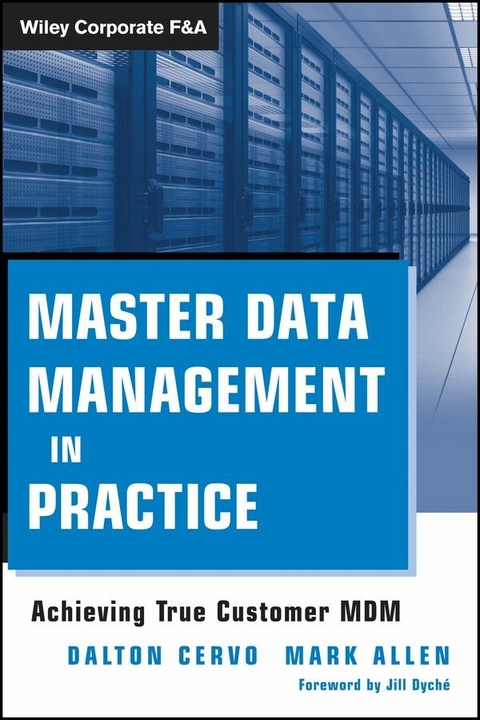
In this book, authors Dalton Cervo and Mark Allen show you how to implement Master Data Management (MDM) within your business model to create a more quality controlled approach. Focusing on techniques that can improve data quality management, lower data maintenance costs, reduce corporate and compliance risks, and drive increased efficiency in customer data management practices, the book will guide you in successfully managing and maintaining your customer master data. You'll find the expert guidance you need, complete with tables, graphs, and charts, in planning, implementing, and managing MDM.
DALTON CERVO is Senior Solutions Consultant at DataFlux Corporation, assisting customers with master data management, data governance, and data quality implementations.??Prior to joining DataFlux, Dalton was a senior program manager at both Sun Microsystems and Oracle, leading the data quality efforts as a member of the data governance team responsible for defining policies and procedures governing the oversight of master customer data. He is an expert panelist and a featured blogger for Data Quality PRO and a contributing author in The Next Wave of Technologies: Opportunities in Chaos (Wiley). MARK ALLEN is a Senior Consultant and Enterprise Data Governance Lead at WellPoint, Inc. Prior to joining WellPoint, Mark was a senior program manager in customer operations groups at both Sun Microsystems and Oracle. Mark has led Sun's Customer Data Governance Board and has been a member of customer advisory boards for DataFlux, Oracle, and Dun & Bradstreet, where he was a presenter and panel member for various data governance and master data management events and forums. Please visit their website at www.mdm-in-practice.com.
Introduction
Today's business environment requires companies to find a way to differentiate themselves from their competition and thrive amid increased pressure to succeed. While a company's data is obviously extremely important to drive and gauge success, the data is often poorly organized and underutilized due to quality and consistency issues. This can be particularly true with master data.
Master data provides a foundation and a connecting function for business intelligence (BI) by the way in which it interacts and connects with transactional data from multiple business areas such as sales, service, order management, purchasing, manufacturing, billing, accounts receivable, and accounts payable (AP). Master data consists of information critical to a company's operations and BI, and is usually categorized into master data entity areas (also often referred to as data domains) such as customers, products, suppliers, partners, employees, materials, and so on. While often nontransactional in nature, master data is utilized in most transactional processes and operations, and serves BI by providing data for analytics and reporting. Although defined as master data, this data often exists in duplicate, fragmented, and inconsistent forms in disparate systems across the organization and typically lacks a common data management approach.
Master Data Management (MDM) practices have arisen primarily to address these data quality and fragmentation issues. For years, there has been a huge proliferation of data due to cheap storage and increased digitization. Furthermore, compartmentalized solutions have added to the fragmentation of information considerably, magnifying data duplication and lack of a common entity identification. Organizations came to the realization that the most effective way to address this growing problem is by creating a single source approach for management of master data based on high standards of quality and governance serving the entire business.
Unfortunately, this is easier said than done. At the root of these data quality issues is the well-acknowledged garbage in, garbage out (GIGO) problem from which most legacy environments still suffer. This persistent problem creates the underlying enterprise data management challenge that MDM is focused on addressing. Historically, data management focuses centered in Data Warehouse, Customer Relationship Management (CRM), and Customer Data Integration (CDI) practices have not actually tried to broadly solve the GIGO problem. Instead, those practices have focused primarily on the reconciliation, organization, and improvement of the data after the point of entry or just within specific process areas. Thus, the GIGO factor persists and continues to pollute the transactional data, the master data, and BI.
Although there is certainly good rationale and benefit to a back-end reconciliation and scrubbing approach, there is also a consequence whereby these practices themselves can create yet more process or context-specific fragmentation moving enterprise data further from a system of record and source of truth. CDI practices are geared more toward a source of truth outcome but CDI is still often implemented just with specific data environments. In spite of the limitations or data specific application, these types of data management practices have set the stage for what is now being recognized with MDM as a more holistic set of techniques and approaches that can span business practices and aim at developing enterprise-wide data quality management and governance practices.
It is fair to point out that MDM practices are not likely, nor should they be expected, to fully eliminate the GIGO problem. Instead, through focus on improving the control and consistency of the master data shared by both the operational and business intelligence processes, and through data governance-driven policies and standards aimed at improving the data management practices associated with a data entity area, the degree and impact of the GIGO problems can be greatly minimized. This focus around gaining control and management of the shared data is a key concept also described in various data governance maturity models that illustrate how data management practices have been evolving from undisciplined or independently oriented application practices toward MDM disciplines focused on enterprise-wide data integration and governance models supported by ubiquitous oriented technologies and best practices.
Many excellent books have been published that address the what and why aspects of MDM, and dive into key topic areas that distinguish MDM in the data management space. These publications have established the overall recognition, definition, and the value proposition that is driving companies to consider and position MDM initiatives in their business and IT strategies. There are a number of books we highly recommend. Please refer to the Recommended Reading section of this book for specific recommendations.
When navigating through a topic such as MDM, it is not unexpected to find variation in the specific context and definition. We feel that the following Gartner definition and context best articulates MDM:
Master data management is a technology-enabled business discipline that helps organizations achieve a “single version of the truth” in such important areas as customers, products and accounts.
In MDM, the business and the IT organization work together to ensure the uniformity, accuracy, semantic persistence, stewardship and accountability of the enterprise's official, shared master data. Organizations apply MDM to eliminate endless, time-consuming debates about “whose data is right,” which can lead to poor decision making and business performance.1
Although the MDM movement is well underway, how to develop the business discipline and how business and IT work together to enable this is still very much a topic for debate and often a work in progress dynamic as an MDM initiative takes shape. A closer look across the MDM market reveals a lack of much practical instruction for MDM planning and implementation from a business practice perspective. How the business needs to be engaged to create the business discipline has not been well articulated.
The lack of this type of instruction is actually not a new or unique problem in the data management arena. Consider that just as data management has traditionally been centered in more application and IT-oriented practices, the planning and instructional aspects of data management have also been tailored to specific application or vendor product scenarios and usually stem from vendor literature, consultant material and white papers, or simply from self-discovery. Unfortunately, though, growth and execution of MDM as a business practice will continue to be subject to a slow and unpaved road if the business planning and implementation teams continue to be faced with too much self-discovery where the vendor or consultant material comes up short.
When the practitioners of MDM come together at conferences or in community forums, there is quick recognition that many of their MDM needs and initiatives are centered around the execution of fundamentally common practices and techniques with the variation only in the implementation approach and the adaptation of these practices and techniques to the specific environments, infrastructure, and business models within their company. Most practitioners will also indicate that had they garnered a better fundamental understanding of MDM practices along with more “under the hood” insight to guide their approach and techniques, their implementation and adaptation efforts could have been better focused and handled more effectively.
The main challenge with bridging this instructional gap is simply in determining a good starting point. Although MDM discipline can be applied to various data domains, any of which can present significant data management problems in a company, a common starting point where an MDM initiative is usually most critically needed, and will initially be considered, is with the customer data domain commonly referred to as Customer MDM.
Customer MDM is where we have cultivated our MDM experiences, perspectives, and solutions that we present in this book. Our backgrounds span many years of both business and IT experience primarily with Sun Microsystems and later with Oracle, and also reflect the data integration experience we have had in relation to companies Sun had acquired and from the acquisition of Sun itself by Oracle. As with all large multinational companies, there are huge data management challenges that emerge over the years as companies grow, constrict, acquire other companies, face new competitive challenges, transition from old system infrastructure to new platforms, and are subject to increasing requirements regarding security, information privacy, government regulations, and compliance.
Because any of these conditions can be very disruptive, companies that maintain a flexible and fluid dynamic between the business and IT roles will be most able to adapt quickly to address these challenges. The flexibility and adaptability needed here has to be an existing dynamic within specific roles and responsibilities, and doesn't just happen with initiating a new project or a consulting engagement. This dynamic needs to be demonstrated by dedicated managers, data stewards, and data analysts working closely together across business and IT lines under data governance authority to address these data management challenges while also minimizing disruption to the normal operational practices.
It has been our...
| Erscheint lt. Verlag | 25.5.2011 |
|---|---|
| Reihe/Serie | Wiley Corporate F&A |
| Wiley Corporate F&A | Wiley Corporate F&A |
| Vorwort | Jill Dyché |
| Sprache | englisch |
| Themenwelt | Mathematik / Informatik ► Mathematik ► Finanz- / Wirtschaftsmathematik |
| Wirtschaft ► Betriebswirtschaft / Management ► Marketing / Vertrieb | |
| Wirtschaft ► Betriebswirtschaft / Management ► Unternehmensführung / Management | |
| Schlagworte | Analytical MDM • Business & Management • CRM • customer data integration • Customer MDM • Customer Relationship Management • Dalton Cervo • Dalton Cervo, Mark Allen, data management, master data management, MDM, customer data integration, data quality, data stewardship, data governance, data access management, customer relationship management, CRM, Customer MDM, Operational MDM, Analytical MDM, Enterprise MDM, data cleansing, data profiling, data duplication, metadata • data access management • data cleansing • Data duplication • data governance • Data Management • Data Profiling • Data Quality • data stewardship • Enterprise MDM • Mark Allen • Master Data Management • MDM • Metadata • Operational MDM • Strategic Management • Strategisches Management • Wirtschaft u. Management |
| ISBN-13 | 9781118085660 / 9781118085660 |
| Informationen gemäß Produktsicherheitsverordnung (GPSR) | |
| Haben Sie eine Frage zum Produkt? |
 PDF (Adobe DRM)
Kopierschutz: Adobe-DRM
Adobe-DRM ist ein Kopierschutz, der das eBook vor Mißbrauch schützen soll. Dabei wird das eBook bereits beim Download auf Ihre persönliche Adobe-ID autorisiert. Lesen können Sie das eBook dann nur auf den Geräten, welche ebenfalls auf Ihre Adobe-ID registriert sind.
Details zum Adobe-DRM
Dateiformat: PDF (Portable Document Format)
Mit einem festen Seitenlayout eignet sich die PDF besonders für Fachbücher mit Spalten, Tabellen und Abbildungen. Eine PDF kann auf fast allen Geräten angezeigt werden, ist aber für kleine Displays (Smartphone, eReader) nur eingeschränkt geeignet.
Systemvoraussetzungen:
PC/Mac: Mit einem PC oder Mac können Sie dieses eBook lesen. Sie benötigen eine
eReader: Dieses eBook kann mit (fast) allen eBook-Readern gelesen werden. Mit dem amazon-Kindle ist es aber nicht kompatibel.
Smartphone/Tablet: Egal ob Apple oder Android, dieses eBook können Sie lesen. Sie benötigen eine
Geräteliste und zusätzliche Hinweise
Buying eBooks from abroad
For tax law reasons we can sell eBooks just within Germany and Switzerland. Regrettably we cannot fulfill eBook-orders from other countries.
aus dem Bereich