


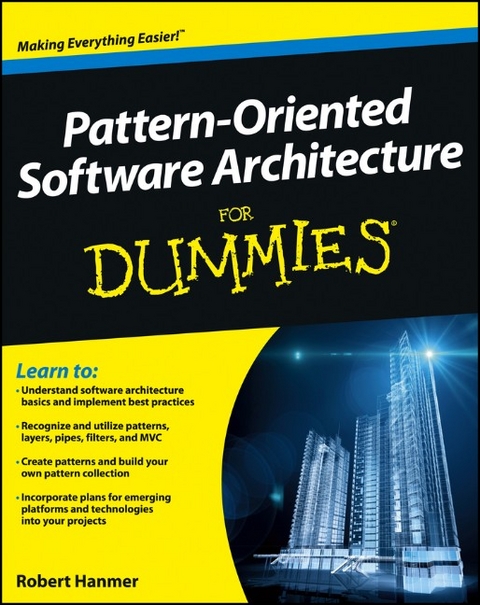
Pattern-Oriented Software Architecture For Dummies (eBook)
384 Seiten
John Wiley & Sons (Verlag)
9781119966319 (ISBN)
up
Imagine how much easier it would be to solve a programming
problem, if you had access to the best practices from all the top
experts in the field, and you could follow the best design patterns
that have evolved through the years. Well, now you can. This unique
book offers development solutions ranging from high-level
architectural patterns, to design patterns that apply to specific
problems encountered after the overall structure has been designed,
to idioms in specific programming languages--all in one,
accessible, guide. Not only will you improve your understanding of
software design, you'll also improve the programs you create and
successfully take your development ideas to the next level.
* Pulls together the best design patterns and best practices for
software design into one accessible guide to help you improve your
programming projects
* Helps you avoid re-creating the wheel and also meet the
ever-increasing pace of rev cycles, as well as the ever-increasing
number of new platforms and technologies for mobile, web, and
enterprise computing
* Fills a gap in the entry-level POSA market, as well as a need
for guidance in implementing best practices from the ground up
Save time and avoid headaches with your software development
projects with Pattern-Oriented Software Architecture For
Dummies.
Robert Hanmer is a Consulting Member of Technical Staff at Alcatel-Lucent. His work has included development, architecture, and evaluation of highly reliable systems for today's telephone network. He has been a prominent member of the software patterns community since the mid-1990s.
Introduction 1
Part I: Introducing Software Architecture and Patterns
7
Chapter 1: Software Architecture Basics 9
Chapter 2: Where Do Architectures Come From? 25
Chapter 3: What Do Software Architectures Look Like? 37
Chapter 4: Software Pattern Basics 55
Chapter 5: Seeing How Patterns Are Made and Used 73
Part II: Putting Patterns to Work 83
Chapter 6: Making Sense of Patterns 85
Chapter 7: Building Your Own Pattern Catalog 95
Chapter 8: Choosing a Pattern 103
Part III: Creating Your Application Architecture 115
Chapter 9: Building Functionality in Layers 117
Chapter 10: Piping Your Data through Filters 137
Chapter 11: Sharing Knowledge and Results on a Blackboard
151
Chapter 12: Coordinating Communication through a Broker 171
Chapter 13: Structuring Your Interactive Application with
Model-View-Controller 189
Chapter 14: Layering Interactive Agents with
Presentation-Abstraction-Control 209
Chapter 15: Putting Key Functions in a Microkernel 229
Chapter 16: Refl ecting and Adapting 245
Part IV: Designing with Other POSA Patterns 263
Chapter 17: Decomposing the System's Structure 265
Chapter 18: Making a Component the Master 271
Chapter 19: Controlling Access 277
Chapter 20: Managing the System 285
Chapter 21: Enhancing Interprocess Communication 295
Chapter 22: Counting the Number of References 309
Part V: The Part of Tens 319
Chapter 23: Ten Patterns You Should Know 321
Chapter 24 Ten Places to Look for Patterns 327
Chapter 25: Ten Ways to Get Involved with the Pattern Community
333
Index 339
| Erscheint lt. Verlag | 7.12.2012 |
|---|---|
| Sprache | englisch |
| Themenwelt | Mathematik / Informatik ► Informatik ► Programmiersprachen / -werkzeuge |
| Schlagworte | Computer Science • Informatik • Object Technologies • Objektorientiertes Programmieren |
| ISBN-13 | 9781119966319 / 9781119966319 |
| Informationen gemäß Produktsicherheitsverordnung (GPSR) | |
| Haben Sie eine Frage zum Produkt? |
 EPUB (Adobe DRM)
Kopierschutz: Adobe-DRM
Adobe-DRM ist ein Kopierschutz, der das eBook vor Mißbrauch schützen soll. Dabei wird das eBook bereits beim Download auf Ihre persönliche Adobe-ID autorisiert. Lesen können Sie das eBook dann nur auf den Geräten, welche ebenfalls auf Ihre Adobe-ID registriert sind.
Details zum Adobe-DRM
Dateiformat: EPUB (Electronic Publication)
EPUB ist ein offener Standard für eBooks und eignet sich besonders zur Darstellung von Belletristik und Sachbüchern. Der Fließtext wird dynamisch an die Display- und Schriftgröße angepasst. Auch für mobile Lesegeräte ist EPUB daher gut geeignet.
Systemvoraussetzungen:
PC/Mac: Mit einem PC oder Mac können Sie dieses eBook lesen. Sie benötigen eine
eReader: Dieses eBook kann mit (fast) allen eBook-Readern gelesen werden. Mit dem amazon-Kindle ist es aber nicht kompatibel.
Smartphone/Tablet: Egal ob Apple oder Android, dieses eBook können Sie lesen. Sie benötigen eine
Geräteliste und zusätzliche Hinweise
Buying eBooks from abroad
For tax law reasons we can sell eBooks just within Germany and Switzerland. Regrettably we cannot fulfill eBook-orders from other countries.
aus dem Bereich


