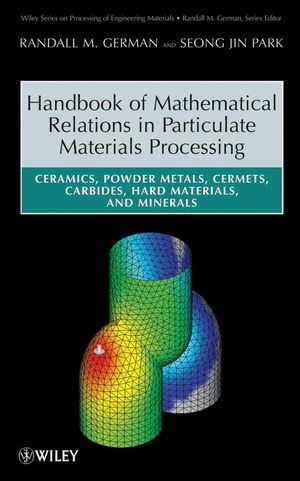
Handbook of Mathematical Relations in Particulate Materials Processing (eBook)
464 Seiten
John Wiley & Sons (Verlag)
978-0-470-36872-5 (ISBN)
particulate materials processing
The National Science Foundation estimates that over 35% of
materials-related funding is now directed toward modeling. In part,
this reflects the increased knowledge and the high cost of
experimental work. However, currently there is no organized
reference book to help the particulate materials community with
sorting out various relations. This book fills that important need,
providing readers with a quick-reference handbook for easy
consultation.
This one-of-a-kind handbook gives readers the relevant
mathematical relations needed to model behavior, generate computer
simulations, analyze experiment data, and quantify physical and
chemical phenomena commonly found in particulate materials
processing. It goes beyond the traditional barriers of only one
material class by covering the major areas in ceramics, cemented
carbides, powder metallurgy, and particulate materials. In many
cases, the governing equations are the same but the terms are
material-specific. To rise above these differences, the authors
have assembled the basic mathematics around the following topical
structure:
* Powder technology relations, such as those encountered in
atomization, milling, powder production, powder characterization,
mixing, particle packing, and powder testing
* Powder processing, such as uniaxial compaction, injection
molding, slurry and paste shaping techniques, polymer pyrolysis,
sintering, hot isostatic pressing, and forging, with accompanying
relations associated with microstructure development and
microstructure coarsening
* Finishing operations, such as surface treatments, heat
treatments, microstructure analysis, material testing, data
analysis, and structure-property relations
Handbook of Mathematical Relations in Particulate Materials
Processing is suited for quick reference with stand-alone
definitions, making it the perfect complement to existing resources
used by academic researchers, corporate product and process
developers, and various scientists, engineers, and technicians
working in materials processing.
Randall M. German, PhD, is the CAVS Chair Professor of Mechanical Engineering and Director of the Center for Advanced Vehicular Systems at Mississippi State University. He holds an Honorary Doctorate from the Universidad Carlos III de Madrid in Spain, is a Fellow of APMI and ASM, holds the Tesla Medal, and is listed in various issues of Who's Who. His accomplishments comprise 850 published articles, twenty-three issued patents, nineteen edited proceedings, and fourteen books, including Sintering Theory and Practice (Wiley). Seong Jin Park, PhD, is Associate Research Professor in the Center for Advanced Vehicular Systems at Mississippi State University. He is the recipient of numerous awards and honors, including Leading Scientists of the World and Outstanding Scientists Worldwide, both awarded by the International Biographical Centre in 2007. Dr. Park is the author of over 190 published articles and three books, holds four patents, and created four commercialized software programs. His areas of specialization and interest include materials processing technology, numerical technology, and physics.
"Suited for quick reference with stand alone definitions. It is the
perfect complement to existing
textbooks since it will simply cut to the key relations. "
(Alamogordo Daily News, 16 March 2011)
| Erscheint lt. Verlag | 20.1.2009 |
|---|---|
| Reihe/Serie | Wiley Series on Processing of Engineering Materials | Wiley Series on Processing of Engineering Materials |
| Sprache | englisch |
| Themenwelt | Mathematik / Informatik ► Mathematik ► Angewandte Mathematik |
| Naturwissenschaften ► Chemie | |
| Technik ► Maschinenbau | |
| Schlagworte | chemical engineering • Chemische Verfahrenstechnik • Materials Science • Materialwissenschaften • Mathematical Analysis • Mathematics • Mathematik • Mathematische Analyse |
| ISBN-10 | 0-470-36872-1 / 0470368721 |
| ISBN-13 | 978-0-470-36872-5 / 9780470368725 |
| Informationen gemäß Produktsicherheitsverordnung (GPSR) | |
| Haben Sie eine Frage zum Produkt? |
 PDF (Adobe DRM)
Kopierschutz: Adobe-DRM
Adobe-DRM ist ein Kopierschutz, der das eBook vor Mißbrauch schützen soll. Dabei wird das eBook bereits beim Download auf Ihre persönliche Adobe-ID autorisiert. Lesen können Sie das eBook dann nur auf den Geräten, welche ebenfalls auf Ihre Adobe-ID registriert sind.
Details zum Adobe-DRM
Dateiformat: PDF (Portable Document Format)
Mit einem festen Seitenlayout eignet sich die PDF besonders für Fachbücher mit Spalten, Tabellen und Abbildungen. Eine PDF kann auf fast allen Geräten angezeigt werden, ist aber für kleine Displays (Smartphone, eReader) nur eingeschränkt geeignet.
Systemvoraussetzungen:
PC/Mac: Mit einem PC oder Mac können Sie dieses eBook lesen. Sie benötigen eine
eReader: Dieses eBook kann mit (fast) allen eBook-Readern gelesen werden. Mit dem amazon-Kindle ist es aber nicht kompatibel.
Smartphone/Tablet: Egal ob Apple oder Android, dieses eBook können Sie lesen. Sie benötigen eine
Geräteliste und zusätzliche Hinweise
Buying eBooks from abroad
For tax law reasons we can sell eBooks just within Germany and Switzerland. Regrettably we cannot fulfill eBook-orders from other countries.
aus dem Bereich