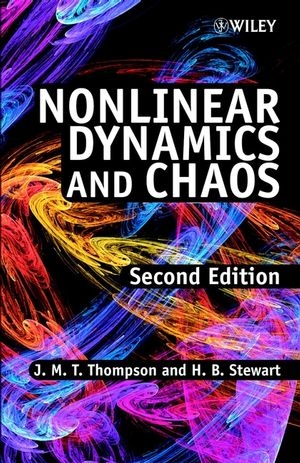
Nonlinear Dynamics and Chaos
John Wiley & Sons Inc (Verlag)
978-0-471-87684-7 (ISBN)
Nonlinear dynamics and chaos involves the study of apparent random happenings within a system or process. The subject has wide applications within mathematics, engineering, physics and other physical sciences. Since the bestselling first edition was published, there has been a lot of new research conducted in the area of nonlinear dynamics and chaos.
Expands on the bestselling, highly regarded first edition
A new chapter which will cover the new research in the area since first edition
Glossary of terms and a bibliography have been added
All figures and illustrations will be 'modernised'
Comprehensive and systematic account of nonlinear dynamics and chaos, still a fast-growing area of applied mathematics
Highly illustrated
Excellent introductory text, can be used for an advanced undergraduate/graduate course text
John Michael Tutill Thompson, born on 7 June 1937 in Cottingham, England, is an Honorary Fellow in the Department of Applied Mathematics and Theoretical Physics at the University of Cambridge. He is married with two children. H. B. Stewart is the author of Nonlinear Dynamics and Chaos, 2nd Edition, published by Wiley.
Preface vi
Preface to the First Edition xv
Acknowledgements from the First Edition xxi
1 Introduction 1
1.1 Historical background 1
1.2 Chaotic dynamics in Duffing's oscillator 3
1.3 Attractors and bifurcations 8
Part I Basic Concepts of Nonlinear Dynamics
2 An overview of nonlinear phenomena 15
2.1 Undamped, unforced linear oscillator 15
2.2 Undamped, unforced nonlinear oscillator 17
2.3 Damped, unforced linear oscillator 18
2.4 Damped, unforced nonlinear oscillator 20
2.5 Forced linear oscillator 21
2.6 Forced nonlinear oscillator: periodic attractors 22
2.7 Forced nonlinear oscillator: chaotic attractor 24
3 Point attractors in autonomous systems 26
3.1 The linear oscillator 26
3.2 Nonlinear pendulum oscillations 34
3.3 Evolving ecological systems 41
3.4 Competing point attractors 45
3.5 Attractors of a spinning satellite 47
4 Limit cycles in autonomous systems 50
4.1 The single attractor 50
4.2 Limit cycle in a neural system 51
4.3 Bifurcations of a chemical oscillator 55
4.4 Multiple limit cycles in aeroelastic galloping 58
4.5 Topology of two-dimensional phase space 61
5 Periodic attractors in driven oscillators 62
5.1 The Poincare map 62
5.2 Linear resonance 64
5.3 Nonlinear resonance 66
5.4 The smoothed variational equation 71
5.5 Variational equation for subharmonics 72
5.6 Basins ofattraction by mapping techniques 73
5.7 Resonance ofa self-exciting system 76
5.8 The ABC ofnonlinear dynamics 79
6 Chaotic attractors in forced oscillators 80
6.1 Relaxation oscillations and heartbeat 80
6.2 The Birkhoff±Shaw chaotic attractor 82
6.3 Systems with nonlinear restoring force 93
7 Stability and bifurcations of equilibria and cycles 106
7.1 Liapunov stability and structural stability 106
7.2 Centre manifold theorem 109
7.3 Local bifurcations of equilibrium paths 111
7.4 Local bifurcations of cycles 123
7.5 Basin changes at local bifurcations 126
7.6 Prediction ofincipient instability 128
Part II Iterated Maps as Dynamical Systems
8 Stability and bifurcation of maps 135
8.1 Introduction 135
8.2 Stability of one-dimensional maps 138
8.3 Bifurcations of one-dimensional maps 139
8.4 Stability of two-dimensional maps 149
8.5 Bifurcations of two-dimensional maps 156
8.6 Basin changes at local bifurcations of limit cycles 158
9 Chaotic behaviour of one- and two-dimensional maps 161
9.1 General outline 161
9.2 Theory for one-dimensional maps 164
9.3 Bifurcations to chaos 167
9.4 Bifurcation diagram of one-dimensional maps 170
9.5 HeÂnon map 174
Part III Flows, Outstructures, and Chaos
10 The geometry of recurrence 183
10.1 Finite-dimensional dynamical systems 183
10.2 Types ofrecurrent behaviour 187
10.3 Hyperbolic stability types for equilibria 195
10.4 Hyperbolic stability types for limit cycles 200
10.5 Implications ofhyperbolic structure 205
11 The Lorenz system 207
11.1 A model ofthermal convection 207
11.2 First convective instability 209
11.3 The chaotic attractor ofLorenz 214
11.4 Geometry ofa transition to chaos 222
1 2 RoÈssler's band 229
12.1 The simply folded band in an autonomous system 229
12.2 Return map and bifurcations 233
12.3 Smale's horseshoe map 238
12.4 Transverse homoclinic trajectories 243
12.5 Spatial chaos and localized buckling 246
13 Geometry of bifurcations 249
13.1 Local bifurcations 249
13.2 Global bifurcations in the phase plane 258
13.3 Bifurcations of chaotic attractors 266
Part IV Applications in the Physical Sciences
14 Subharmonic resonances of an offshore structure 285
14.1 Basic equation and non-dimensional form 286
14.2 Analytical solution for each domain 288
14.3 Digital computer program 289
14.4 Resonance response curves 290
14.5 Effect of damping 294
14.6 Computed phase projections 296
14.7 Multiple solutions and domains ofattraction 298
15 Chaotic motions of an impacting system 302
15.1 Resonance response curve 302
15.2 Application to moored vessels 306
15.3 Period-doubling and chaotic solutions 306
16 Escape from a potential well 313
16.1 Introduction 313
16.2 Analytical formulation 314
16.3 Overview ofthe steady-state response 319
16.4 The two-band chaotic attractor 324
16.5 Resonance ofthe steady states 328
16.6 Transients and basins ofattraction 333
16.7 Homoclinic phenomena 340
16.8 Heteroclinic phenomena 346
16.9 Indeterminate bifurcations 352
Appendix 359
Illustrated Glossary 369
Bibliography 402
Online Resources 428
Index 429
| Erscheint lt. Verlag | 4.2.2002 |
|---|---|
| Verlagsort | New York |
| Sprache | englisch |
| Maße | 151 x 233 mm |
| Gewicht | 680 g |
| Themenwelt | Mathematik / Informatik ► Mathematik ► Analysis |
| Mathematik / Informatik ► Mathematik ► Angewandte Mathematik | |
| ISBN-10 | 0-471-87684-4 / 0471876844 |
| ISBN-13 | 978-0-471-87684-7 / 9780471876847 |
| Zustand | Neuware |
| Informationen gemäß Produktsicherheitsverordnung (GPSR) | |
| Haben Sie eine Frage zum Produkt? |
aus dem Bereich