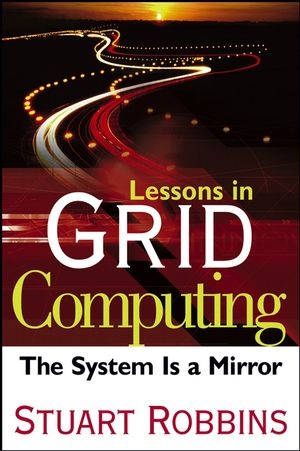
Lessons in Grid Computing (eBook)
384 Seiten
John Wiley & Sons (Verlag)
978-0-470-04750-7 (ISBN)
concept."
--Geoffrey Moore, consultant and author, Dealing with Darwin
"Since he first identified 'information systems as mirrors of the
people who build them' for me, I have seen it operate in many ways.
It is a fascinating idea, and a completely new way of thinking
about technology."
--Sean Moriarty, Chief Operating Officer, Ticketmaster
"This book makes for compelling reading--it's easy to become
immersed in the stories, and the insights gradually grow in the
reader's mind as they take root in the character's minds. This is
quite a useful work. The ideas presented here could be quickly put
to practical use in any organization."
--Mohamed Muhsin, VP and CIO, The World Bank
A breakthrough exploration of information systems as mirrors of the
people who build them.
Packed with truer-than-life stories, stimulating characters, and
unique IT analysis, Lessons in Grid Computing finally
declares:
* Our systems will not "talk to each other" if our people are not
talking to each other
* We must transform ourselves to the same degree that we want to
transform our systems
* To correct problems in our information systems, we must first
address the problems between the people that build and support
them
Discover how to adjust your management style to enable the next
generation of technologies with the help of Lessons in Grid
Computing.
STUART ROBBINS, a senior management consultant and lecturer, is the founder and Executive Director of The CIO Collective, a not-for-profit association of technology executives providing strategic guidance to emerging institutions and initiatives, including Yahoo!, Macromedia, The World Bank, the Federal CIO Council, and numerous venture capital firms on the west coast. Stuart has served on advisory boards for Encentuate, Netscaler/Citrix, DataArt, Morgan Stanley, and Ziff Davis Media, and held senior IT management positions at Cadence Design Systems, Synopsys, Inc., EMC Documentum, and Jamcracker where he served as the company's first CIO. He is a contributing author to CIO Wisdom: Best Practices from Silicon Valley's Leading IT Experts and serves on the editorial board for ISM Journal, a quarterly IT magazine in which he also writes a column entitled "Sustainable Knowledge." He holds a master's degree in fine arts from Warren Wilson College and lives in Oakland, California, with his wife, his son Max, three cats, and a golden retriever.
Foreword by Geoffrey Moore.
Foreword by Thornton May.
Acknowledgments.
Chapter 1: The Prime Theorem
Information Systems Mirror the People that Build Them.
Chapter 2: Interfaces
How They Work and What Happens When They Are Broken.
Chapter 3: Relationship Management
We Can No Longer Manage the Systems as Single Nodes.
Chapter 4: Virtualization
A Natural Stage in the Maturity Cycle of Technologies
Chapter 5: Orchestration
Finding a Sensible Order amid too Many Complications to Count.
Chapter 6: Complexity
Databases, Passwords, Collaboration, Funding, Smashed Atoms, and a
Professor.
Chapter 7: Distributed Resources
Two Types of Diffusion--Compute Resources and Human
Capital.
Chapter 8: Flash Teams
Analysis of New Organizational Groups from Several
Perspectives.
Chapter 9: Network as Narrative Form
Basic Building Blocks Connected to Create Various Structures.
Chapter 10: Identity
Finding the Needle in the Haystack and Giving It a Name.
Chapter 11: Organizational Architecture
How We Organize Ourselves Is as Important as What We Say and
Do.
Chapter 12: (Theory of) Resonant Usability
Everything Is Moving to the Presentation Layer, Where Humans
Interact.
Chapter 13: Turbulence
Creating Stability in the Face of Chaotic Disruption.
Chapter 14: Libraries
Two Lives, Two Windows, and the Search for Information.
Chapter 15: Abstraction
Lift Yourself above the Conflicting Details and Look for
Similarity.
Chapter 16: Insubordination as an Asset
Why You Must Allow Employees to Disagree with Your Decisions.
Chapter 17: The Consortium
The Multisourced IT Organization and a Software Commons--Our
Future.
Chapter 18: The Everysphere
An Example of Synchronous Events between "Unrelated"
Objects.
Chapter 19: Q Narratives
Understand the Story and You Will Understand the Business
Process.
Chapter 20: Leaving Flatland
To Adjust Somehow after Learning That Your World Has Another
Dimension.
Chapter 21: We Are the Platform
Some Final Observations about the System and the Mirror.
Index.
| Erscheint lt. Verlag | 27.10.2006 |
|---|---|
| Sprache | englisch |
| Themenwelt | Mathematik / Informatik ► Informatik ► Theorie / Studium |
| Wirtschaft ► Betriebswirtschaft / Management | |
| Schlagworte | Business & Management • grid computing • Informationstechnologie • Management • Wirtschaft u. Management |
| ISBN-10 | 0-470-04750-X / 047004750X |
| ISBN-13 | 978-0-470-04750-7 / 9780470047507 |
| Informationen gemäß Produktsicherheitsverordnung (GPSR) | |
| Haben Sie eine Frage zum Produkt? |
 PDF (Adobe DRM)
Kopierschutz: Adobe-DRM
Adobe-DRM ist ein Kopierschutz, der das eBook vor Mißbrauch schützen soll. Dabei wird das eBook bereits beim Download auf Ihre persönliche Adobe-ID autorisiert. Lesen können Sie das eBook dann nur auf den Geräten, welche ebenfalls auf Ihre Adobe-ID registriert sind.
Details zum Adobe-DRM
Dateiformat: PDF (Portable Document Format)
Mit einem festen Seitenlayout eignet sich die PDF besonders für Fachbücher mit Spalten, Tabellen und Abbildungen. Eine PDF kann auf fast allen Geräten angezeigt werden, ist aber für kleine Displays (Smartphone, eReader) nur eingeschränkt geeignet.
Systemvoraussetzungen:
PC/Mac: Mit einem PC oder Mac können Sie dieses eBook lesen. Sie benötigen eine
eReader: Dieses eBook kann mit (fast) allen eBook-Readern gelesen werden. Mit dem amazon-Kindle ist es aber nicht kompatibel.
Smartphone/Tablet: Egal ob Apple oder Android, dieses eBook können Sie lesen. Sie benötigen eine
Geräteliste und zusätzliche Hinweise
Buying eBooks from abroad
For tax law reasons we can sell eBooks just within Germany and Switzerland. Regrettably we cannot fulfill eBook-orders from other countries.
aus dem Bereich