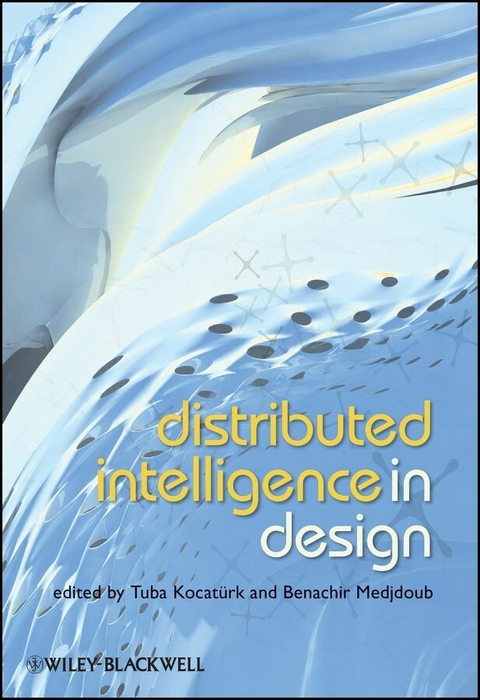
Distributed Intelligence In Design (eBook)
280 Seiten
John Wiley & Sons (Verlag)
9781444392371 (ISBN)

the Distributed Intelligence in Design Symposium, held in
Salford in May 2009. In this context, Distributed Intelligence
refers to the interdisciplinary knowledge of a range of different
individuals in different organisations, with different backgrounds
and experience, and the symposium discussed the media, technologies
and behaviours required to support their successful collaboration.
The book focusses on:
* how parametric and generative design media can be coupled with
and managed alongside Building Information Modelling tools and
systems
* how the cross-disciplinary knowledge is distributed and
coordinated across different software, participants and
organizations
* the characteristics of the evolving creative and collaborative
practices
* how built environment education should be adapted to this
digitally-networked practice and highly distributed intelligence in
design
The chapters address a range of innovative developments,
methodologies, applications, research work and theoretical
arguments, to present current experience and expectations as
collaborative practice becomes critical in the design
of future built environments.
Dr Tuba Kocaturk is a Lecturer in Architectural Design and Technology, and Programme Director for the MSc in Digital Architectural Design, in the School of the Built Environment at the University of Salford. Dr Benachir Medjdoub is a Reader in the Built Environment in the School of the Built Environment at the University of Salford.
Note on editors page.
List of contributors.
Foreword (Paul Richens).
Introduction: Distributed intelligence in design (Tuba
Kocatürk and Benachir Medjdoub).
PART 1.
1 Of sails and sieves and sticky tape (Bryan Lawson).
2 Distributed perspectives for intelligent conceptual design
(Volker Mueller).
3 Distributed intelligence or a simple coherent mental model?
(Chris J. K. Williams and Roly Hudson).
4 Sharing intelligence: The problem of knowledge atrophy
(Peter Brandon).
PART 2.
5 Pedagogical frameworks for emergent digital practices in
architecture (Brent Allpress).
6 Emergence and convergence of knowledge in building
production: Knowledge-based design and digital
manufacturing (Eduardo Lyon).
7 Artifact and affect: Open-ended strata of communication
(Matias del Campo and Sandra Manninger).
8 Digital tools for creative hinges (Sean Hanna).
PART 3.
9 The effects of integrated BIM in processes and business models
(Arto Kiviniemi).
10 Integrated building design for production management systems
(Rita Cristina Ferreira).
11 Flexibility, semantics and standards (Robin Drogemuller
and John H. Frazer).
12 Examples of distributed intelligence on large-scale building
lifecycle projects (Martin Riese).
PART 4.
13 Rapid practice expansion through strategic design computation
(Cristiano Ceccato).
14 Algorithmic modelling, parametric thinking (Neil
Katz).
15 Interview with the Specialist Modelling Group (SMG): The
dynamic coordination of distributed intelligence at Foster and
Partners (Hugh Whitehead, Xavier de Kestelier, Irene Gallou and
Tuba Kocatürk).
16 Interview with Lars Hesselgren, Director PLP Research
(Lars Hesselgren and Benachir Medjdoub).
17 Geometry, topology, materiality: The structural parameters in
a collaborative design approach (Manfred Grohmann and Oliver
Tessmann).
Index.
| Erscheint lt. Verlag | 18.11.2010 |
|---|---|
| Sprache | englisch |
| Themenwelt | Mathematik / Informatik ► Informatik ► Theorie / Studium |
| Technik ► Bauwesen | |
| Schlagworte | Architecture • Architektur • Baubetrieb • Bauingenieur- u. Bauwesen • Berufspraxis i. d. Architektur • Civil Engineering & Construction • Construction Management • Professional Practice |
| ISBN-13 | 9781444392371 / 9781444392371 |
| Informationen gemäß Produktsicherheitsverordnung (GPSR) | |
| Haben Sie eine Frage zum Produkt? |
 PDF (Adobe DRM)
Kopierschutz: Adobe-DRM
Adobe-DRM ist ein Kopierschutz, der das eBook vor Mißbrauch schützen soll. Dabei wird das eBook bereits beim Download auf Ihre persönliche Adobe-ID autorisiert. Lesen können Sie das eBook dann nur auf den Geräten, welche ebenfalls auf Ihre Adobe-ID registriert sind.
Details zum Adobe-DRM
Dateiformat: PDF (Portable Document Format)
Mit einem festen Seitenlayout eignet sich die PDF besonders für Fachbücher mit Spalten, Tabellen und Abbildungen. Eine PDF kann auf fast allen Geräten angezeigt werden, ist aber für kleine Displays (Smartphone, eReader) nur eingeschränkt geeignet.
Systemvoraussetzungen:
PC/Mac: Mit einem PC oder Mac können Sie dieses eBook lesen. Sie benötigen eine
eReader: Dieses eBook kann mit (fast) allen eBook-Readern gelesen werden. Mit dem amazon-Kindle ist es aber nicht kompatibel.
Smartphone/Tablet: Egal ob Apple oder Android, dieses eBook können Sie lesen. Sie benötigen eine
Geräteliste und zusätzliche Hinweise
Buying eBooks from abroad
For tax law reasons we can sell eBooks just within Germany and Switzerland. Regrettably we cannot fulfill eBook-orders from other countries.
aus dem Bereich