


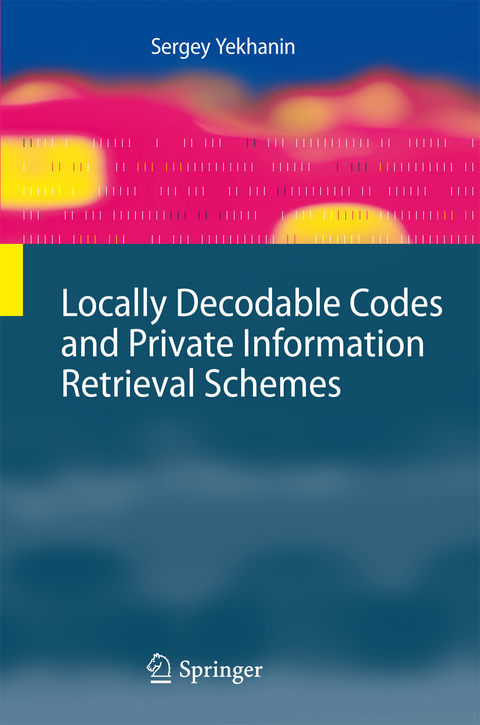
Locally Decodable Codes and Private Information Retrieval Schemes
Seiten
2013
Springer Berlin (Verlag)
9783642265778 (ISBN)
Springer Berlin (Verlag)
9783642265778 (ISBN)
In this book, the author provides a fresh algebraic look at the theory of locally decodable codes and private information retrieval schemes. The author's related thesis won the ACM Dissertation Award in 2007, and this book includes some expanded sections.
Locally decodable codes (LDCs) are codes that simultaneously provide efficient random access retrieval and high noise resilience by allowing reliable reconstruction of an arbitrary bit of a message by looking at only a small number of randomly chosen codeword bits. Local decodability comes with a certain loss in terms of efficiency - specifically, locally decodable codes require longer codeword lengths than their classical counterparts. Private information retrieval (PIR) schemes are cryptographic protocols designed to safeguard the privacy of database users. They allow clients to retrieve records from public databases while completely hiding the identity of the retrieved records from database owners.
In this book the author provides a fresh algebraic look at the theory of locally decodable codes and private information retrieval schemes, obtaining new families of each which have much better parameters than those of previously known constructions, and he also proves limitations of two server PIRs in a restricted setting that covers all currently known schemes. The author's related thesis won the ACM Dissertation Award in 2007, and this book includes some expanded sections and proofs, and notes on recent developments.
Locally decodable codes (LDCs) are codes that simultaneously provide efficient random access retrieval and high noise resilience by allowing reliable reconstruction of an arbitrary bit of a message by looking at only a small number of randomly chosen codeword bits. Local decodability comes with a certain loss in terms of efficiency - specifically, locally decodable codes require longer codeword lengths than their classical counterparts. Private information retrieval (PIR) schemes are cryptographic protocols designed to safeguard the privacy of database users. They allow clients to retrieve records from public databases while completely hiding the identity of the retrieved records from database owners.
In this book the author provides a fresh algebraic look at the theory of locally decodable codes and private information retrieval schemes, obtaining new families of each which have much better parameters than those of previously known constructions, and he also proves limitations of two server PIRs in a restricted setting that covers all currently known schemes. The author's related thesis won the ACM Dissertation Award in 2007, and this book includes some expanded sections and proofs, and notes on recent developments.
Introduction.- Locally Decodable Codes via the the Point Removal Method.- Limitations of the Point Removal Method.- Private Information Retrieval.- References.- Index
| Erscheint lt. Verlag | 2.1.2013 |
|---|---|
| Reihe/Serie | Information Security and Cryptography |
| Zusatzinfo | XII, 82 p. |
| Verlagsort | Berlin |
| Sprache | englisch |
| Maße | 155 x 235 mm |
| Gewicht | 161 g |
| Themenwelt | Informatik ► Theorie / Studium ► Algorithmen |
| Informatik ► Theorie / Studium ► Kryptologie | |
| Schlagworte | Codierung • Codierung / Kodierung • Database • Information Retrieval • Informationssicherheit • Locally decodable codes • Point removal method • privacy • private information retrieval |
| ISBN-13 | 9783642265778 / 9783642265778 |
| Zustand | Neuware |
| Informationen gemäß Produktsicherheitsverordnung (GPSR) | |
| Haben Sie eine Frage zum Produkt? |
Mehr entdecken
aus dem Bereich



aus dem Bereich
Buch | Softcover (2025)
Lehmanns Media (Verlag)
CHF 62,95
die Welt der generativen KI verstehen
Buch | Hardcover (2025)
Hanser (Verlag)
CHF 48,95
IT zum Anfassen für alle von 9 bis 99 – vom Navi bis Social Media
Buch | Softcover (2021)
Springer (Verlag)
CHF 46,15


