Queueing Modelling Fundamentals (eBook)
John Wiley & Sons (Verlag)
978-0-470-99466-5 (ISBN)
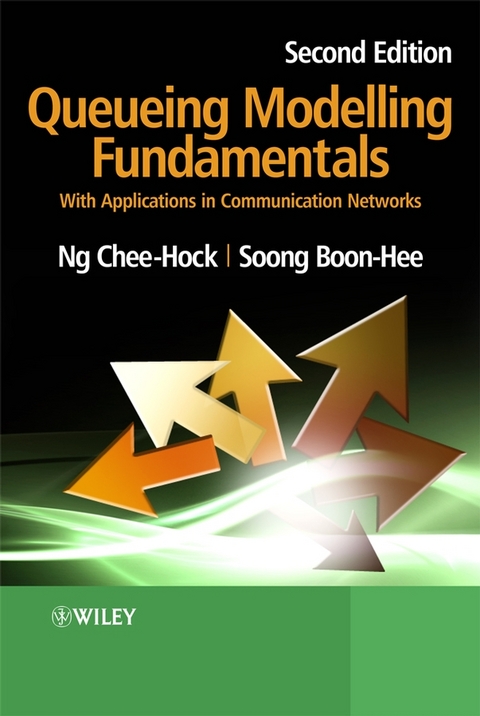
Fully revised, this second edition of a popular book contains the significant addition of a new chapter on Flow & Congestion Control and a section on Network Calculus among other new sections that have been added to remaining chapters. An introductory text, Queueing Modelling Fundamentals focuses on queueing modelling techniques and applications of data networks, examining the underlying principles of isolated queueing systems. This book introduces the complex queueing theory in simple language/proofs to enable the reader to quickly pick up an overview to queueing theory without utilizing the diverse necessary mathematical tools. It incorporates a rich set of worked examples on its applications to communication networks.
Features include:
- Fully revised and updated edition with significant new chapter on Flow and Congestion Control as-well-as a new section on Network Calculus
- A comprehensive text which highlights both the theoretical models and their applications through a rich set of worked examples, examples of applications to data networks and performance curves
- Provides an insight into the underlying queuing principles and features step-by-step derivation of queueing results
- Written by experienced Professors in the field
Queueing Modelling Fundamentals is an introductory text for undergraduate or entry-level post-graduate students who are taking courses on network performance analysis as well as those practicing network administrators who want to understand the essentials of network operations. The detailed step-by-step derivation of queueing results also makes it an excellent text for professional engineers.
Chee-Hock Ng, Nanyang Technological University, Singapore
Chee-Hock Ng is currently an Associate Professor in the School of Electrical & Electronic Engineering, Nanyang Technological University (NTU). He is also serving as an external examiner and assessor to the SIM University for its computer science programmes. The author of the first edition of 'Queueing Modelling Fundamentals', Chee-Hock Ng runs short courses to the industry and other statuary bodies in the area of networking.? A Chartered Engineer and a Senior Member of IEEE, he has also published many papers in international journals and conferences in the areas of networking.
Boon-Hee Soong, Nanyang Technological University, Singapore
Soong Boon-Hee is currently an Associate Professor with the School of Electrical and Electronic Engineering, Nanyang Technological University. Previously a Visiting Research Fellow at the Department of Electrical and Electronic Engineering, Imperial College, London, under the Commonwealth Fellowship Award, he has served as a consultant for many companies including Mobile IP in a recent technical field trial of Next-Generation Wireless LAN initiated by IDA (InfoComm Development Authority, Singapore). Boon-Hee Soong was awarded the Tan Chin Tuan Fellowship in 2004. Author of over 100 international journals, book chapters and conference papers, he is currently a Senior member of IEEE and a member of ACM.
Queueing analysis is a vital tool used in the evaluation of system performance. Applications of queueing analysis cover a wide spectrum from bank automated teller machines to transportation and communications data networks. Fully revised, this second edition of a popular book contains the significant addition of a new chapter on Flow & Congestion Control and a section on Network Calculus among other new sections that have been added to remaining chapters. An introductory text, Queueing Modelling Fundamentals focuses on queueing modelling techniques and applications of data networks, examining the underlying principles of isolated queueing systems. This book introduces the complex queueing theory in simple language/proofs to enable the reader to quickly pick up an overview to queueing theory without utilizing the diverse necessary mathematical tools. It incorporates a rich set of worked examples on its applications to communication networks. Features include: Fully revised and updated edition with significant new chapter on Flow and Congestion Control as-well-as a new section on Network Calculus A comprehensive text which highlights both the theoretical models and their applications through a rich set of worked examples, examples of applications to data networks and performance curves Provides an insight into the underlying queuing principles and features step-by-step derivation of queueing results Written by experienced Professors in the field Queueing Modelling Fundamentals is an introductory text for undergraduate or entry-level post-graduate students who are taking courses on network performance analysis as well as those practicing network administrators who want to understand the essentials of network operations. The detailed step-by-step derivation of queueing results also makes it an excellent text for professional engineers.
Chee-Hock Ng, Nanyang Technological University, Singapore Chee-Hock Ng is currently an Associate Professor in the School of Electrical & Electronic Engineering, Nanyang Technological University (NTU). He is also serving as an external examiner and assessor to the SIM University for its computer science programmes. The author of the first edition of "Queueing Modelling Fundamentals", Chee-Hock Ng runs short courses to the industry and other statuary bodies in the area of networking.? A Chartered Engineer and a Senior Member of IEEE, he has also published many papers in international journals and conferences in the areas of networking. Boon-Hee Soong, Nanyang Technological University, Singapore Soong Boon-Hee is currently an Associate Professor with the School of Electrical and Electronic Engineering, Nanyang Technological University. Previously a Visiting Research Fellow at the Department of Electrical and Electronic Engineering, Imperial College, London, under the Commonwealth Fellowship Award, he has served as a consultant for many companies including Mobile IP in a recent technical field trial of Next-Generation Wireless LAN initiated by IDA (InfoComm Development Authority, Singapore). Boon-Hee Soong was awarded the Tan Chin Tuan Fellowship in 2004. Author of over 100 international journals, book chapters and conference papers, he is currently a Senior member of IEEE and a member of ACM.
List of Tables.
List of Illustrations.
Preface.
1. Preliminaries.
1.1. Probability Theory.
1.2. z-Transforms - Generating Functions.
1.3. Laplace Transforms.
1.4. Matrix Operations.
Problems.
2. Introduction to Queueing Systems.
2.1. Nomenclature of a Queueing System.
2.2. Random Variables and their Relationships.
2.3. Kendall Notation.
2.4 Little's Theorem.
2.5 Resource Utilization and Traffic Intensity.
2.6 Flow Conservation Law.
2.7 Poisson Process.
2.8 Properties of Poisson Process.
Problems.
3. Discrete and Continuous Markov Processes.
3.1. Stochastic Processes.
3.2. Discrete-time Markov Chains.
3.3. Continuous-time Markov Chains.
3.4. Birth-Death Processes.
Problems.
4. Single-Queue Markovian Systems.
4.1. Classical M/M/1 Queue.
4.2. PASTA - Poisson Arrivals See Time Averages.
4.3. M/M/1/S Queueing Systems.
4.5. Multi-server Systems - M/M/m
4.6. Erlang's Loss Queueing Systems - M/M/m/m Systems.
4.7. Engset's Loss Systems.
4.8. Considerations for Applications of Queueing Models
Problems.
5. Semi-Markovian Queueing Systems.
5.1. The M/G/1 Queueing System.
5.2 The Residual Service Time Approach.
5.3 M/G/1 Non-preemptive Priority Queueing.
5.4 Priority Queueing Systems.
5.5 The G/M/1 Queueing System.
6. Open Queueing Networks.
6.1. Markovian Queries in Tandem.
6.2. Applications of Tandem Queues in Data Networks.
6.3. Jackson Queueing Networks.
Problems.
7. Closed Queueing Networks.
7.1. Jackson Closed Queueing Networks.
7.2. Steady-state Probability Distribution.
7.3. Convolution Algorithm.
7.4. Performance Measures.
7.5. Mean Value Analysis.
7.6. Application of Closed Queueing Networks.
Problems.
8. Markov-Modulated Arrival Process.
8.1. Markov-modulated Poisson Process (MMPP).
8.2. Markov-modulated Bernoulli Process.
8.3. Markov-modulated Fluid Flow.
8.4. Network Calculus.
9. Flow and Congestion Control.
9.1. Introduction.
9.2. Quality of Service.
9.3. Analysis of Sliding Window Flow Control Mechanisms.
9.4. Rate Based Adaptive Congestion Control.
References.
Index.
"The book is well written and nicely illustrated. I recommend it as
an introduction for graduate students and telecommunications
engineers." (Computing Reviews, November 24, 2008)
"This book would serve ideally as a text for an undergraduate
course on network performance analysis." (Computing Reviews,
July 2008)
| Erscheint lt. Verlag | 30.4.2008 |
|---|---|
| Sprache | englisch |
| Themenwelt | Mathematik / Informatik ► Mathematik ► Angewandte Mathematik |
| Technik ► Elektrotechnik / Energietechnik | |
| Technik ► Nachrichtentechnik | |
| Schlagworte | Addition • Analysis • Applications • Bank • Communication technology • Communication Technology - Networks • Computer Science • Congestion • Control • Edition • Electrical & Electronics Engineering • Elektrotechnik u. Elektronik • Evaluation • flow • focuses • fundamentals • Informatik • Kommunikationsnetze • Kommunikationstechnik • machines • Networking • Netzwerke • New • Performance • popular book contains • significant • spectrum • System • techniques • Teller • vital tool • wide |
| ISBN-10 | 0-470-99466-5 / 0470994665 |
| ISBN-13 | 978-0-470-99466-5 / 9780470994665 |
| Informationen gemäß Produktsicherheitsverordnung (GPSR) | |
| Haben Sie eine Frage zum Produkt? |
 PDF (Adobe DRM)
Kopierschutz: Adobe-DRM
Adobe-DRM ist ein Kopierschutz, der das eBook vor Mißbrauch schützen soll. Dabei wird das eBook bereits beim Download auf Ihre persönliche Adobe-ID autorisiert. Lesen können Sie das eBook dann nur auf den Geräten, welche ebenfalls auf Ihre Adobe-ID registriert sind.
Details zum Adobe-DRM
Dateiformat: PDF (Portable Document Format)
Mit einem festen Seitenlayout eignet sich die PDF besonders für Fachbücher mit Spalten, Tabellen und Abbildungen. Eine PDF kann auf fast allen Geräten angezeigt werden, ist aber für kleine Displays (Smartphone, eReader) nur eingeschränkt geeignet.
Systemvoraussetzungen:
PC/Mac: Mit einem PC oder Mac können Sie dieses eBook lesen. Sie benötigen eine
eReader: Dieses eBook kann mit (fast) allen eBook-Readern gelesen werden. Mit dem amazon-Kindle ist es aber nicht kompatibel.
Smartphone/Tablet: Egal ob Apple oder Android, dieses eBook können Sie lesen. Sie benötigen eine
Geräteliste und zusätzliche Hinweise
Buying eBooks from abroad
For tax law reasons we can sell eBooks just within Germany and Switzerland. Regrettably we cannot fulfill eBook-orders from other countries.
aus dem Bereich