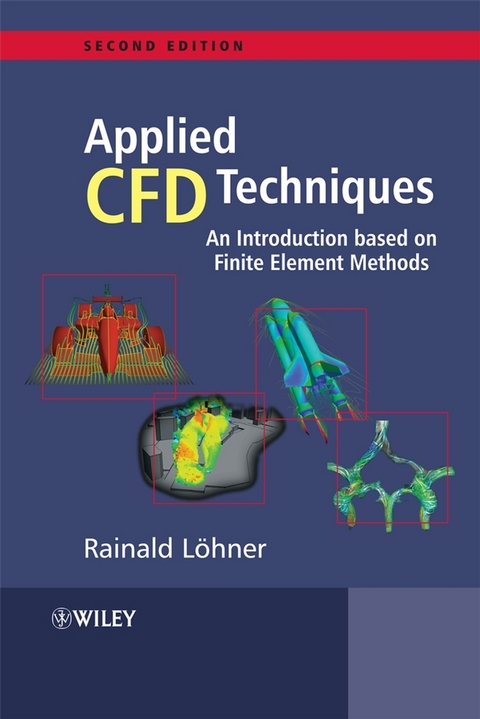
Applied Computational Fluid Dynamics Techniques (eBook)
John Wiley & Sons (Verlag)
978-0-470-98966-1 (ISBN)
This heavily revised second edition takes a practice-oriented approach with a strong emphasis on efficiency, and offers important new and updated material on;
- Overlapping and embedded grid methods
- Treatment of free surfaces
- Grid generation
- Optimal use of supercomputing hardware
- Optimal shape and process design
Applied Computational Fluid Dynamics Techniques, 2nd edition is a vital resource for engineers, researchers and designers working on CFD, aero and hydrodynamics simulations and bioengineering. Its unique practical approach will also appeal to graduate students of fluid mechanics and aero and hydrodynamics as well as biofluidics.
Rainald Lohner, Department of Computational and Data Sciences, 4400 University Drive, Fairfax, Virginia 22030, USA? Rainald Lohner gained his PhD from the University of Wales, Swansea. He is now a director of the Computational Fluid Dynamics Center of the Department of Computational and Data Sciences at George Mason University, Virginia, USA. His research interests include Fluid-Structure Interaction, Unstructured Grid Generation, Pre-Processing, and Parallel Computing.? Notable achievements include a Distinguished Professor award 'for his substantive and innovative contributions to the field of computational fluid dynamics' by GMU and being a made a Honorary Professor of the University of Wales at Swansea.
Computational fluid dynamics (CFD) is concerned with the efficient numerical solution of the partial differential equations that describe fluid dynamics. CFD techniques are commonly used in the many areas of engineering where fluid behavior is an important factor. Traditional fields of application include aerospace and automotive design, and more recently, bioengineering and consumer and medical electronics. With Applied Computational Fluid Dynamics Techniques, 2nd edition, Rainald L hner introduces the reader to the techniques required to achieve efficient CFD solvers, forming a bridge between basic theoretical and algorithmic aspects of the finite element method and its use in an industrial context where methods have to be both as simple but also as robust as possible. This heavily revised second edition takes a practice-oriented approach with a strong emphasis on efficiency, and offers important new and updated material on; Overlapping and embedded grid methods Treatment of free surfaces Grid generation Optimal use of supercomputing hardware Optimal shape and process design Applied Computational Fluid Dynamics Techniques, 2nd edition is a vital resource for engineers, researchers and designers working on CFD, aero and hydrodynamics simulations and bioengineering. Its unique practical approach will also appeal to graduate students of fluid mechanics and aero and hydrodynamics as well as biofluidics.
Rainald Lohner, Department of Computational and Data Sciences, 4400 University Drive, Fairfax, Virginia 22030, USA? Rainald Lohner gained his PhD from the University of Wales, Swansea. He is now a director of the Computational Fluid Dynamics Center of the Department of Computational and Data Sciences at George Mason University, Virginia, USA. His research interests include Fluid-Structure Interaction, Unstructured Grid Generation, Pre-Processing, and Parallel Computing.? Notable achievements include a Distinguished Professor award 'for his substantive and innovative contributions to the field of computational fluid dynamics' by GMU and being a made a Honorary Professor of the University of Wales at Swansea.
Acknowledgments.
Introduction.
Data Structures and Algorithms.
Grid Generation.
Approximation Theory.
Approximation of Operators.
Discretization in Time.
Solution of Large Systems of Equations.
Simple Euler/Navier-Stokes Solvers.
Flux-Corrected Transport (FCT) Schemes.
Edge-Based Compressible Flow Solvers.
Incompressible Flow Solvers.
Mesh Movement.
Interpolation.
Adaptive Mesh Refinement.
Efficient use of Supercomputer Hardware.
Space-marching and Deactivation.
Index.
?This book has a good concept und gives a compact description of
applied CFD.? (ZAMM, October 2009)
| Erscheint lt. Verlag | 30.4.2008 |
|---|---|
| Sprache | englisch |
| Themenwelt | Mathematik / Informatik ► Mathematik ► Angewandte Mathematik |
| Naturwissenschaften ► Physik / Astronomie | |
| Technik ► Maschinenbau | |
| Schlagworte | Aerospace • application • Areas • Behavior • CFD • commonly • Computational • describe • Design • Differential • Dynamics • Efficient • Electrical & Electronics Engineering • Elektrotechnik u. Elektronik • Engineering • Equations • Factor • Fields • Fluid • fluid mechanics • important • many • Maschinenbau • Mathematics • Mathematik • mechanical engineering • Numerical • Numerical Methods • Numerical Methods & Algorithms • numerische Methoden • Numerische Methoden u. Algorithmen • Partial • Solution • Strömungsmechanik • Strömungsmechanik • techniques • Traditional |
| ISBN-10 | 0-470-98966-1 / 0470989661 |
| ISBN-13 | 978-0-470-98966-1 / 9780470989661 |
| Informationen gemäß Produktsicherheitsverordnung (GPSR) | |
| Haben Sie eine Frage zum Produkt? |
 PDF (Adobe DRM)
Kopierschutz: Adobe-DRM
Adobe-DRM ist ein Kopierschutz, der das eBook vor Mißbrauch schützen soll. Dabei wird das eBook bereits beim Download auf Ihre persönliche Adobe-ID autorisiert. Lesen können Sie das eBook dann nur auf den Geräten, welche ebenfalls auf Ihre Adobe-ID registriert sind.
Details zum Adobe-DRM
Dateiformat: PDF (Portable Document Format)
Mit einem festen Seitenlayout eignet sich die PDF besonders für Fachbücher mit Spalten, Tabellen und Abbildungen. Eine PDF kann auf fast allen Geräten angezeigt werden, ist aber für kleine Displays (Smartphone, eReader) nur eingeschränkt geeignet.
Systemvoraussetzungen:
PC/Mac: Mit einem PC oder Mac können Sie dieses eBook lesen. Sie benötigen eine
eReader: Dieses eBook kann mit (fast) allen eBook-Readern gelesen werden. Mit dem amazon-Kindle ist es aber nicht kompatibel.
Smartphone/Tablet: Egal ob Apple oder Android, dieses eBook können Sie lesen. Sie benötigen eine
Geräteliste und zusätzliche Hinweise
Buying eBooks from abroad
For tax law reasons we can sell eBooks just within Germany and Switzerland. Regrettably we cannot fulfill eBook-orders from other countries.
aus dem Bereich