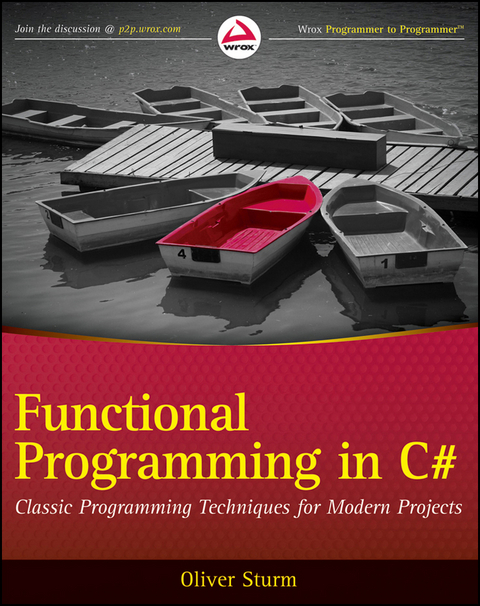
Functional Programming in C# (eBook)
John Wiley & Sons (Verlag)
978-0-470-97110-9 (ISBN)

Take advantage of the growing trend in functional programming.
C# is the number-one language used by .NET developers and one of the most popular programming languages in the world. It has many built-in functional programming features, but most are complex and little understood. With the shift to functional programming increasing at a rapid pace, you need to know how to leverage your existing skills to take advantage of this trend.
Functional Programming in C# leads you along a path that begins with the historic value of functional ideas. Inside, C# MVP and functional programming expert Oliver Sturm explains the details of relevant language features in C# and describes theory and practice of using functional techniques in C#, including currying, partial application, composition, memoization, and monads. Next, he provides practical and versatile examples, which combine approaches to solve problems in several different areas, including complex scenarios like concurrency and high-performance calculation frameworks as well as simpler use cases like Web Services and business logic implementation.
- Shows how C# developers can leverage their existing skills to take advantage of functional programming
- Uses very little math theory and instead focuses on providing solutions to real development problems with functional programming methods, unlike traditional functional programming titles
- Includes examples ranging from simple cases to more complex scenarios
Let Functional Programming in C# show you how to get in front of the shift toward functional programming.
Oliver Sturm has over 20 years experience developing professional software. He is a well-known expert in various areas of application architecture, programming languages and the third-party .NET tools made by DevExpress. His main focus since 2002 has been on the .NET platform.
Take advantage of the growing trend in functional programming. C# is the number-one language used by .NET developers and one of the most popular programming languages in the world. It has many built-in functional programming features, but most are complex and little understood. With the shift to functional programming increasing at a rapid pace, you need to know how to leverage your existing skills to take advantage of this trend. Functional Programming in C# leads you along a path that begins with the historic value of functional ideas. Inside, C# MVP and functional programming expert Oliver Sturm explains the details of relevant language features in C# and describes theory and practice of using functional techniques in C#, including currying, partial application, composition, memoization, and monads. Next, he provides practical and versatile examples, which combine approaches to solve problems in several different areas, including complex scenarios like concurrency and high-performance calculation frameworks as well as simpler use cases like Web Services and business logic implementation. Shows how C# developers can leverage their existing skills to take advantage of functional programming Uses very little math theory and instead focuses on providing solutions to real development problems with functional programming methods, unlike traditional functional programming titles Includes examples ranging from simple cases to more complex scenarios Let Functional Programming in C# show you how to get in front of the shift toward functional programming.
Oliver Sturm has over 20 years experience developing professional software. He is a well-known expert in various areas of application architecture, programming languages and the third-party .NET tools made by DevExpress. His main focus since 2002 has been on the .NET platform.
INTRODUCTION.
PART I: INTRODUCTION TO FUNCTIONAL PROGRAMMING.
CHAPTER 1: A LOOK AT FUNCTIONAL PROGRAMMING HISTORY.
CHAPTER 2: PUTTING FUNCTIONAL PROGRAMMING INTO A MODERN
CONTEXT.
PART II: C# FOUNDATIONS OF FUNCTIONAL PROGRAMMING.
CHAPTER 3: FUNCTIONS, DELEGATES, AND LAMBDA EXPRESSIONS.
CHAPTER 4: FLEXIBLE TYPING WITH GENERICS.
CHAPTER 5: LAZY LISTING WITH ITERATORS.
CHAPTER 6: ENCAPSULATING DATA IN CLOSURES.
CHAPTER 7: CODE IS DATA.
PART III: IMPLEMENTING WELL-KNOWN FUNCTIONAL TECHNIQUES IN
C#.
CHAPTER 8: CURRYING AND PARTIAL APPLICATION.
CHAPTER 9: LAZY EVALUATION.
CHAPTER 10: CACHING TECHNIQUES.
CHAPTER 11: CALLING YOURSELF.
CHAPTER 12: STANDARD HIGHER ORDER FUNCTIONS.
CHAPTER 13: SEQUENCES.
CHAPTER 14: CONSTRUCTING FUNCTIONS FROM FUNCTIONS.
CHAPTER 15: OPTIONAL VALUES.
CHAPTER 16: KEEPING DATA FROM CHANGING.
CHAPTER 17: MONADS.
PART IV: PUTTING FUNCTIONAL PROGRAMMING INTO ACTION.
CHAPTER 18: INTEGRATING FUNCTIONAL PROGRAMMING APPROACHES.
CHAPTER 19: THE MAPREDUCE PATTERN.
CHAPTER 20: APPLIED FUNCTIONAL MODULARIZATION.
CHAPTER 21: EXISTING PROJECTS USING FUNCTIONAL TECHNIQUES.
INDEX.
| Erscheint lt. Verlag | 21.3.2011 |
|---|---|
| Sprache | englisch |
| Themenwelt | Informatik ► Programmiersprachen / -werkzeuge ► C# |
| Mathematik / Informatik ► Informatik ► Software Entwicklung | |
| Schlagworte | C#, functional programming, .NET, .NET framework, .NET programming, C# programming language, Oliver Sturm, currying, partial application, composition, memoization, monads • Computer Science • C Sharp • Informatik • Programmierung u. Software-Entwicklung • Programming & Software Development |
| ISBN-10 | 0-470-97110-X / 047097110X |
| ISBN-13 | 978-0-470-97110-9 / 9780470971109 |
| Informationen gemäß Produktsicherheitsverordnung (GPSR) | |
| Haben Sie eine Frage zum Produkt? |
 EPUB (Adobe DRM)
Kopierschutz: Adobe-DRM
Adobe-DRM ist ein Kopierschutz, der das eBook vor Mißbrauch schützen soll. Dabei wird das eBook bereits beim Download auf Ihre persönliche Adobe-ID autorisiert. Lesen können Sie das eBook dann nur auf den Geräten, welche ebenfalls auf Ihre Adobe-ID registriert sind.
Details zum Adobe-DRM
Dateiformat: EPUB (Electronic Publication)
EPUB ist ein offener Standard für eBooks und eignet sich besonders zur Darstellung von Belletristik und Sachbüchern. Der Fließtext wird dynamisch an die Display- und Schriftgröße angepasst. Auch für mobile Lesegeräte ist EPUB daher gut geeignet.
Systemvoraussetzungen:
PC/Mac: Mit einem PC oder Mac können Sie dieses eBook lesen. Sie benötigen eine
eReader: Dieses eBook kann mit (fast) allen eBook-Readern gelesen werden. Mit dem amazon-Kindle ist es aber nicht kompatibel.
Smartphone/Tablet: Egal ob Apple oder Android, dieses eBook können Sie lesen. Sie benötigen eine
Geräteliste und zusätzliche Hinweise
Buying eBooks from abroad
For tax law reasons we can sell eBooks just within Germany and Switzerland. Regrettably we cannot fulfill eBook-orders from other countries.
aus dem Bereich