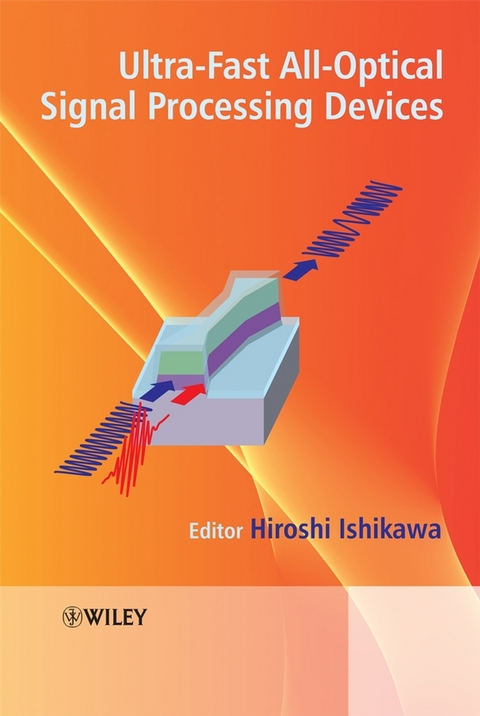
Ultrafast All-Optical Signal Processing Devices (eBook)
John Wiley & Sons (Verlag)
978-0-470-75868-7 (ISBN)
The introduction of ultra-fast communication systems based on all-optical signal processing is considered to be one of the most promising ways to handle the rapidly increasing global communication traffic. Such systems will enable real time super-high definition moving pictures such as high reality TV-conference, remote diagnosis and surgery, cinema entertainment and many other applications with small power consumption. The key issue to realize such systems is to develop ultra-fast optical devices such as light sources, all-optical gates and wavelength converters.
Ultra-Fast All-Optical Signal Processing Devices discusses the state of the art development of semiconductor-based ultrafast all-optical devices, and their various signal processing applications for bit-rates 100Gb/s to 1Tb/s.
Ultra-Fast All-Optical Signal Processing Devices:
- Provides a thorough and in-depth treatment of the most recent achievements in ultrafast all-optical devices
- Discusses future networks with applications such as HD-TV and super-high definition moving screens as a motivating background for devices research
- Covers mode-locked semiconductor lasers, electro-absorption modulator based 160Gb/s signal sources, SOA based symmetric Mach-Zehnder type all-optical gates, intersubband transition gate device, and more
- Explains the technical issues behind turning the ultra-fast optical devices into practical working tools
- Examples of above 160Gb/s transmission experiments
- Discusses future prospects of the ultra-fast signal processing devices
This invaluable reference will provide device researchers and engineers in industry, researchers at universities (including graduate students, and post doctorial researchers and professors) and research institutes with a thorough understanding of ultrahigh bandwidth optical communication systems. Device and communication market watchers will also find this book useful.
Dr Hiroshi Ishikawa, Tsukuba, Japan
Dr Ishikawa is the Director of the Ultrafast Photonic Devices Laboratory in National Institute of Advanced Industrial Science and Technology (AIST) in Japan. He worked for research and development of optical semiconductor devices in Fujitsu Labs Ltd from 1972 to 2001. In 2001 he moved to Femtosecond Technology Research Association Central Res. Lab. as a group leader of ultrafast all-optical switching devices. He is at AIST since 2004. He is a member of Japan Society of Applied Physics, The Physical Society of Japan, The Institute of Electronics, Information and Communication Engineers, and IEEE (Fellow).
Semiconductor-based Ultra-Fast All-Optical Signal Processing Devices a key technology for the next generation of ultrahigh bandwidth optical communication systems! The introduction of ultra-fast communication systems based on all-optical signal processing is considered to be one of the most promising ways to handle the rapidly increasing global communication traffic. Such systems will enable real time super-high definition moving pictures such as high reality TV-conference, remote diagnosis and surgery, cinema entertainment and many other applications with small power consumption. The key issue to realize such systems is to develop ultra-fast optical devices such as light sources, all-optical gates and wavelength converters. Ultra-Fast All-Optical Signal Processing Devices discusses the state of the art development of semiconductor-based ultrafast all-optical devices, and their various signal processing applications for bit-rates 100Gb/s to 1Tb/s. Ultra-Fast All-Optical Signal Processing Devices: Provides a thorough and in-depth treatment of the most recent achievements in ultrafast all-optical devices Discusses future networks with applications such as HD-TV and super-high definition moving screens as a motivating background for devices research Covers mode-locked semiconductor lasers, electro-absorption modulator based 160Gb/s signal sources, SOA based symmetric Mach-Zehnder type all-optical gates, intersubband transition gate device, and more Explains the technical issues behind turning the ultra-fast optical devices into practical working tools Examples of above 160Gb/s transmission experiments Discusses future prospects of the ultra-fast signal processing devices This invaluable reference will provide device researchers and engineers in industry, researchers at universities (including graduate students, and post doctorial researchers and professors) and research institutes with a thorough understanding of ultrahigh bandwidth optical communication systems. Device and communication market watchers will also find this book useful.
Dr Hiroshi Ishikawa, Tsukuba, Japan Dr Ishikawa is the Director of the Ultrafast Photonic Devices Laboratory in National Institute of Advanced Industrial Science and Technology (AIST) in Japan. He worked for research and development of optical semiconductor devices in Fujitsu Labs Ltd from 1972 to 2001. In 2001 he moved to Femtosecond Technology Research Association Central Res. Lab. as a group leader of ultrafast all-optical switching devices. He is at AIST since 2004. He is a member of Japan Society of Applied Physics, The Physical Society of Japan, The Institute of Electronics, Information and Communication Engineers, and IEEE (Fellow).
CHAPTER 1. Introduction
1.1 Evolution of optical communication systems and devicetechnologies
1.2 Increasing communication traffics and power consumption
1.3 Future networks and technologies
1.4 Ultrafast all-optical signal processing devices
1.5 Overview of the devices and their concepts
1.6 Summary
CHAPTER 2. Light Sources
2.1 Requirement for light sources
2.2 Mode-locked laser diodes
2.3 Electro-absorption modulator (EAM) based signal source
2.4 Summary
CHAPTER 3 Semiconductor optical amplifier basedultrafast signal processing devices
3.1 Introduction
3.2 Fundamental of SOA
3.3 SOA as an ultrafast nonlinear medium
3.4 Use of ultrafast response component by filtering
3.5 Symmetric Mach-Zehnder (SMZ) all-optical gate
3.6 Summary
CHAPTER 4Uni-traveling-carrier photodiode (UTC-PD)and PD-EAM optical gate integrating a UTC-PD and a traveling waveelectro-absorption modulator
4.1 Introduction
4.2 Uni-traveling-carrier photodiode (UTC-PD)
4.3 Concept of new opto-electronic integrated device
4.4 PD-EAM optical gate integrating UTC-PD and TW-EAM
4.5 Summary and prospects
CHAPTER 5 Intersubband transition all-opticalgates
5.1 Operation principle
5.2 GaN/AlN ISBT gate
5.3 (CdS/ZnSe)/BeTe ISBT gate
5.4 InGaAs/AlAs/AlAsSb ISBT gate
5.5 Cross-phase modulation effect in InGaAs/AlAs/AlAsSb ISBTgate
5.6 Summary
CHAPTER 6 Wavelength conversion devices
6.1 Introduction
6.2 Wavelength conversion schemes
6.3 Physics of four-wave mixing in LDs and SOAs
6.4 Wavelength conversion of short pulses using FWM insemiconductor devices
6.5 Experimental results of wavelength conversion using FWM inSOAs and LDs
6.6 The future view of wavelength conversion using FWM
6.7 Summary
CHAPTER 7 Summary and future prospects
7.1 Introduction
7.2 Transmission experiments
7.3 Requirements on devices and prospects
7.4 Summary and future prospects
| Erscheint lt. Verlag | 15.9.2008 |
|---|---|
| Sprache | englisch |
| Themenwelt | Mathematik / Informatik ► Informatik |
| Technik ► Elektrotechnik / Energietechnik | |
| Technik ► Nachrichtentechnik | |
| Schlagworte | alloptical • bandwidth • Communication • considered • Electrical & Electronics Engineering • Elektrotechnik u. Elektronik • Generation • Introduction • Key • NeXT • Optical • Optical Communications • Optische Nachrichtentechnik • Processing • processing devices • Promising • semiconductorbased • Signal • Signal Processing • Signalverarbeitung • Systems • Technology • ultrafast • ultrahigh |
| ISBN-10 | 0-470-75868-6 / 0470758686 |
| ISBN-13 | 978-0-470-75868-7 / 9780470758687 |
| Informationen gemäß Produktsicherheitsverordnung (GPSR) | |
| Haben Sie eine Frage zum Produkt? |
 PDF (Adobe DRM)
Kopierschutz: Adobe-DRM
Adobe-DRM ist ein Kopierschutz, der das eBook vor Mißbrauch schützen soll. Dabei wird das eBook bereits beim Download auf Ihre persönliche Adobe-ID autorisiert. Lesen können Sie das eBook dann nur auf den Geräten, welche ebenfalls auf Ihre Adobe-ID registriert sind.
Details zum Adobe-DRM
Dateiformat: PDF (Portable Document Format)
Mit einem festen Seitenlayout eignet sich die PDF besonders für Fachbücher mit Spalten, Tabellen und Abbildungen. Eine PDF kann auf fast allen Geräten angezeigt werden, ist aber für kleine Displays (Smartphone, eReader) nur eingeschränkt geeignet.
Systemvoraussetzungen:
PC/Mac: Mit einem PC oder Mac können Sie dieses eBook lesen. Sie benötigen eine
eReader: Dieses eBook kann mit (fast) allen eBook-Readern gelesen werden. Mit dem amazon-Kindle ist es aber nicht kompatibel.
Smartphone/Tablet: Egal ob Apple oder Android, dieses eBook können Sie lesen. Sie benötigen eine
Geräteliste und zusätzliche Hinweise
Buying eBooks from abroad
For tax law reasons we can sell eBooks just within Germany and Switzerland. Regrettably we cannot fulfill eBook-orders from other countries.
aus dem Bereich