Multivariate Methods in Chromatography (eBook)
John Wiley & Sons (Verlag)
978-0-470-75413-9 (ISBN)
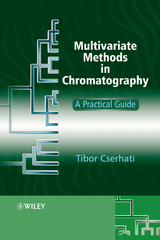
- A comprehensive, compilation and evaluation of the newest results in the field of enumerate evaluation of chromatographic data
- Aimed at the practicing professional, researchers and advanced students working in this area
- Special emphasis on practical applications
- While the principles of chromatography and multivariate mathematical-statistical methods are discussed separately, the book focuses on their interconnection.
- Written by a chromatographer for chromatographers
Professor Tibor Cserhati, Chemical Research Centre, Research Institute of Materials and Environmental Chemistry, Hungarian Academy of Sciences, Budapest, HungaryGraduated in Chemical Engineering in 1962 and received his PhD in 1973 from the Technical University of Budapest. From 1975 - 1988 he was a senior research scientists at the Plant Protection Institute of the Hungarian Academy of Sciences and from 1989 scientific counsellor at the Central Research Institute for Chemistry. He is the author/coauthor of more than 500 papers and 5 books. His main fields of interest are various chromatographic methods including TLC, GC and HPLC and the application of multivariate methods for the evaluation of chromatographic data.
A comprehensive, compilation and evaluation of the newest results in the field of enumerate evaluation of chromatographic data Aimed at the practicing professional, researchers and advanced students working in this area Special emphasis on practical applications While the principles of chromatography and multivariate mathematical-statistical methods are discussed separately, the book focuses on their interconnection. Written by a chromatographer for chromatographers
Professor Tibor Cserhati, Chemical Research Centre, Research Institute of Materials and Environmental Chemistry, Hungarian Academy of Sciences, Budapest, HungaryGraduated in Chemical Engineering in 1962 and received his PhD in 1973 from the Technical University of Budapest. From 1975 - 1988 he was a senior research scientists at the Plant Protection Institute of the Hungarian Academy of Sciences and from 1989 scientific counsellor at the Central Research Institute for Chemistry. He is the author/coauthor of more than 500 papers and 5 books. His main fields of interest are various chromatographic methods including TLC, GC and HPLC and the application of multivariate methods for the evaluation of chromatographic data.
Preface.
Introduction.
List of Abbreviations, Acronyms and Symbols.
Chapter 1. Fundamentals.
1.1. Multilinear and nonlinear regression analyses.
1.2. Stepwise regression analysis and partial least squares method.
1.3. Two and three-dimensional principal component analysis, various factor analytical techniques.
1.4. Canonical correlation analysis.
1.5. Discriminance analysis.
1.6. Spectral mapping.
1.7 Nonlinear mapping.
1.8. Cluster analysis.
1.9. Other multivariate techniques (fixed-size window movement, rank annihilation, etc).
1.10. Measured and calculated physicochemical parameters of chromatographis systems and analytes.
Chapter 2. Gas Chromatography (GC).
2.1. Theory and practice of gas chromatography.
2.2. Comparison of GC stationary phases using homogenous and non-homogenous set of analytes.
2.3. Elucidation of similarities and dissimilarities among samples.
2.3.1. Human health and pharmaceuticals.
2.3.2. Forensic analyses.
2.3.3. Biology and agrobiology.
2.3.4. Food and food products.
2.3.4.1. Wines.
2.3.4.2. Oils.
2.3.4.3. Foods of plant origin.
2.3.4.4. Miscellaneous food products.
2.3.5. Environmental analyses.
2.3.5.1. Volatile organic compounds (VOC), polycyclic aromatic hydrocarbons (PAH), and polychlorinated biphenyls (PCB).
2.3.5.2. Miscellaneous environmental pollutants.
2.3.5.3. Gasoline.
2.3.6. Other synthetic compounds.
2.3.7. Miscellaneous applications.
Chapter 3. Liquid Chromatography (LC).
3.1. Thin-layer chromatography (TLC).
3.1.1. Theory and practice of thin-layer chromatography.
3.1.2. Multidimensional classification of TLC stationary and/or mobile phases.
3.1.3. Relationships between molecular parameters and TLC retention of analytes.
3.1.3.1. Pharmaceuticals and natural organic compounds.
3.1.3.2. Fatty acids and bile acids.
3.1.3.3. Pesticides and pesticide adjuvants.
3.1.4. Relationship between TLC retention parameters and biological activity of analytes..
3.1.5. Miscellaneous applications.
3.2. High performance liquid chromatography (HPLC).
3.2.1. Theory and practice of HPLC.
3.2.2. Multidivariate classification of HPLC stationary and/or mobile phases.
3.2.2.1. Classification of stationary or mobile phases.
3.2.2.1.1. Principal component analysis (PCA).
3.2.2.1.2. Other multivariate techniques.
3.2.2.4. Classification of chromatographic systems.
3.2.2.4.1. Multilinear and multi nonlinear regression analyses (MLR and MNLR).
3.2.2.4.2. Principal component analysis (PCA), cluster analysis (CA) and other multivariate techniques.
3.2.3. Differentiation between homologous and non-homologoues sets of analytes.
3.2.3.1. Human health.
3.2.3.2. Biological applications.
3.2.3.3. Agrobiochemistry.
3.2.3.4. Microbiology.
3.2.3.5. Natural (herbal) medicines.
3.2.3.6. Synthetic pharmaceuticals.
3.2.3.7. Wines.
3.2.3.8. Cheeses.
3.2.3.9. Miscellaneous foods and food products.
3.2.3.10. Polycyclic aromatic hydrocarbons.
3.2.3.11. Pesticides and homologous series of pollutants.
3.2.3.12. Non homologous series of pollutants.
3.2.3.13. Other environmental pollutants.
3.2.3.14. Miscellaneous HPLC applications.
Chapter 4. Electrically Driven Systems.
4.1. Theory and practice of electrically driven systems.
4.2. Gel electrophoretic techniques.
4.2.1. Theory and human health aspects.
4.2.2. Microorganisms.
4.2.3. Microbial communities.
4.2.4. Plant tissues.
4.3. Capillary zone electrophoresis (CZE).
4.3.1. New advances in CZE theory.
4.3.2. Human health and pharmacology.
4.3.3. Other applications.
4.4. Micellar electrokinetic chromatography (MEKC) and related technologies.
Index.
| Erscheint lt. Verlag | 15.9.2008 |
|---|---|
| Sprache | englisch |
| Themenwelt | Mathematik / Informatik ► Mathematik ► Analysis |
| Naturwissenschaften ► Chemie ► Analytische Chemie | |
| Technik | |
| Schlagworte | amounts • Analytical • Chemie • Chemistry • Chromatographie • Chromatographie / Trennverfahren • Chromatography • Chromatography / Separation Techniques • components within • Data • Different • Lab Automation & Miniaturization • Laborautomatisierung u. Miniaturisierung • Large • Methods • Mixtures • multivariate • Multivariate Analyse • multivariate analysis • Number • numerically • Process • recognized • regularly • Relationship • Separation • Statistics • Statistik • techniques generate • Users |
| ISBN-10 | 0-470-75413-3 / 0470754133 |
| ISBN-13 | 978-0-470-75413-9 / 9780470754139 |
| Informationen gemäß Produktsicherheitsverordnung (GPSR) | |
| Haben Sie eine Frage zum Produkt? |
 PDF (Adobe DRM)
Kopierschutz: Adobe-DRM
Adobe-DRM ist ein Kopierschutz, der das eBook vor Mißbrauch schützen soll. Dabei wird das eBook bereits beim Download auf Ihre persönliche Adobe-ID autorisiert. Lesen können Sie das eBook dann nur auf den Geräten, welche ebenfalls auf Ihre Adobe-ID registriert sind.
Details zum Adobe-DRM
Dateiformat: PDF (Portable Document Format)
Mit einem festen Seitenlayout eignet sich die PDF besonders für Fachbücher mit Spalten, Tabellen und Abbildungen. Eine PDF kann auf fast allen Geräten angezeigt werden, ist aber für kleine Displays (Smartphone, eReader) nur eingeschränkt geeignet.
Systemvoraussetzungen:
PC/Mac: Mit einem PC oder Mac können Sie dieses eBook lesen. Sie benötigen eine
eReader: Dieses eBook kann mit (fast) allen eBook-Readern gelesen werden. Mit dem amazon-Kindle ist es aber nicht kompatibel.
Smartphone/Tablet: Egal ob Apple oder Android, dieses eBook können Sie lesen. Sie benötigen eine
Geräteliste und zusätzliche Hinweise
Buying eBooks from abroad
For tax law reasons we can sell eBooks just within Germany and Switzerland. Regrettably we cannot fulfill eBook-orders from other countries.
aus dem Bereich