IPTV Security (eBook)
John Wiley & Sons (Verlag)
978-0-470-72719-5 (ISBN)
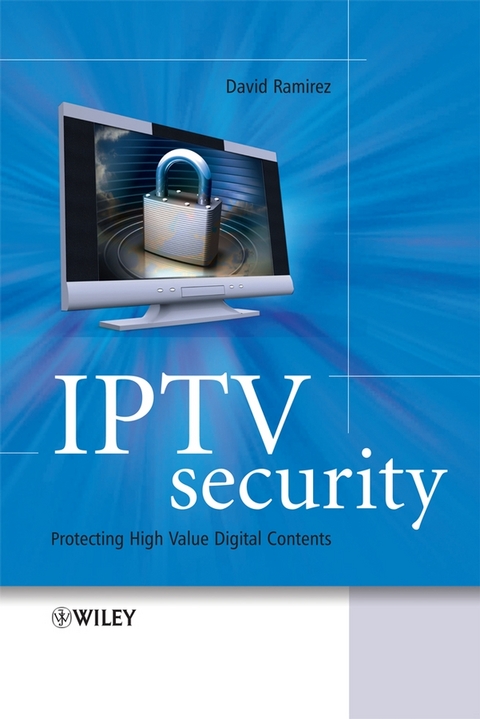
IPTV Security describes the science and history behind TV as well as detailed descriptions of all the architectural components that comprise an IPTV environment. It covers subjects logically from the Head End passing through the aggregation network and concluding with the Home End environment. The countermeasures required to ensure the safe operation of the IPTV environment are also examined, including Digital Rights Management technologies, network level security and application level security. IPTV Security defines the security model for an IPTV environment, ensuring that all critical elements are covered and a layered approach to security is implemented.
- One of the only books available on IPTV Security
- Provides a comprehensive view of IPTV components along with the associated threats and required countermeasures
- Detailed descriptions allow readers to understand the technology even if new to the field
- A complete reference guide to the security aspects of IPTV.
This book is ideal for anyone responsible for IPTV security such as security officers and auditors working with internet services and telecommunications providers, phone and cable companies, content owners and security consultants and architects. It will also be of interest to networking and security engineers, software developers, network operators and university lectures and students involved in media, IT and security.
David Ramirez, Alcatel-Lucent, UK. David is Senior Manager of Alcatel-Lucent's Security Consulting practice where his responsibilities include Innovation & Technology, Thought Leadership and Knowledge Sharing. He has contributed to several magazines, newspapers and web sites on topics such as Ethical Hacking, Web Security, Security Incidents, Forensics, Digital Certificates, etc. David is the author of a white paper on IPTV Threats for Lucent, interviews and articles for the IEC, Lucent, Webtorials, magazines in Europe and the US. He is also speaker at several European and Easter European conferences on security and telecommunications, where he presented the topic of IPTV Security, security for converged networks and networking security.
Television was one of the inventions that shaped the way society and culture evolved over the second half of the twentieth century. It had the powerful effect of shrinking the world which creating a unified view of how things were. There continues to be an evolution of television and a migration towards a fully interactive and ubiquitous IPTV. IPTV Security describes the science and history behind TV as well as detailed descriptions of all the architectural components that comprise an IPTV environment. It covers subjects logically from the Head End passing through the aggregation network and concluding with the Home End environment. The countermeasures required to ensure the safe operation of the IPTV environment are also examined, including Digital Rights Management technologies, network level security and application level security. IPTV Security defines the security model for an IPTV environment, ensuring that all critical elements are covered and a layered approach to security is implemented. One of the only books available on IPTV Security Provides a comprehensive view of IPTV components along with the associated threats and required countermeasures Detailed descriptions allow readers to understand the technology even if new to the field A complete reference guide to the security aspects of IPTV. This book is ideal for anyone responsible for IPTV security such as security officers and auditors working with internet services and telecommunications providers, phone and cable companies, content owners and security consultants and architects. It will also be of interest to networking and security engineers, software developers, network operators and university lectures and students involved in media, IT and security.
David Ramirez, Alcatel-Lucent, UK. David is Senior Manager of Alcatel-Lucent's Security Consulting practice where his responsibilities include Innovation & Technology, Thought Leadership and Knowledge Sharing. He has contributed to several magazines, newspapers and web sites on topics such as Ethical Hacking, Web Security, Security Incidents, Forensics, Digital Certificates, etc. David is the author of a white paper on IPTV Threats for Lucent, interviews and articles for the IEC, Lucent, Webtorials, magazines in Europe and the US. He is also speaker at several European and Easter European conferences on security and telecommunications, where he presented the topic of IPTV Security, security for converged networks and networking security.
Preface.
About the Author.
1. Introduction to IPTV
1.1 Introduction.
1.2 General Threats to IPTV Deployments.
2. Principles Supporting IPTV.
2.1 History of video and television.
2.2 Viewing Experience of Video.
2.3 Video compression.
2.4 TCP/IP Principles.
2.5 Summary.
3. IPTV Architecture.
3.1 High-level Architecture.
3.2 Functional architecture for the IPTV service.
3.3 Detailed IPTV architecture.
3.4 Summary.
4.Intellectual Property (IP).
4.1 Introduction.
4.2 Supporting technology.
4.3 General mechanisms for content protection.
4.4 Operation of DRM on IPTV.
4.5 Watermarking and Fingerprinting.
4.6 WWW? (What went wrong).
4.7 Authentication.
4.8 Summary.
5.Existing Threats to IPTV implementations.
5.1 Introduction to IPTV Threats.
5.2 IPTV Service provider - Head End.
5.3 IPTV Network provider - transport and aggregation
network.
5.4 IPTV Subscriber - Home End.
5.5 Conclusion.
6. Countering the Threats.
6.1 Securing the basis.
6.2 Head End (IPTV Service Provider).
6.3Aggregation and Transport Network.
6.4 Home End.
6.5 Secure IPTV a reality.
Appendix 1. Converged Video Security.
A1.1 Introduction.
A1.2 Threats to IPTV Deployments.
A1.3 Protecting Intellectual Property.
A1.4 VOD and Broadcast.
A1.5 Smart Cards and DRM.
A1.6 Countering the Threats.
A1.6.1 Threat References.
A1.6.2 Threat Models.
Appendix 2. Federated Identity in IPTV Environments.
A2.1 Introduction.
A2.2 IPTV Federated Identity Solutions.
A2.3 Applicability to an IPTV Security Environment.
A2.4 Video on Demand.
Appendix 3. Barbarians at the Gate.
A3.1 Barbarians at the Gate.
A3.2 How to Break an IPTV Environment.
A3.3 Network Under Siege.
A3.4 Countermeasures.
A3.5 Conclusion.
Index.
| Erscheint lt. Verlag | 28.2.2008 |
|---|---|
| Sprache | englisch |
| Themenwelt | Informatik ► Netzwerke ► Sicherheit / Firewall |
| Technik ► Elektrotechnik / Energietechnik | |
| Technik ► Nachrichtentechnik | |
| Schlagworte | architectural components • Communication technology • Continues • Descriptions • Drahtlose Kommunikation • Electrical & Electronics Engineering • Elektrotechnik u. Elektronik • End • Environment • Evolution • Half • Head • History • inventions • IPTV • Kommunikationstechnik • logically • Migration • Mobile & Wireless Communications • Network • powerful effect • Science • Second • Society • Television • things • TV • Unified • View • Way • World |
| ISBN-10 | 0-470-72719-5 / 0470727195 |
| ISBN-13 | 978-0-470-72719-5 / 9780470727195 |
| Informationen gemäß Produktsicherheitsverordnung (GPSR) | |
| Haben Sie eine Frage zum Produkt? |
 PDF (Adobe DRM)
Kopierschutz: Adobe-DRM
Adobe-DRM ist ein Kopierschutz, der das eBook vor Mißbrauch schützen soll. Dabei wird das eBook bereits beim Download auf Ihre persönliche Adobe-ID autorisiert. Lesen können Sie das eBook dann nur auf den Geräten, welche ebenfalls auf Ihre Adobe-ID registriert sind.
Details zum Adobe-DRM
Dateiformat: PDF (Portable Document Format)
Mit einem festen Seitenlayout eignet sich die PDF besonders für Fachbücher mit Spalten, Tabellen und Abbildungen. Eine PDF kann auf fast allen Geräten angezeigt werden, ist aber für kleine Displays (Smartphone, eReader) nur eingeschränkt geeignet.
Systemvoraussetzungen:
PC/Mac: Mit einem PC oder Mac können Sie dieses eBook lesen. Sie benötigen eine
eReader: Dieses eBook kann mit (fast) allen eBook-Readern gelesen werden. Mit dem amazon-Kindle ist es aber nicht kompatibel.
Smartphone/Tablet: Egal ob Apple oder Android, dieses eBook können Sie lesen. Sie benötigen eine
Geräteliste und zusätzliche Hinweise
Buying eBooks from abroad
For tax law reasons we can sell eBooks just within Germany and Switzerland. Regrettably we cannot fulfill eBook-orders from other countries.
aus dem Bereich