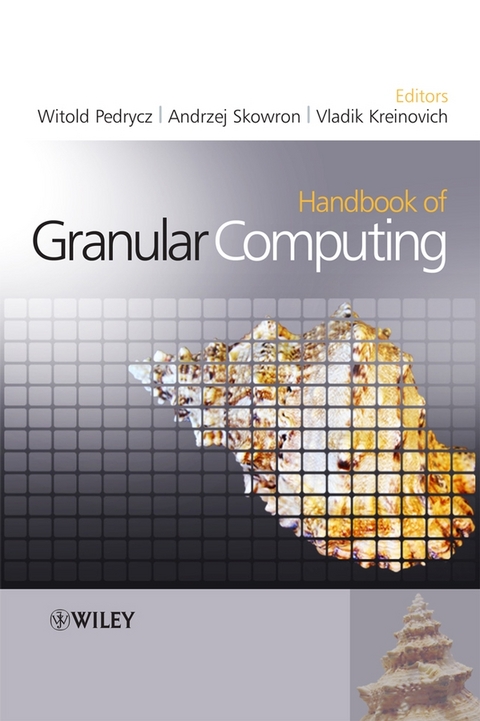
The Handbook of Granular Computing offers a comprehensive reference source for the granular computing community, edited by and with contributions from leading experts in the field.
- Includes chapters covering the foundations of granular computing, interval analysis and fuzzy set theory; hybrid methods and models of granular computing; and applications and case studies.
- Divided into 5 sections: Preliminaries, Fundamentals, Methodology and Algorithms, Development of Hybrid Models and Applications and Case Studies.
- Presents the flow of ideas in a systematic, well-organized manner, starting with the concepts and motivation and proceeding to detailed design that materializes in specific algorithms, applications and case studies.
- Provides the reader with a self-contained reference that includes all pre-requisite knowledge, augmented with step-by-step explanations of more advanced concepts.
The Handbook of Granular Computing represents a significant and valuable contribution to the literature and will appeal to a broad audience including researchers, students and practitioners in the fields of Computational Intelligence, pattern recognition, fuzzy sets and neural networks, system modelling, operations research and bioinformatics.
Witold Pedrycz is a Professor and Canada Research Chair (CRC) in the Department of Electrical and Computer Engineering, University of Alberta, Edmonton, Canada. He is also with the Systems Research Institute of the Polish Academy of Sciences. He is actively pursuing research in Computational Intelligence, fuzzy modeling, knowledge discovery and data mining, fuzzy control including fuzzy controllers, pattern recognition, knowledge-based neural networks, relational computation, bioinformatics, and Software Engineering. He has published numerous papers in this area. He is also an author of 9 research monographs covering various aspects of Computational Intelligence and Software Engineering.
Andrzej Skowron holds a Ph.D. degree in Mathematical Foundations of Computer Science from the University of Warsaw in Poland, Doctor of Science (Habilitation) degree in Mathematical Foundations of Computer Science from the University of Warsaw in Poland. In 1991 he received the Scientific Title of Professor. Andrzej Skowron is the author and co-author of more than 280 scientific publications, 15 edited books and several special issues of international journals.
Vladik Kreinovich Department of Computer Science University of Texas. He received his M.S. in Mathematics and Computer Science from St. Petersburg University, Russia, in 1974, and Ph.D. from the Institute of Mathematics, Soviet Academy of Sciences, Published 6 books and more than 600 papers. Member of the editorial board of the international journal 'Reliable Computing' (formerly, 'Interval Computations'), and several other journals. Co-maintainer of the international website on interval computations.
Although the notion is a relatively recent one, the notions and principles of Granular Computing (GrC) have appeared in a different guise in many related fields including granularity in Artificial Intelligence, interval computing, cluster analysis, quotient space theory and many others. Recent years have witnessed a renewed and expanding interest in the topic as it begins to play a key role in bioinformatics, e-commerce, machine learning, security, data mining and wireless mobile computing when it comes to the issues of effectiveness, robustness and uncertainty. The Handbook of Granular Computing offers a comprehensive reference source for the granular computing community, edited by and with contributions from leading experts in the field. Includes chapters covering the foundations of granular computing, interval analysis and fuzzy set theory; hybrid methods and models of granular computing; and applications and case studies. Divided into 5 sections: Preliminaries, Fundamentals, Methodology and Algorithms, Development of Hybrid Models and Applications and Case Studies. Presents the flow of ideas in a systematic, well-organized manner, starting with the concepts and motivation and proceeding to detailed design that materializes in specific algorithms, applications and case studies. Provides the reader with a self-contained reference that includes all pre-requisite knowledge, augmented with step-by-step explanations of more advanced concepts. The Handbook of Granular Computing represents a significant and valuable contribution to the literature and will appeal to a broad audience including researchers, students and practitioners in the fields of Computational Intelligence, pattern recognition, fuzzy sets and neural networks, system modelling, operations research and bioinformatics.
Witold Pedrycz is a Professor and Canada Research Chair (CRC) in the Department of Electrical and Computer Engineering, University of Alberta, Edmonton, Canada. He is also with the Systems Research Institute of the Polish Academy of Sciences. He is actively pursuing research in Computational Intelligence, fuzzy modeling, knowledge discovery and data mining, fuzzy control including fuzzy controllers, pattern recognition, knowledge-based neural networks, relational computation, bioinformatics, and Software Engineering. He has published numerous papers in this area. He is also an author of 9 research monographs covering various aspects of Computational Intelligence and Software Engineering. Andrzej Skowron holds a Ph.D. degree in Mathematical Foundations of Computer Science from the University of Warsaw in Poland, Doctor of Science (Habilitation) degree in Mathematical Foundations of Computer Science from the University of Warsaw in Poland. In 1991 he received the Scientific Title of Professor. Andrzej Skowron is the author and co-author of more than 280 scientific publications, 15 edited books and several special issues of international journals. Vladik Kreinovich Department of Computer Science University of Texas. He received his M.S. in Mathematics and Computer Science from St. Petersburg University, Russia, in 1974, and Ph.D. from the Institute of Mathematics, Soviet Academy of Sciences, Published 6 books and more than 600 papers. Member of the editorial board of the international journal "Reliable Computing" (formerly, "Interval Computations"), and several other journals. Co-maintainer of the international website on interval computations.
| Erscheint lt. Verlag | 31.7.2008 |
|---|---|
| Sprache | englisch |
| Themenwelt | Informatik ► Theorie / Studium ► Künstliche Intelligenz / Robotik |
| Technik ► Elektrotechnik / Energietechnik | |
| Schlagworte | Applied Mathematics in Science • begins • Comprehensive • Computer Engineering • Computertechnik • Different • Effectiveness • Electrical & Electronics Engineering • Elektrotechnik u. Elektronik • Expanding • fields including • Fuzzy-Systeme • Fuzzy Systems • granular • granularity • GRC • guise • Handbook • Issues • Key • many • Mathematics • Mathematik • Mathematik in den Naturwissenschaften • Mobile • notion • Principles • Quotient space • Reference • Role • source • topic • years |
| ISBN-13 | 9780470724156 / 9780470724156 |
| Informationen gemäß Produktsicherheitsverordnung (GPSR) | |
| Haben Sie eine Frage zum Produkt? |
 PDF (Adobe DRM)
Kopierschutz: Adobe-DRM
Adobe-DRM ist ein Kopierschutz, der das eBook vor Mißbrauch schützen soll. Dabei wird das eBook bereits beim Download auf Ihre persönliche Adobe-ID autorisiert. Lesen können Sie das eBook dann nur auf den Geräten, welche ebenfalls auf Ihre Adobe-ID registriert sind.
Details zum Adobe-DRM
Dateiformat: PDF (Portable Document Format)
Mit einem festen Seitenlayout eignet sich die PDF besonders für Fachbücher mit Spalten, Tabellen und Abbildungen. Eine PDF kann auf fast allen Geräten angezeigt werden, ist aber für kleine Displays (Smartphone, eReader) nur eingeschränkt geeignet.
Systemvoraussetzungen:
PC/Mac: Mit einem PC oder Mac können Sie dieses eBook lesen. Sie benötigen eine
eReader: Dieses eBook kann mit (fast) allen eBook-Readern gelesen werden. Mit dem amazon-Kindle ist es aber nicht kompatibel.
Smartphone/Tablet: Egal ob Apple oder Android, dieses eBook können Sie lesen. Sie benötigen eine
Geräteliste und zusätzliche Hinweise
Buying eBooks from abroad
For tax law reasons we can sell eBooks just within Germany and Switzerland. Regrettably we cannot fulfill eBook-orders from other countries.
aus dem Bereich