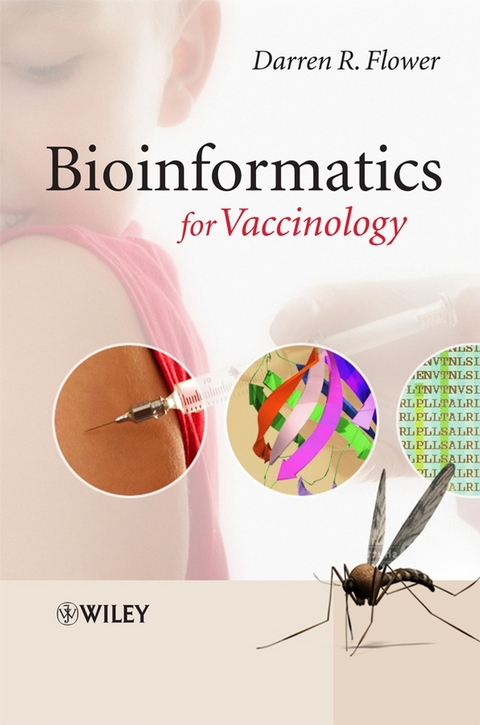
Bioinformatics for Vaccinology (eBook)
John Wiley & Sons (Verlag)
978-0-470-69982-9 (ISBN)
'... This book has several strong points. Although there are many textbooks that deal with vaccinology, few attempts have been made to bring together descriptions of vaccines in history, basic bioinformatics, various computational solutions and challenges in vaccinology, detailed experimental methodologies, and cutting-edge technologies... This book may well serve as a first line of reference for all biologists and computer scientists...' -Virology Journal, 2009
Vaccines have probably saved more lives and reduced suffering in a greater number of people than any other medical intervention in human history, succeeding in eradicating smallpox and significantly reducing the mortality and incidence of other diseases. However, with the emergence of diseases such as SARS and the threat of biological warfare, vaccination has once again become a topic of major interest in public health.
Vaccinology now has at its disposal an array of post-genomic approaches of great power. None has a more persuasive potential impact than the application of computational informatics to vaccine discovery; the recent expansion in genome data and the parallel increase in cheap computing power have placed the bioinformatics exploration of pathogen genomes centre stage for vaccine researchers.
This is the first book to address the area of bioinformatics as applied to rational vaccine design, discussing the ways in which bioinformatics can contribute to improved vaccine development by
- introducing the subject of harnessing the mathematical and computing power inherent in bioinformatics to the study of vaccinology
- putting it into a historical and societal context, and
- exploring the scope of its methods and applications.
Bioinformatics for Vaccinology is a one-stop introduction to computational vaccinology. It will be of particular interest to bioinformaticians with an interest in immunology, as well as to immunologists, and other biologists who need to understand how advances in theoretical and computational immunobiology can transform their working practices.
Dr Darren R Flower, Reader in Pharmacy, School of Life and Health Sciences, University of Aston, Birmingham, UK.
this book was written from start to finish by one extremely dedicated and erudite individual. The author has done an excellent job of covering the many topics that fall under the umbrella of computational biology for vaccine design, demonstrating an admirable command of subject matter in fields as disparate as object-oriented databases and regulation of T cell response. Simply put, it has just the right breadth and depth, and it reads well. In fact, readability is one of its virtues making the book enticing and useful, all at once Human Vaccines, 2010 "e;... This book has several strong points. Although there are many textbooks that deal with vaccinology, few attempts have been made to bring together descriptions of vaccines in history, basic bioinformatics, various computational solutions and challenges in vaccinology, detailed experimental methodologies, and cutting-edge technologies... This book may well serve as a first line of reference for all biologists and computer scientists..."e; Virology Journal, 2009 Vaccines have probably saved more lives and reduced suffering in a greater number of people than any other medical intervention in human history, succeeding in eradicating smallpox and significantly reducing the mortality and incidence of other diseases. However, with the emergence of diseases such as SARS and the threat of biological warfare, vaccination has once again become a topic of major interest in public health. Vaccinology now has at its disposal an array of post-genomic approaches of great power. None has a more persuasive potential impact than the application of computational informatics to vaccine discovery; the recent expansion in genome data and the parallel increase in cheap computing power have placed the bioinformatics exploration of pathogen genomes centre stage for vaccine researchers. This is the first book to address the area of bioinformatics as applied to rational vaccine design, discussing the ways in which bioinformatics can contribute to improved vaccine development by introducing the subject of harnessing the mathematical and computing power inherent in bioinformatics to the study of vaccinology putting it into a historical and societal context, and exploring the scope of its methods and applications. Bioinformatics for Vaccinology is a one-stop introduction to computational vaccinology. It will be of particular interest to bioinformaticians with an interest in immunology, as well as to immunologists, and other biologists who need to understand how advances in theoretical and computational immunobiology can transform their working practices.
Dr Darren R Flower, Reader in Pharmacy, School of Life and Health Sciences, University of Aston, Birmingham, UK.
Bioinformatics for Vaccinology 3
Contents 9
Preface 15
Acknowledgements 17
Exordium 19
1 Vaccines: Their place in history 23
Smallpox in history 23
Variolation 25
Variolation in history 27
Variolation comes to Britain 28
Lady Mary Wortley Montagu 31
Variolation and the Sublime Porte 33
The royal experiment 35
The boston connection 36
Variolation takes hold 39
The Suttonian method 40
Variolation in Europe 41
The coming of vaccination 43
Edward Jenner 45
Cowpox 48
Vaccination vindicated 50
Louis Pasteur 51
Vaccination becomes a science 52
Meister, Pasteur and rabies 53
A vaccine for every disease 55
In the time of cholera 56
Haffkine and cholera 58
Bubonic plague 59
The changing face of disease 61
Almroth wright and typhoid 62
Tuberculosis, Koch, and Calmette 65
Vaccine BCG 66
Poliomyelitis 68
Salk and Sabin 69
Diphtheria 71
Whooping cough 72
Many diseases, many vaccines 73
Smallpox: Endgame 75
Further reading 76
2 Vaccines: Need and opportunity 77
Eradication and reservoirs 77
The ongoing burden of disease 79
Lifespans 79
The evolving nature of disease 81
Economics, climate and disease 82
Three threats 82
Tuberculosis in the 21 st century 83
HIV and AIDS 84
Malaria: Then and now 85
Influenza 86
Bioterrorism 87
Vaccines as medicines 89
Vaccines and the pharmaceutical industry 90
Making vaccines 92
The coming of the vaccine industry 92
3 Vaccines: How they work 95
Challenging the immune system 95
The threat from bacteria: Robust, diverse, and endemic 96
Microbes, diversity and metagenomics 97
The intrinsic complexity of the bacterial threat 98
Microbes and humankind 99
The nature of vaccines 100
Types of vaccine 102
Carbohydrate vaccines 104
Epitopic vaccines 104
Vaccine delivery 105
Emerging immunovaccinology 106
The immune system 107
Innate immunity 108
Adaptive immunity 110
The microbiome and mucosal immunity 112
Cellular components of immunity 112
Cellular immunity 115
The T cell repertoire 115
Epitopes: The immunological quantum 116
The major histocompatibility complex 117
MHC nomenclature 119
Peptide binding by the MHC 120
The structure of the MHC 121
Antigen presentation 123
The proteasome 123
Transporter associated with antigen processing 125
Class II processing 125
Seek simplicity and then distrust it 126
Cross presentation 127
T cell receptor 128
T cell activation 130
Immunological synapse 131
Signal 1, signal 2, immunodominance 131
Humoral immunity 132
Further reading 134
4 Vaccines: Data and databases 135
Making sense of data 135
Knowledge in a box 136
The science of -omes and -omics 137
The proteome 137
Systems biology 138
The immunome 139
Databases and databanks 140
The relational database 141
The XML database 141
The protein universe 142
Much data, many databases 144
What proteins do 144
What proteins are 146
The amino acid world 146
The chiral nature of amino acids 149
Naming the amino acids 152
The amino acid alphabet 154
Defining amino acid properties 156
Size, charge and hydrogen bonding 157
Hydrophobicity, lipophilicity and partitioning 158
Understanding partitioning 161
Charges, ionization, and pka 162
Many kinds of property 165
Mapping the world of sequences 168
Biological sequence databases 169
Nucleic acid sequence databases 170
Protein sequence databases 171
Annotating databases 172
Text mining 173
Ontologies 175
Secondary sequence databases 176
Other databases 177
Databases in immunology 178
Host databases 178
Pathogen databases 181
Functional immunological databases 183
Composite, integrated databases 184
Allergen databases 185
Further reading 187
Reference 187
5 Vaccines: Data driven prediction of binders, epitopes and immunogenicity 189
Towards epitope-based vaccines 189
T cell epitope prediction 190
Predicting MHC binding 191
Binding is biology 194
Quantifying binding 195
Entropy, enthalpy and entropy-enthalpy compensation 196
Experimental measurement of binding 197
Modern measurement methods 199
Isothermal titration calorimetry 200
Long and short of peptide binding 201
The class I peptide repertoire 202
Practicalities of binding prediction 203
Binding becomes recognition 204
Immunoinformatics lends a hand 205
Motif based prediction 206
The imperfect motif 207
Other approaches to binding prediction 208
Representing sequences 209
Computer science lends a hand 210
Artificial neural networks 210
Hidden Markov models 212
Support vector machines 212
Robust multivariate statistics 213
Partial least squares 213
Quantitative structure activity relationships 214
Other techniques and sequence representations 215
Amino acid properties 216
Direct epitope prediction 217
Predicting antigen presentation 218
Predicting class II MHC binding 219
Assessing prediction accuracy 221
ROC plots 224
Quantitative accuracy 225
Prediction assessment protocols 226
Comparing predictions 228
Prediction versus experiment 229
Predicting B cell epitopes 230
Peak profiles and smoothing 231
Early methods 232
Imperfect B cell prediction 233
References 234
6 Vaccines: Structural approaches 239
Structure and function 239
Types of protein structure 241
Protein folding 242
Ramachandran plots 243
Local structures 244
Protein families, protein folds 245
Comparing structures 245
Experimental structure determination 246
Structural genomics 248
Protein structure databases 249
Other databases 250
Immunological structural databases 251
Small molecule databases 252
Protein homology modelling 253
Using homology modelling 254
Predicting MHC supertypes 255
Application to alloreactivity 257
3D-QSAR 258
Protein docking 260
Predicting B cell epitopes with docking 260
Virtual screening 262
Limitations to virtual screening 263
Predicting epitopes with virtual screening 265
Virtual screening and adjuvant discovery 266
Adjuvants and innate immunity 267
Small molecule adjuvants 268
Molecular dynamics and immunology 270
Molecular dynamics methodology 271
Molecular dynamics and binding 271
Immunological applications 272
Limitations of molecular dynamics 273
Molecular dynamics and high performance computing 274
References 275
7 Vaccines: Computational solutions 279
Vaccines and the world 279
Bioinformatics and the challenge for vaccinology 281
Predicting immunogenicity 282
Computational vaccinology 283
The threat remains 284
Beyond empirical vaccinology 284
Designing new vaccines 285
The perfect vaccine 286
Conventional approaches 287
Genome sequences 288
Size of a genome 288
Reverse vaccinology 290
Finding antigens 291
The success of reverse vaccinology 293
Tumour vaccines 295
Prediction and personalised medicine 296
Imperfect data 298
Forecasting and the future of computational vaccinology 299
Index 305
"It pulls a number of different disciplines into a concise
review that illustrates the potential we have in science to change
our world." (Doody's, April 2009)
"This book may well serve as a first line of reference for all
biologists and
computer scientists. This textbook would be an excellent addition
to the bookshelf of most scientists who encounter vaccinology in
the drug discovery and development processes." ( Virology Journal -
October -2009)
| Erscheint lt. Verlag | 13.10.2008 |
|---|---|
| Sprache | englisch |
| Themenwelt | Informatik ► Weitere Themen ► Bioinformatik |
| Studium ► Querschnittsbereiche ► Infektiologie / Immunologie | |
| Studium ► Querschnittsbereiche ► Prävention / Gesundheitsförderung | |
| Naturwissenschaften ► Biologie ► Biochemie | |
| Schlagworte | Bioinformatics & Computational Biology • Bioinformatik • Bioinformatik u. Computersimulationen in der Biowissenschaften • Biowissenschaften • Britain • bubonic • burden • Cholera • contents • Disease • every • Exordium • FACE • Genetics • Genetik • History • Immunologie • immunology • Impfung • Influenza • Introduction • Lady • Life Sciences • many diseases • many vaccines • Medical Science • Medizin • Opportunity • Place • Short • Smallpox • ST • threats • Time • Vaccine • variolation |
| ISBN-10 | 0-470-69982-5 / 0470699825 |
| ISBN-13 | 978-0-470-69982-9 / 9780470699829 |
| Informationen gemäß Produktsicherheitsverordnung (GPSR) | |
| Haben Sie eine Frage zum Produkt? |
 PDF (Adobe DRM)
Kopierschutz: Adobe-DRM
Adobe-DRM ist ein Kopierschutz, der das eBook vor Mißbrauch schützen soll. Dabei wird das eBook bereits beim Download auf Ihre persönliche Adobe-ID autorisiert. Lesen können Sie das eBook dann nur auf den Geräten, welche ebenfalls auf Ihre Adobe-ID registriert sind.
Details zum Adobe-DRM
Dateiformat: PDF (Portable Document Format)
Mit einem festen Seitenlayout eignet sich die PDF besonders für Fachbücher mit Spalten, Tabellen und Abbildungen. Eine PDF kann auf fast allen Geräten angezeigt werden, ist aber für kleine Displays (Smartphone, eReader) nur eingeschränkt geeignet.
Systemvoraussetzungen:
PC/Mac: Mit einem PC oder Mac können Sie dieses eBook lesen. Sie benötigen eine
eReader: Dieses eBook kann mit (fast) allen eBook-Readern gelesen werden. Mit dem amazon-Kindle ist es aber nicht kompatibel.
Smartphone/Tablet: Egal ob Apple oder Android, dieses eBook können Sie lesen. Sie benötigen eine
Geräteliste und zusätzliche Hinweise
Buying eBooks from abroad
For tax law reasons we can sell eBooks just within Germany and Switzerland. Regrettably we cannot fulfill eBook-orders from other countries.
aus dem Bereich