Error-controlled Adaptive Finite Elements in Solid Mechanics (eBook)
John Wiley & Sons (Verlag)
978-0-470-85797-7 (ISBN)
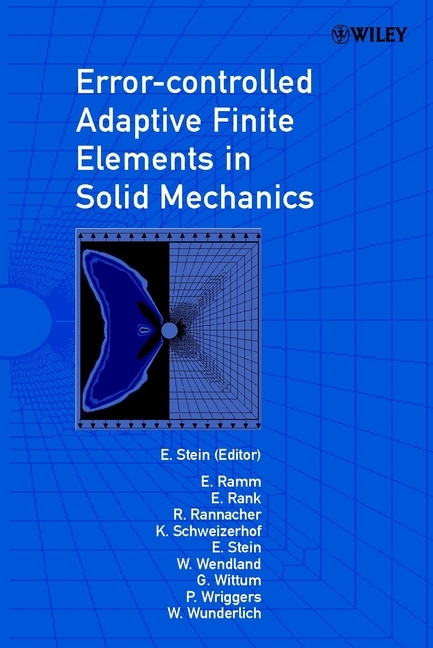
Finite Element Methods are used for numerous engineering applications where numerical solutions of partial differential equations are needed. As computers can now deal with the millions of parameters used in these methods, automatic error estimation and automatic adaptation of the utilised method (according to this error estimation), has become a hot research topic.
This text offers comprehensive coverage of this new field of automatic adaptation and error estimation, bringing together the work of eight outstanding researchers in this field who have completed a six year national research project within the German Science Foundation. The result is a state-of-the-art work in true reference style. Each chapter is self-contained and covers theoretical, algorithmic and software presentations as well as solved problems. A main feature consists of several carefully elaborated benchmarks of 2D- and 3D- applications.
- First book to go beyond the Finite Element Method in itself
- Covers material from a new research area
- Presents benchmarks of 2D- and 3D- applications
- Fits with the new trend for genetic strategies in engineering
Erwin Stein, PhD is Professor Emeritus, Curator of the Leibniz Exhibition, Stein Institut für Baumechanik und Numerische Mechanik, Leibniz Universität, Hannover, Germany. Institute of Mechanics and Computational Mechanics.
Finite Element Methods are used for numerous engineering applications where numerical solutions of partial differential equations are needed. As computers can now deal with the millions of parameters used in these methods, automatic error estimation and automatic adaptation of the utilised method (according to this error estimation), has become a hot research topic. This text offers comprehensive coverage of this new field of automatic adaptation and error estimation, bringing together the work of eight outstanding researchers in this field who have completed a six year national research project within the German Science Foundation. The result is a state-of-the-art work in true reference style. Each chapter is self-contained and covers theoretical, algorithmic and software presentations as well as solved problems. A main feature consists of several carefully elaborated benchmarks of 2D- and 3D- applications. First book to go beyond the Finite Element Method in itself Covers material from a new research area Presents benchmarks of 2D- and 3D- applications Fits with the new trend for genetic strategies in engineering
Erwin Stein, PhD is Professor Emeritus, Curator of the Leibniz Exhibition, Stein Institut für Baumechanik und Numerische Mechanik, Leibniz Universität, Hannover, Germany. Institute of Mechanics and Computational Mechanics.
Preface.
Introduction (Stein).
Error Estimation and Adaptive Mesh Design for FE Models in Elasto-Plasticity Theory (Rannacher and Suttmeier).
Adaptive FEM for elasto-plastic Deformations (Stein and Schmidt).
Numerical Simulation of Localization Phenomena in Geomechanics by Entended Continuum Formulations (Wunderlich et al).
Adaptive Methods for Contact Problems (Rieger et al).
An Adaptive Boundary Element Method for Contact Problems (Eck et al).
Goal-Oriented Error Estimation in Solid Mechanics (Steeb,Maute and Ramm).
The p-version of the Finite Element Method for Structural Problems (Rank et al).
Adaptive Analysis of Plate and Shell Structures Under Transient Loading (Schweizerhof, Neumann and Riccius).
The Application of Adaptive Parallel Multigrid Methods to Problems in Nonlinear Solid Mechanics (Lang, Wieners and Wittum).
Benchmarks (Stein et al).
| Erscheint lt. Verlag | 1.8.2003 |
|---|---|
| Sprache | englisch |
| Themenwelt | Mathematik / Informatik ► Informatik ► Theorie / Studium |
| Mathematik / Informatik ► Mathematik ► Angewandte Mathematik | |
| Technik ► Bauwesen | |
| Technik ► Maschinenbau | |
| Schlagworte | algorithms • Aspects • Bauingenieur- u. Bauwesen • Bauwesen • Book • Civil Engineering & Construction • Civil Engineering & Construction Special Topics • Computational / Numerical Methods • DFG • Efficient • Element • error • Estimates • Festkörpermechanik • Festkörpermechanik • Finite • Finite-Elemente-Methode • Foundation • German • mainly • Maschinenbau • Mathematics • Mathematik • mechanical engineering • Method • Methods • national • New • nine • Nonlinear • Numerical • Numerical Methods • numerische Methoden • Problems • Progress • Rechnergestützte / Numerische Verfahren im Maschinenbau • Rechnergestützte / Numerische Verfahren im Maschinenbau • Science • six year joint project • Spezialthemen Bauingenieur- u. Bauwesen • university institutes |
| ISBN-10 | 0-470-85797-8 / 0470857978 |
| ISBN-13 | 978-0-470-85797-7 / 9780470857977 |
| Informationen gemäß Produktsicherheitsverordnung (GPSR) | |
| Haben Sie eine Frage zum Produkt? |
 PDF (Adobe DRM)
Kopierschutz: Adobe-DRM
Adobe-DRM ist ein Kopierschutz, der das eBook vor Mißbrauch schützen soll. Dabei wird das eBook bereits beim Download auf Ihre persönliche Adobe-ID autorisiert. Lesen können Sie das eBook dann nur auf den Geräten, welche ebenfalls auf Ihre Adobe-ID registriert sind.
Details zum Adobe-DRM
Dateiformat: PDF (Portable Document Format)
Mit einem festen Seitenlayout eignet sich die PDF besonders für Fachbücher mit Spalten, Tabellen und Abbildungen. Eine PDF kann auf fast allen Geräten angezeigt werden, ist aber für kleine Displays (Smartphone, eReader) nur eingeschränkt geeignet.
Systemvoraussetzungen:
PC/Mac: Mit einem PC oder Mac können Sie dieses eBook lesen. Sie benötigen eine
eReader: Dieses eBook kann mit (fast) allen eBook-Readern gelesen werden. Mit dem amazon-Kindle ist es aber nicht kompatibel.
Smartphone/Tablet: Egal ob Apple oder Android, dieses eBook können Sie lesen. Sie benötigen eine
Geräteliste und zusätzliche Hinweise
Buying eBooks from abroad
For tax law reasons we can sell eBooks just within Germany and Switzerland. Regrettably we cannot fulfill eBook-orders from other countries.
aus dem Bereich