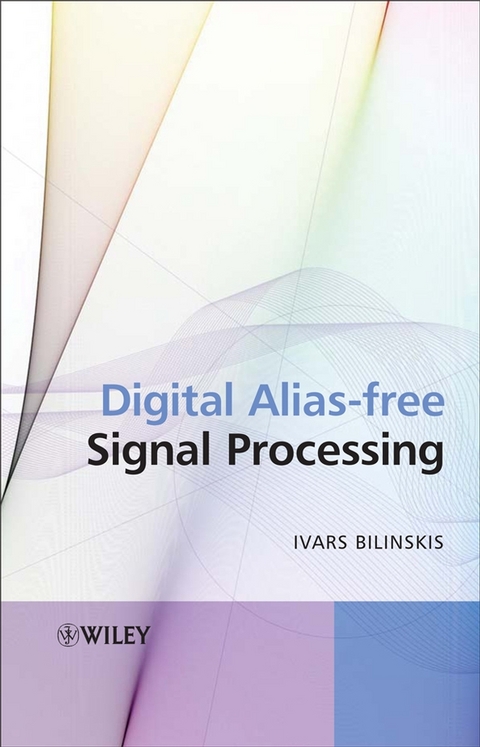
Digital Alias-free Signal Processing (eBook)
John Wiley & Sons (Verlag)
978-0-470-51162-6 (ISBN)
This book provides practical and comprehensive coverage of the theory and techniques behind alias-free digital signal processing.
Key features:
- Analyses issues of sampling, randomised and pseudo-randomised quantisation and direct and indirectly randomised sampling.
- Examines periodic and hybrid sampling, including information on processing algorithms and potential limitations imposed by signal dynamics.
- Sets out leading methods and techniques for complexity reduced designs, in particular designs of large aperture sensor arrays, massive data acquisition and compression from a number of signal sources and complexity-reduced processing of non-uniform data.
- Presents examples of engineering applications using these techniques including spectrum analysis, waveform reconstruction and the estimation of various parameters, emphasising the importance of the technique for developing new technologies.
- Links DASP and traditional technologies by mapping them into embedded systems with standard inputs and outputs.
Digital Alias-free Signal Processing is ideal for practising engineers and researchers working on the development of digital signal processing applications at extended frequencies. It is also a valuable reference for electrical and computer engineering graduates taking courses in signal processing or digital signal processing.
Ivars Bilinskis is currently a Professor in the Institute of Electronics and Computer Science and Head of the Laboratory for Digital Signal Processing at the Latvian University, Latvia. He has been at the university since 1992, where his research interests include digital signal processing, particularly digital alias-free signal processing (DASP), signal parameter estimation, and digital filtering of irregular data sequences. Previous to this, he has lectured at the University of Westminster, London, and at the Universitat Politecnica de Catalunya, Barcelona, Spain. He is Editor in Chief of the journal Automatic Control and Computer Science (Russian Institute of Electronics and Computer Science), and has co-authored the books Randomized Signal Processing (Prentice Hall, 1992) and Randomized Signal Processing of Continuous Signals (in Russian, Zinatne Press, 1983). He has also written 165 academic publications, including 52 certificates of inventions, and been Head of several European research projects.
As demand for applications working in extended frequency ranges increases, classical Digital signal processing (DSP) techniques, not protected against aliasing, are becoming less effective. Digital alias-free signal processing (DASP) is a technique for overcoming the problems of aliasing at extended frequency ranges. Based on non-uniform or randomised sampling techniques and the development of novel algorithms, it creates the capacity to suppress potential aliasing crucial for high frequency applications and to reduce the complexity of designs. This book provides practical and comprehensive coverage of the theory and techniques behind alias-free digital signal processing. Key features: Analyses issues of sampling, randomised and pseudo-randomised quantisation and direct and indirectly randomised sampling. Examines periodic and hybrid sampling, including information on processing algorithms and potential limitations imposed by signal dynamics. Sets out leading methods and techniques for complexity reduced designs, in particular designs of large aperture sensor arrays, massive data acquisition and compression from a number of signal sources and complexity-reduced processing of non-uniform data. Presents examples of engineering applications using these techniques including spectrum analysis, waveform reconstruction and the estimation of various parameters, emphasising the importance of the technique for developing new technologies. Links DASP and traditional technologies by mapping them into embedded systems with standard inputs and outputs. Digital Alias-free Signal Processing is ideal for practising engineers and researchers working on the development of digital signal processing applications at extended frequencies. It is also a valuable reference for electrical and computer engineering graduates taking courses in signal processing or digital signal processing.
Ivars Bilinskis is currently a Professor in the Institute of Electronics and Computer Science and Head of the Laboratory for Digital Signal Processing at the Latvian University, Latvia. He has been at the university since 1992, where his research interests include digital signal processing, particularly digital alias-free signal processing (DASP), signal parameter estimation, and digital filtering of irregular data sequences. Previous to this, he has lectured at the University of Westminster, London, and at the Universitat Politecnica de Catalunya, Barcelona, Spain. He is Editor in Chief of the journal Automatic Control and Computer Science (Russian Institute of Electronics and Computer Science), and has co-authored the books Randomized Signal Processing (Prentice Hall, 1992) and Randomized Signal Processing of Continuous Signals (in Russian, Zinatne Press, 1983). He has also written 165 academic publications, including 52 certificates of inventions, and been Head of several European research projects.
"It is a solid reference book for electronic and computer engineers working in the DSP domain." (Zentralblatt Math 1130, May 2008)
| Erscheint lt. Verlag | 27.9.2007 |
|---|---|
| Sprache | englisch |
| Themenwelt | Mathematik / Informatik ► Informatik |
| Technik ► Elektrotechnik / Energietechnik | |
| Technik ► Nachrichtentechnik | |
| Schlagworte | algorithms • aliasfree • Aliasing • Applications • Classical • Communication technology • DASP • demand • DSP • Electrical & Electronics Engineering • Elektrotechnik u. Elektronik • Extended • Frequency • increases • Kommunikationstechnik • less effective • nonuniform • Novel • Problems • Processing • ranges • Signal • Signal Processing • Signalverarbeitung • technique • techniques |
| ISBN-10 | 0-470-51162-1 / 0470511621 |
| ISBN-13 | 978-0-470-51162-6 / 9780470511626 |
| Informationen gemäß Produktsicherheitsverordnung (GPSR) | |
| Haben Sie eine Frage zum Produkt? |
 PDF (Adobe DRM)
Kopierschutz: Adobe-DRM
Adobe-DRM ist ein Kopierschutz, der das eBook vor Mißbrauch schützen soll. Dabei wird das eBook bereits beim Download auf Ihre persönliche Adobe-ID autorisiert. Lesen können Sie das eBook dann nur auf den Geräten, welche ebenfalls auf Ihre Adobe-ID registriert sind.
Details zum Adobe-DRM
Dateiformat: PDF (Portable Document Format)
Mit einem festen Seitenlayout eignet sich die PDF besonders für Fachbücher mit Spalten, Tabellen und Abbildungen. Eine PDF kann auf fast allen Geräten angezeigt werden, ist aber für kleine Displays (Smartphone, eReader) nur eingeschränkt geeignet.
Systemvoraussetzungen:
PC/Mac: Mit einem PC oder Mac können Sie dieses eBook lesen. Sie benötigen eine
eReader: Dieses eBook kann mit (fast) allen eBook-Readern gelesen werden. Mit dem amazon-Kindle ist es aber nicht kompatibel.
Smartphone/Tablet: Egal ob Apple oder Android, dieses eBook können Sie lesen. Sie benötigen eine
Geräteliste und zusätzliche Hinweise
Buying eBooks from abroad
For tax law reasons we can sell eBooks just within Germany and Switzerland. Regrettably we cannot fulfill eBook-orders from other countries.
aus dem Bereich