Pier Luigi Luisi and Peter Walde, both of Institut fur Polymere, ETH-Zurich, Switzerland
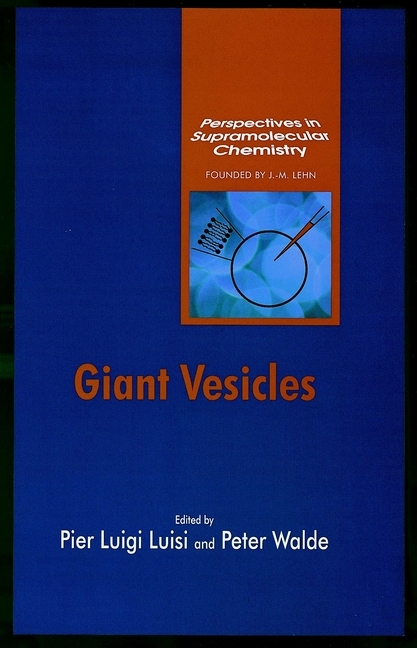
Perspectives in Supramolecular Chemistry Founded by J.-M. Lehn Perspectives in Supramolecular Chemistry reflects research which develops supramolecular structures with specific new properties, such as recognition, transport and simulation of biosystems or new materials. The series covers all areas from theoretical and modelling aspects through organic and inorganic chemistry and biochemistry to materials, solid-state and polymer sciences reflecting the many and varied applications of supramolecular structures in modern chemistry. Giant Vesicles Edited by Pier Luigi Luisi and Peter Walde Institute f r Polymere, ETH-Z rich, Switzerland Giant vesicles or giant liposomes are supramolecular assembles of amphiphiles, surface active substances which normally contain one or two hydrophobic chains and one hydrophilic head. Due to their relatively large size, giant vesicles are easily observed by light microscopy. This volume provides an overview of ideas and results obtained from experimental studies as well as theoretical approaches. A wide variety of aspects ranging from pure mathematics and physical considerations to biochemical and biological applications are covered. Historical and fundamental aspects are discussed as well as a range of experimental approaches including the micromanipulation and micro-puncturing of single giant vesicles. 87 international contributors comment on a wide range of issues contained under the five main part headings: Introduction Preparation Methods Basic Theoretical Aspects Physical Properties Chemical and Biological Aspects. Giant Vesicles has been written for researchers in the fields of chemistry, biochemistry and biophysics, working in supra-molecular chemistry, surfactant science, liposome and pharmaceutical sciences.
Pier Luigi Luisi and Peter Walde, both of Institut fur Polymere, ETH-Zurich, Switzerland
INTRODUCTION.
Why Giant Vesicles? (P. Luisi).
Giant Vesicles: A Historical Introduction (D. Lasic).
PREPARATION METHODS.
Liposome Electroformation (M. Angelova).
Formation of Giant Vesicles from Different Kinds of Lipids Using the Electroformation Method (A. Fischer, et al.).
Observation of a Variety of Giant Vesicles under an Optical Microscope (Ken-ichirou Akashi et al).
BASIC THEORETICAL ASPECTS.
Bending Elasticity of Fluid Membranes (W. Helfrich).
Giant Vesicles: A Theoretical Perspective (U. Seifert).
Free Energy of a Fluctuating Vesicle. Influence of the Fluctuations on the Laplace Law (I. Bivas).
PHYSICAL PROPERTIES.
Use of Micropipet Manipulation Techniques to Measure the Properties of Giant Lipid Vesicles (David Needham and Doncho Zhelev)
Fluctuating Vesicle Shapes (H.-G. Dobereiner).
Oblate-Prolate Transition of Ellipsoidal Magnetoliposomes: Experiments showing an Anisotropic Spontaneous Curvature (Olivier Sandre et al).
Micromanipulation of Tubular Vesicles (L. Xu H.-G. Dobereiner).
Electromechanical Properties of Model Membranes and Giant Vesicle Deformations (Phillipe Meleard et al).
Mechanical Properties of Lipid Bilayers Containing Grafted Lipids (I. Bivas, et al.).
Motion of Particles Attached to Giant Vesicles: Falling Ball Viscosimetry and Elasticity Measurements on Lipid Membranes (Rumiana Dimova et al).
Control of Fusion Between Giant Vesicles (Sek Wen Hui et al)
Membrane Roughness and Dispersive Phase as Effects of Higher-order Bending in Fluid Membranes (Beate Klosgen et al).
Swelling and Separation of DOPC Multilayer Systems (J. Thimmel, et al.).
Dynamic Aspects of Fatty Acid Vesicles: pH-induced Vesicle-Micelle Transition and Dilution-induced Formation of Giant Vesicles (Ayako Goto et al).
CHEMICAL AND BIOLOGICAL ASPECTS.
Giant Liposomes as Model Biomembranes for Roles of Lipids in Cellular Signalling ( P. Kinnunen, et al.).
Microinjection of Macromolecules in Giant Vesicles Prepared by Electroformation (Thomas Oberholzer et al).
Enzymatic Reactions in Giant Vesicles (P. Walde).
Giant Phospholid Vesicles Entrapping Giant DNA (Shin-ichirou Nomura et al).
Cell Deformation Mechanisms Studies with Actin-containing Giant Vesicles, a Cell-mimicking System (Hidetake Miyata et al).
Light-Induced Shape Transitions of Giant Vesicles ( P. Petrov H.-G. Dobereiner).
Changes in the Morphology of Giant Vesicles Under Various Physico-chemical Stresses (Marie-Alice Guedeau-Boudeville et al).
Magnification of Shpae Fluctuations of Active Giant Unilamellar Vesicles (Jean-Baptiste Manneville et al).
Entrapment of Proteins in Soybean Phosphatidylcholine Vesicles (M. Imai, et al.).
Study on Stress-mediated Behavior and Preparation of Giant Vesicles (Toshinori Shimanouchi et al).
Molecular Organization on Giant Unilamellar Vesicles (S. Gangl, et al.).
Membrane Properties of Archaeal Phospholipids: Effect of Macrocyclization (Olivier Dannenmuller et al).
Indexes.
| Erscheint lt. Verlag | 30.4.2008 |
|---|---|
| Reihe/Serie | Perspectives in Supramolecular Chemistry |
| Perspectives in Supramolecular Chemistry | Perspectives in Supramolecular Chemistry |
| Sprache | englisch |
| Themenwelt | Mathematik / Informatik ► Mathematik ► Angewandte Mathematik |
| Naturwissenschaften ► Chemie ► Organische Chemie | |
| Naturwissenschaften ► Chemie ► Physikalische Chemie | |
| Technik | |
| Schlagworte | Areas • Aspects • biochemistry • Biosystems • Chemie • Chemistry • chemistry reflects • develops • inorganic • Lehn • Liposomen • New • Oberflächen- u. Kolloidchemie • Oberflächen- u. Kolloidchemie • Perspectives • Properties • Research • series • specific • Structures • Supramolecular • supramolecular chemistry • Supramolekulare Chemie • Surface & Colloid Chemistry • Theoretical • Transport |
| ISBN-10 | 0-470-51152-4 / 0470511524 |
| ISBN-13 | 978-0-470-51152-7 / 9780470511527 |
| Informationen gemäß Produktsicherheitsverordnung (GPSR) | |
| Haben Sie eine Frage zum Produkt? |
 PDF (Adobe DRM)
Kopierschutz: Adobe-DRM
Adobe-DRM ist ein Kopierschutz, der das eBook vor Mißbrauch schützen soll. Dabei wird das eBook bereits beim Download auf Ihre persönliche Adobe-ID autorisiert. Lesen können Sie das eBook dann nur auf den Geräten, welche ebenfalls auf Ihre Adobe-ID registriert sind.
Details zum Adobe-DRM
Dateiformat: PDF (Portable Document Format)
Mit einem festen Seitenlayout eignet sich die PDF besonders für Fachbücher mit Spalten, Tabellen und Abbildungen. Eine PDF kann auf fast allen Geräten angezeigt werden, ist aber für kleine Displays (Smartphone, eReader) nur eingeschränkt geeignet.
Systemvoraussetzungen:
PC/Mac: Mit einem PC oder Mac können Sie dieses eBook lesen. Sie benötigen eine
eReader: Dieses eBook kann mit (fast) allen eBook-Readern gelesen werden. Mit dem amazon-Kindle ist es aber nicht kompatibel.
Smartphone/Tablet: Egal ob Apple oder Android, dieses eBook können Sie lesen. Sie benötigen eine
Geräteliste und zusätzliche Hinweise
Buying eBooks from abroad
For tax law reasons we can sell eBooks just within Germany and Switzerland. Regrettably we cannot fulfill eBook-orders from other countries.
aus dem Bereich