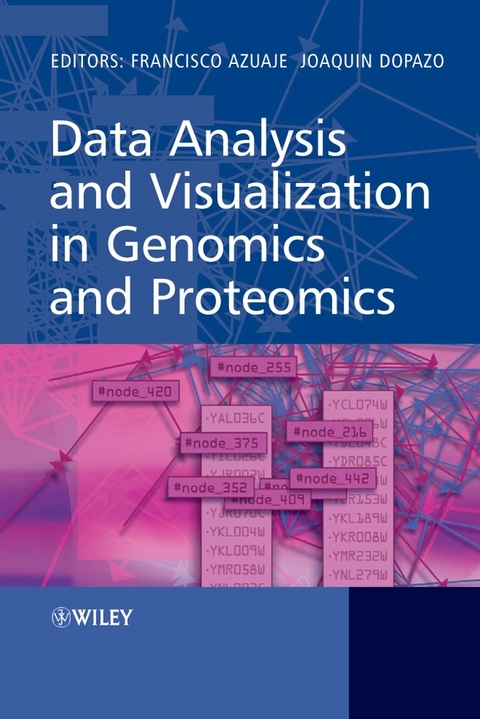
Data Analysis and Visualization in Genomics and Proteomics (eBook)
John Wiley & Sons (Verlag)
978-0-470-09440-2 (ISBN)
- One of the first systematic overviews of the problem of biological data integration using computational approaches
- This book provides scientists and students with the basis for the development and application of integrative computational methods to analyse biological data on a systemic scale
- Places emphasis on the processing of multiple data and knowledge resources, and the combination of different models and systems
Dr Francisco Azuaje, Faculty of Informatics, University of Ulster, Jordanstown, Northern Ireland.
Dr.?Joaquin Dopazo, Head of Bioinformatics, Spanish National Cancer Centre, Madrid, Spain.
Data Analysis and Visualization in Genomics and Proteomics is the first book addressing integrative data analysis and visualization in this field. It addresses important techniques for the interpretation of data originating from multiple sources, encoded in different formats or protocols, and processed by multiple systems. One of the first systematic overviews of the problem of biological data integration using computational approaches This book provides scientists and students with the basis for the development and application of integrative computational methods to analyse biological data on a systemic scale Places emphasis on the processing of multiple data and knowledge resources, and the combination of different models and systems
Dr Francisco Azuaje, Faculty of Informatics, University of Ulster, Jordanstown, Northern Ireland. Dr.?Joaquin Dopazo, Head of Bioinformatics, Spanish National Cancer Centre, Madrid, Spain.
Data Analysis and Visualization in Genomics and Proteomics 3
Contents 7
Preface 13
List of Contributors 15
SECTION I INTRODUCTION – DATA DIVERSITY AND INTEGRATION 19
1 Integrative Data Analysis and Visualization: Introduction to Critical Problems, Goals and Challenges 21
1.1 Data Analysis and Visualization: An Integrative Approach 21
1.2 Critical Design and Implementation Factors 23
1.3 Overview of Contributions 26
References 27
2 Biological Databases: Infrastructure, Content and Integration 29
2.1 Introduction 29
2.2 Data Integration 30
2.3 Review of Molecular Biology Databases 35
2.4 Conclusion 41
References 44
3 Data and Predictive Model Integration: an Overview of Key Concepts, Problems and Solutions 47
3.1 Integrative Data Analysis and Visualization: Motivation and Approaches 47
3.2 Integrating Informational Views and Complexity for Understanding Function 49
3.3 Integrating Data Analysis Techniques for Supporting Functional Analysis 52
3.4 Final Remarks 54
References 56
SECTION II INTEGRATIVE DATA MINING AND VISUALIZATION – EMPHASIS ON COMBINATION OF MULTIPLE DATA TYPES 59
4 Applications of Text Mining in Molecular Biology, from Name Recognition to Protein Interaction Maps 61
4.1 Introduction 62
4.2 Introduction to Text Mining and NLP 63
4.3 Databases and Resources for Biomedical Text Mining 65
4.4 Text Mining and Protein–Protein Interactions 68
4.5 Other Text-Mining Applications in Genomics 73
4.6 The Future of NLP in Biomedicine 74
Acknowledgements 74
References 74
5 Protein Interaction Prediction by Integrating Genomic Features and Protein Interaction Network Analysis 79
5.1 Introduction 80
5.2 Genomic Features in Protein Interaction Predictions 81
5.3 Machine Learning on Protein–Protein Interactions 85
5.4 The Missing Value Problem 91
5.5 Network Analysis of Protein Interactions 93
5.6 Discussion 97
References 98
6 Integration of Genomic and Phenotypic Data 101
6.1 Phenotype 101
6.2 Forward Genetics and QTL Analysis 103
6.3 Reverse Genetics 105
6.4 Prediction of Phenotype from Other Sources of Data 106
6.5 Integrating Phenotype Data with Systems Biology 108
6.6 Integration of Phenotype Data in Databases 111
6.7 Conclusions 113
References 113
7 Ontologies and Functional Genomics 117
7.1 Information Mining in Genome-Wide Functional Analysis 117
7.2 Sources of Information: Free Text Versus Curated Repositories 118
7.3 Bio-Ontologies and the Gene Ontology in Functional Genomics 119
7.4 Using GO to Translate the Results of Functional Genomic Experiments into Biological Knowledge 121
7.5 Statistical Approaches to Test Significant Biological Differences 122
7.6 Using FatiGO to Find Significant Functional Associations in Clusters of Genes 124
7.7 Other Tools 125
7.8 Examples of Functional Analysis of Clusters of Genes 126
7.9 Future Prospects 128
References 128
8 The C. elegans Interactome: its Generation and Visualization 131
8.1 Introduction 131
8.2 The ORFeome: the first step toward the interactome of C. elegans 134
8.3 Large-Scale High-Throughput Yeast Two-Hybrid Screens to Map the C. elegans Protein–Protein Interaction (Interactome) Network: Technical Aspects 136
8.4 Visualization and Topology of Protein–Protein Interaction Networks 139
8.5 Cross-Talk Between the C. elegans Interactome and other Large-Scale Genomics and Post-Genomics Data Sets 141
8.6 Conclusion: From Interactions to Therapies 147
References 148
SECTION III INTEGRATIVE DATA MINING AND VISUALIZATION – EMPHASIS ON COMBINATION OF MULTIPLE PREDICTION MODELS AND METHODS 153
9 Integrated Approaches for Bioinformatic Data Analysis and Visualization – Challenges, Opportunities and New Solutions 155
9.1 Introduction 155
9.2 Sequence Analysis Methods and Databases 157
9.3 A View Through a Portal 159
9.4 Problems with Monolithic Approaches: One Size Does Not Fit All 160
9.5 A Toolkit View 161
9.6 Challenges and Opportunities 163
9.7 Extending the Desktop Metaphor 165
9.8 Conclusions 169
Acknowledgements 169
References 170
10 Advances in Cluster Analysis of Microarray Data 171
10.1 Introduction 171
10.2 Some Preliminaries 173
10.3 Hierarchical Clustering 175
10.4 k-Means Clustering 177
10.5 Self-Organizing Maps 177
10.6 A Wish List for Clustering Algorithms 178
10.7 The Self-Organizing Tree Algorithm 179
10.8 Quality-Based Clustering Algorithms 180
10.9 Mixture Models 181
10.10 Biclustering Algorithms 184
10.11 Assessing Cluster Quality 186
10.12 Open Horizons 188
References 189
11 Unsupervised Machine Learning to Support Functional Characterization of Genes: Emphasis on Cluster Description and Class Discovery 193
11.1 Functional Genomics: Goals and Data Sources 193
11.2 Functional Annotation by Unsupervised Analysis of Gene Expression Microarray Data 195
11.3 Integration of Diverse Functional Data For Accurate Gene Function Prediction 197
11.4 MAGIC – General Probabilistic Integration of Diverse Genomic Data 198
11.5 Conclusion 206
References 207
12 Supervised Methods with Genomic Data: a Review and Cautionary View 211
12.1 Chapter Objectives 211
12.2 Class Prediction and Class Comparison 212
12.3 Class Comparison: Finding/Ranking Differentially Expressed Genes 212
12.4 Class Prediction and Prognostic Prediction 216
12.5 ROC Curves for Evaluating Predictors and Differential Expression 219
12.6 Caveats and Admonitions 221
12.7 Final Note: Source Code Should be Available 227
Acknowledgements 228
References 228
13 A Guide to the Literature on Inferring Genetic Networks by Probabilistic Graphical Models 233
13.1 Introduction 233
13.2 Genetic Networks 234
13.3 Probabilistic Graphical Models 236
13.4 Inferring Genetic Networks by Means of Probabilistic Graphical Models 247
13.5 Conclusions 252
Acknowledgements 253
References 253
14 Integrative Models for the Prediction and Understanding of Protein Structure Patterns 257
14.1 Introduction 257
14.2 Structure Prediction 259
14.3 Classifications of Structures 262
14.4 Comparing Protein Structures 264
14.5 Methods for the Discovery of Structure Motifs 267
14.6 Discussion and Conclusions 270
References 272
Index 275
| Erscheint lt. Verlag | 24.6.2005 |
|---|---|
| Sprache | englisch |
| Themenwelt | Informatik ► Datenbanken ► Data Warehouse / Data Mining |
| Informatik ► Weitere Themen ► Bioinformatik | |
| Medizin / Pharmazie ► Allgemeines / Lexika | |
| Naturwissenschaften ► Biologie ► Genetik / Molekularbiologie | |
| Schlagworte | analysing • APPROACHES • Areas • Basis • Bioinformatics & Computational Biology • Bioinformatik • Bioinformatik u. Computersimulationen in der Biowissenschaften • biological • biomedical engineering • Biomedizintechnik • Biowissenschaften • Book • combination • Computational • Data • Datenanalyse • Development • Different • genes • genomics • Integrative • Knowledge • Level • Life Sciences • Medical Informatics & Biomedical Information Technology • Medizininformatik u. biomedizinische Informationstechnologie • Models • Multiple • Prediction • Processing • Proteomics • roles • scientists • Systems • techniques |
| ISBN-10 | 0-470-09440-0 / 0470094400 |
| ISBN-13 | 978-0-470-09440-2 / 9780470094402 |
| Informationen gemäß Produktsicherheitsverordnung (GPSR) | |
| Haben Sie eine Frage zum Produkt? |
 PDF (Adobe DRM)
Kopierschutz: Adobe-DRM
Adobe-DRM ist ein Kopierschutz, der das eBook vor Mißbrauch schützen soll. Dabei wird das eBook bereits beim Download auf Ihre persönliche Adobe-ID autorisiert. Lesen können Sie das eBook dann nur auf den Geräten, welche ebenfalls auf Ihre Adobe-ID registriert sind.
Details zum Adobe-DRM
Dateiformat: PDF (Portable Document Format)
Mit einem festen Seitenlayout eignet sich die PDF besonders für Fachbücher mit Spalten, Tabellen und Abbildungen. Eine PDF kann auf fast allen Geräten angezeigt werden, ist aber für kleine Displays (Smartphone, eReader) nur eingeschränkt geeignet.
Systemvoraussetzungen:
PC/Mac: Mit einem PC oder Mac können Sie dieses eBook lesen. Sie benötigen eine
eReader: Dieses eBook kann mit (fast) allen eBook-Readern gelesen werden. Mit dem amazon-Kindle ist es aber nicht kompatibel.
Smartphone/Tablet: Egal ob Apple oder Android, dieses eBook können Sie lesen. Sie benötigen eine
Geräteliste und zusätzliche Hinweise
Buying eBooks from abroad
For tax law reasons we can sell eBooks just within Germany and Switzerland. Regrettably we cannot fulfill eBook-orders from other countries.
aus dem Bereich