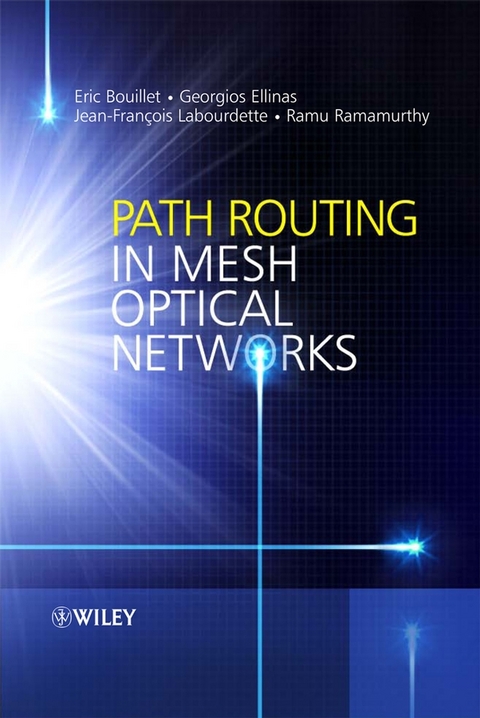
Path Routing in Mesh Optical Networks (eBook)
John Wiley & Sons (Verlag)
978-0-470-03297-8 (ISBN)
Optical transport networks today not only provide trunking capacity to higher-layer networks, such as inter-router connectivity in an IP-centric infrastructure, but also support efficient routing and fast failure recovery of high-bandwidth services. This is possible due to the emergence of optical network elements that have the intelligence required to efficiently control the network. Optical mesh networks will enable a variety of dynamic services such as bandwidth-on-demand, Just-In-Time bandwidth, bandwidth scheduling, bandwidth brokering, and optical virtual private networks that open up new opportunities for service providers and their customers alike.
Path Routing in Mesh Optical Networks combines both theoretical as well as practical aspects of routing and dimensioning for mesh optical networks. All authors have worked as technical leaders for the equipment vendor Tellium who implemented such capabilities in its product, and whose product was deployed in service provider networks.
Path Routing in Mesh Optical Networks
- Presents an in-depth treatment of a specific class of optical networks, i.e. path-oriented mesh optical networks.
- Focuses on routing and recovery, dimensioning, performance analysis and availability in mesh optical networks.
- Explains and analyses routing specifically associated with Dedicated Backup Path Protection (DBPP) and Shared Backup Path Protection (SBPP) recovery architectures.
As most of the core backbone networks evolve to mesh topologies utilizing intelligent network elements for provisioning and recovery of services, Path Routing in Mesh Optical Networks will be an invaluable tool for both researchers and engineers in the industry who are responsible for designing, developing, deploying and maintaining mesh optical networks. It will also be a useful reference book for graduate students and university professors who are interested in optical networks or telecommunications networking.
With a foreword by Professor Wayne D. Grover, author of the book Mesh-Based Survivable Networks.
Dr. Jean-Francois Labourdette is manager of system engineering at Tellium. He is responsible for all network element and network management system engineering activities. Before that he was manager of network routing and design, where he was responsible for Tellium's routing architecture and algorithms, network dimensioning, and design studies.
Dr. Eric Bouillet is principal engineer at Tellium. He works on the design of optical networks and optimization of light-path provisioning and fault restoration algorithms. Before joining Tellium, Eric was a member of the technical staff in the Mathematical Sciences Research Center in Bell Labs/Lucent Technologies, working in the areas of routing in ATM and optical networks.
Georgios Ellinas is an Associate Professor of Electrical Engineering at City College of the City University of New York. Before joining City College, George was a senior network architect at Tellium Inc. In this role, he worked on light-path provisioning and fault restoration algorithms in optical mesh networks.
Ramu Ramamurthy is lead engineer in the Optical Switch Division at Ciena (Ciena's Optical Switch has been deployed in the worlds biggest optical mesh networks). At Ciena Ramu works on the design and development of Routing and Restoration algorithms and protocols for optical mesh networks. Before that he worked for Tellium, where Ramu was part of a team that implemented Tellium's routing and restoration algorithms for optical mesh networks. His work at Tellium has resulted in several patent applications, and he coauthored several widely referenced publications in leading journals and conferences.
Transport networks evolved from DCS (Digital Cross-connect Systems)-based mesh architectures, to SONET/SDH (Synchronous Optical Networking/Synchronous Digital Hierarchy) ring architectures in the 1990 s. In the past few years, technological advancements in optical transport switches have allowed service providers to support the same fast recovery in mesh networks previously available in ring networks while achieving better capacity efficiency and resulting in lower capital cost. Optical transport networks today not only provide trunking capacity to higher-layer networks, such as inter-router connectivity in an IP-centric infrastructure, but also support efficient routing and fast failure recovery of high-bandwidth services. This is possible due to the emergence of optical network elements that have the intelligence required to efficiently control the network. Optical mesh networks will enable a variety of dynamic services such as bandwidth-on-demand, Just-In-Time bandwidth, bandwidth scheduling, bandwidth brokering, and optical virtual private networks that open up new opportunities for service providers and their customers alike. Path Routing in Mesh Optical Networks combines both theoretical as well as practical aspects of routing and dimensioning for mesh optical networks. All authors have worked as technical leaders for the equipment vendor Tellium who implemented such capabilities in its product, and whose product was deployed in service provider networks. Path Routing in Mesh Optical Networks Presents an in-depth treatment of a specific class of optical networks, i.e. path-oriented mesh optical networks. Focuses on routing and recovery, dimensioning, performance analysis and availability in mesh optical networks. Explains and analyses routing specifically associated with Dedicated Backup Path Protection (DBPP) and Shared Backup Path Protection (SBPP) recovery architectures. As most of the core backbone networks evolve to mesh topologies utilizing intelligent network elements for provisioning and recovery of services, Path Routing in Mesh Optical Networks will be an invaluable tool for both researchers and engineers in the industry who are responsible for designing, developing, deploying and maintaining mesh optical networks. It will also be a useful reference book for graduate students and university professors who are interested in optical networks or telecommunications networking. With a foreword by Professor Wayne D. Grover, author of the book Mesh-Based Survivable Networks.
Dr. Jean-Francois Labourdette is manager of system engineering at Tellium. He is responsible for all network element and network management system engineering activities. Before that he was manager of network routing and design, where he was responsible for Tellium's routing architecture and algorithms, network dimensioning, and design studies. Dr. Eric Bouillet is principal engineer at Tellium. He works on the design of optical networks and optimization of light-path provisioning and fault restoration algorithms. Before joining Tellium, Eric was a member of the technical staff in the Mathematical Sciences Research Center in Bell Labs/Lucent Technologies, working in the areas of routing in ATM and optical networks. Georgios Ellinas is an Associate Professor of Electrical Engineering at City College of the City University of New York. Before joining City College, George was a senior network architect at Tellium Inc. In this role, he worked on light-path provisioning and fault restoration algorithms in optical mesh networks. Ramu Ramamurthy is lead engineer in the Optical Switch Division at Ciena (Ciena's Optical Switch has been deployed in the worlds biggest optical mesh networks). At Ciena Ramu works on the design and development of Routing and Restoration algorithms and protocols for optical mesh networks. Before that he worked for Tellium, where Ramu was part of a team that implemented Tellium's routing and restoration algorithms for optical mesh networks. His work at Tellium has resulted in several patent applications, and he coauthored several widely referenced publications in leading journals and conferences.
"Lecturers of advanced-communications courses, graduate students, and researchers will profit most from reading this book." (IEEE Communications, October 2008)
| Erscheint lt. Verlag | 24.10.2007 |
|---|---|
| Sprache | englisch |
| Themenwelt | Mathematik / Informatik ► Informatik ► Netzwerke |
| Technik ► Elektrotechnik / Energietechnik | |
| Technik ► Nachrichtentechnik | |
| Schlagworte | Capacity • Communication Technology - Networks • Computer Science • connectivity • crossconnect • DCS • Electrical & Electronics Engineering • Elektrotechnik u. Elektronik • fast recovery • Hierarchy • higherlayer • Informatik • interrouter • Kommunikationsnetz • Kommunikationsnetze • Mesh • Networking • Networks • Netzwerk • Netzwerke • Optical Communications • optical transport • Optische Nachrichtentechnik • provide • providers • Ring • Switches • Synchronous • synchronous digital • Today • Transport • trunking |
| ISBN-10 | 0-470-03297-9 / 0470032979 |
| ISBN-13 | 978-0-470-03297-8 / 9780470032978 |
| Informationen gemäß Produktsicherheitsverordnung (GPSR) | |
| Haben Sie eine Frage zum Produkt? |
 PDF (Adobe DRM)
Kopierschutz: Adobe-DRM
Adobe-DRM ist ein Kopierschutz, der das eBook vor Mißbrauch schützen soll. Dabei wird das eBook bereits beim Download auf Ihre persönliche Adobe-ID autorisiert. Lesen können Sie das eBook dann nur auf den Geräten, welche ebenfalls auf Ihre Adobe-ID registriert sind.
Details zum Adobe-DRM
Dateiformat: PDF (Portable Document Format)
Mit einem festen Seitenlayout eignet sich die PDF besonders für Fachbücher mit Spalten, Tabellen und Abbildungen. Eine PDF kann auf fast allen Geräten angezeigt werden, ist aber für kleine Displays (Smartphone, eReader) nur eingeschränkt geeignet.
Systemvoraussetzungen:
PC/Mac: Mit einem PC oder Mac können Sie dieses eBook lesen. Sie benötigen eine
eReader: Dieses eBook kann mit (fast) allen eBook-Readern gelesen werden. Mit dem amazon-Kindle ist es aber nicht kompatibel.
Smartphone/Tablet: Egal ob Apple oder Android, dieses eBook können Sie lesen. Sie benötigen eine
Geräteliste und zusätzliche Hinweise
Buying eBooks from abroad
For tax law reasons we can sell eBooks just within Germany and Switzerland. Regrettably we cannot fulfill eBook-orders from other countries.
aus dem Bereich