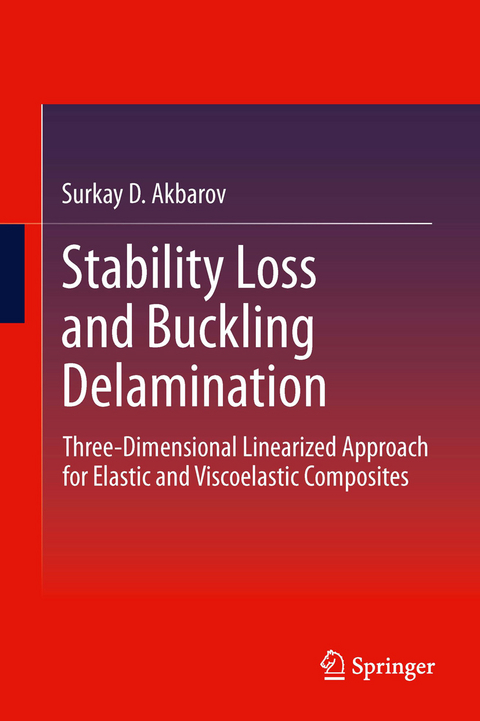
Stability Loss and Buckling Delamination (eBook)
450 Seiten
Springer Berlin (Verlag)
978-3-642-30290-9 (ISBN)
This book investigates stability loss problems of the viscoelastic composite materials and structural members within the framework of the Three-Dimensional Linearized Theory of Stability (TDLTS). The stability loss problems are considered the development of the initial infinitesimal imperfection in the structure of the material or of the structural members. This development is studied within the framework of the Three-Dimensional Geometrical Non-Linear Theory of the Deformable Solid Body Mechanics. The solution to the corresponding boundary-value problems is presented in the series form in the small parameter which characterizes the degree of the initial imperfection. In this way, the nonlinear problems for the domains bounded by noncanonical surfaces are reduced for the same nonlinear problem for the corresponding domains bounded by canonical surfaces and the series subsequent linearized problems. It is proven that the equations and relations of these linearized problems coincide with the corresponding ones of the well-known TDLTS. Under concrete investigations as stability loss criterion the case is taken for the initial infinitesimal imperfection that starts to increase indefinitely. Moreover, it is proven that the critical parameters can be determined by the use of only the zeroth and first approximations.
Stability Loss and Buckling Delamination 2
Preface 5
Acknowledgments 6
Contents 7
Abbreviations 12
1 Introduction 13
1.1…A General Background 13
1.2…Text Preview 17
References 19
2 Stability Loss ProblemsProblems Related to SolidSolid and HollowHollow CircularCircular CylinderCircular cylinders 21
2.1…Formulation of the Problem Related to the Global Stability Loss 21
2.2…Method of SolutionMethod of solution for the Global Stability Lossstability Loss Problem 25
2.3…Approximate Equations for the Stability LossStability loss of the CylinderCylinder-Beam Obtained from Equations of the TDLTS by the Average-IntegratingAverage-Integrating ProcedureAverage-integrating procedure 38
2.3.1 Bernoulli BeamBernoulli Beam theory 38
2.4…The Third Order Refined Beam TheoryThird Order Refined Beam Theory 42
2.5… Numerical Results and Discussions 44
2.5.1 Solid CylinderCylinder 47
2.5.2 Hollow CylinderCylinder 53
2.6…Formulation of the ProblemProblem Related to the Rotationally SymmetricRotationally symmetric Locallocal Stability LossLocal stability loss 57
2.7…Method of SolutionMethod of solution for the Rotationally SymmetricRotationally symmetric ProblemRotationally symmetric problem 60
2.8…Approximate Equations of the Stability Loss of the Cylinder-Shell Obtained from Equations of the TDLTS by the Average-Integrating Procedure 67
2.8.1 Kirchhoff--Love Shell Theory 67
2.9…The Third Order Refined Shell TheoryRefined shell theory 71
2.10…Numerical Results Related to the Rotationally Symmetric Stability Loss Problemproblem 73
2.11…Conclusions 80
References 81
3 Stability Loss ProblemsProblems for ViscoelasticViscoelastic Plates 83
3.1…Formulation of the ProblemProblem and Basic Field EquationsBasic field equations 83
3.2…Approach for the Solution to the Stability LossStability loss ProblemProblem for RectangularRectangular PlatePlate 86
3.3…Simply Supported RectangularRectangular PlatePlate 92
3.3.1 Deriving Approximate Equations of the Stability LossStability loss of the Simply SupportedSimply supported RectangularRectangular PlatePlate from Equations of the TDLTS by the Average-IntegratingAverage-integrating Procedure 92
3.3.1.1 Kirchhoff-Love Plate TheoryKirchhoff-Love Plate Theory 93
3.3.1.2 The Third Order Refined PlatePlate Theory 97
3.3.2 Solution for the Formulated Mathematical ProblemsProblems for the Simply SupportedSimply supported PlatePlate 100
3.3.3 Numerical Results and Discussions 102
3.4…Rectangular PlatePlate ClampedClamped at Two Opposite Ends and Simply Supportedsimply supported at the Two Other Opposite Ends 106
3.4.1 Solution Procedure of the Equations of the TDLTS. Semi-Analytical FEM Modeling 106
3.4.2 Solution Procedure for the Approximate Stability LossStability loss Equations 110
3.4.3 Numerical Results and Discussions 111
3.5…Rectangular PlatePlate ClampedClamped at all Ends 114
3.5.1 Solution Procedure for the TDLTS ProblemProblem. 3D FEM Modeling 114
3.5.2 Solution Procedure for the Approximate Stability LossStability loss ProblemsProblems 116
3.5.3 Numerical Results and Discussions 117
3.6…Symmetric Stability LossStability loss of the CircularCircular PlateCircular plate 119
3.6.1 Formulation of the ProblemProblem and Governing Field EquationsField equations 119
3.6.2 Method of SolutionMethod of Solution 122
3.6.2.1 Approximate Loss of Stability Equations of a CircularCircular PlateCircular plate with Initial ImperfectionInitial imperfection 124
3.6.2.2 Solution Procedure for the TDLTS ProblemsProblems 125
3.6.2.3 Solution Procedure for the Approximate Equations of Stability 128
3.6.3 Numerical Results and Discussions 129
3.6.3.1 Comparison of Some Numerical Results Obtained in the Framework of the TDLTS for the Pure ElasticPure elastic PlatePlate 131
3.6.3.2 Comparison of the Results Obtained for the Pure Elasticpure elastic PlatePlate in the Framework of the TDLTS and Approximate TheoriesTheories 133
3.6.3.3 Viscoelastic Plateplate 134
3.7…Stability Loss of the RotatingRotating CircularCircular and AnnularAnnular Discs 137
3.7.1 Formulation of the ProblemProblem 137
3.7.2 Method of SolutionMethod of Solution 139
3.7.3 Numerical Results and Discussions 141
References 144
4 Buckling Delamination of Elastic and ViscoelasticViscoelastic CompositeComposite Plates with Cracks 146
4.1…Background of Related ProblemsProblems 146
4.2…Buckling Delamination ProblemsProblems for PlatePlate-Strips with a Single CrackCrack 148
4.2.1 Formulation of the ProblemsProblems 148
4.2.2 Method of SolutionMethod of Solution 151
4.2.2.1 Determination of the Zeroth ApproximationZeroth Approximation 154
4.2.2.2 Determination of the First ApproximationFirst Approximation 156
4.2.3 Numerical Results and Discussions 157
4.2.3.1 Testing of the Algorithm Used for Obtaining Numerical Results 157
4.2.3.2 Buckling Delamination of a Simply SupportedSimply Supported Elastic PlatePlate-Strip 158
4.2.3.3 Buckling Delamination of the ClampedClamped Elastic Plateplate-Strip 160
4.2.3.4 Buckling Delamination of the ClampedClamped ViscoelasticViscoelastic PlatePlate-Strip 162
4.3…Buckling Delamination of the PlatePlate-Strip with Two Parallel CracksTwo Parallel Cracks 164
4.3.1 Mathematical Formulation of the ProblemProblem 164
4.3.2 Method of SolutionMethod of Solution: FEM Modeling 166
4.3.3 Numerical Results and Discussions 167
4.4…Buckling Delamination of the PlatePlate-Strip with Two Collinear CracksTwo Collinear Cracks 170
4.4.1 Formulation of the ProblemProblem and Solution Method 170
4.4.2 Numerical Results and Discussions 172
4.5…Buckling Delamination of the Three-LayeredLayered (SandwichSandwich) PlatePlate-Strip with Two Parallel InterfaceInterface Cracks 175
4.5.1 Formulation of the ProblemProblem 175
4.5.2 Method of SolutionMethod of Solution 177
4.5.3 Numerical Results and Discussions 183
4.6…Buckling Delamination of the Three-LayeredLayered (SandwichSandwich) PlatePlate-Strip with Two Collinear Interface CracksTwo Collinear Interface Cracks 187
4.6.1 Formulation of the ProblemProblem and Method of Solution 187
4.6.2 Numerical Results and Discussions 190
4.7…Buckling Delamination of the Elastic and Viscoelstic CompositeComposite CircularCircular PlateCircular Plate-Disc with a Penny-Shaped CrackPenny-Shaped Crack 192
4.7.1 Formulation of the ProblemProblem 192
4.7.2 Method of SolutionMethod of Solution 194
4.7.2.1 The Zeroth ApproximationZeroth Approximation 195
4.7.2.2 The First ApproximationFirst Approximation 196
4.7.3 Numerical Results and Discussions 197
4.8…Buckling Delamination of the Three-LayeredLayered (SandwichSandwich) CircularCircular PlateCircular Plate-Disc with Two Parallel Interface Penny-Shaped CracksTwo Parallel Interface Penny-Shaped Cracks 201
4.8.1 Formulation of the ProblemProblem 201
4.8.2 Method of Solution 204
4.8.2.1 The Zeroth ApproximationZeroth Approximation 208
4.8.2.2 The First ApproximationFirst Approximation 209
4.8.3 Numerical Results and Discussions 211
4.9…Remarks on the FEM Modeling of the CrackCrack’s Tips 213
4.10…Buckling Delamination of a RectangularRectangular PlatePlate Containing a Rectangular CrackCrack 216
4.10.1 Formulation of the ProblemsProblems 217
4.10.2 Solution Method 220
4.10.3 FEM Modeling 223
4.10.4 Numerical Results and Discussions 224
4.10.4.1 Numerical Results Obtained in Case 1 (BandBand CrackBand Crack) 225
4.10.4.2 Numerical Results Obtained in Case 2 (EdgeEdge CrackCrack) 231
4.10.4.3 Numerical Results Obtained in Case 3 (Embedded CrackCrack) 236
4.10.4.4 Main Conclusions Based on the Numerical Results 240
4.11…Buckling Delamination of a SandwichSandwich RectangularRectangular PlatePlate with InterfaceInterface Rectangular Cracks 242
4.11.1 Formulation of the ProblemProblem 242
4.11.2 Solution Method 248
4.11.3 FEM Modeling 252
4.11.4 Numerical Results and Discussions 253
4.11.4.1 Numerical Results Obtained in Case 1 (BandBand CrackBand Cracks) 254
4.11.4.2 Numerical Results Obtained in Case 2 (EdgeEdge Cracks) 258
4.11.4.3 Numerical Results Obtained in Case 3 (Embedded Cracks) 265
4.11.4.4 Conclusions Based on the Numerical Results 273
References 276
5 Surface and InternalInternal Stability LossInternal Stability Loss in the Structure of Elastic and ViscoelasticViscoelastic LayeredLayered CompositesLayered Composites 279
5.1…Background of Related ProblemsProblems 279
5.2…Stability Loss in the Structure of Elastic and ViscoelasticViscoelastic LayeredLayered CompositesLayered Composites with PeriodicalPeriodical Initial ImperfectionsInitial Imperfection 281
5.2.1 Formulation of the ProblemProblem on the Determination of the Stress--Strain StateStress--Strain State in a LayeredLayered CompositeComposite with an Arbitrary Number of Layers with Initially Infinitesimal Imperfections 281
5.2.2 Method of SolutionMethod of Solution 283
5.2.2.1 The Equations of Contact SurfacesContact Surfaces 283
5.2.2.2 The Employing the BoundaryBoundary formForm Perturbation Technique 285
5.2.2.3 Plane-Strain StatePlane-Strain State in Case 1 (Co-PhaseCo-Phase ImperfectionsCo-Phase Imperfections of Layers) 288
5.2.2.4 Plane-Strain StatePlane-Strain State in Case 2 (Imperfection of a Single LayerImperfection of a Single Layer) 296
5.2.3 Numerical Results and Discussions 298
5.2.3.1 Numerical Results Related to Case1 (Co-PhaseCo-Phase CurvingCo-Phase Curving of LayersCo-Phase Curving of Layers) 298
5.2.3.2 Numerical Results Related to Case 2 (Imperfection of a Single LayerImperfection of a Single Layer) 300
5.2.3.3 Numerical Results Related to ViscoelasticViscoelastic CompositeComposite Materials 302
5.3…Stability Loss in the Structure of the Elastic and ViscoelasticViscoelastic LayeredLayered CompositesLayered Composites with LocalLocal Initial ImperfectionsLocal Initial Imperfections 304
5.3.1 Formulation of the ProblemProblem and Method of Solution 304
5.3.2 Numerical Results and Discussions 306
5.4…The Influence of the Inclination of the LocalLocal Initial ImperfectionsLocal Initial Imperfections of the Reinforcing LayersReinforcing Layers on the Values of the CriticalCritical Parameters 312
5.4.1 Formulation of the ProblemProblem and Solution Method 312
5.4.2 Results and Discussions 316
5.4.3 Conclusions 318
5.5…Surface Undulation InstabilitySurface Undulation Instability of the ViscoelasticViscoelastic Half-Space Covered with a Stack of Layers in Bi-Axial Compression 319
5.5.1 Formulation of the ProblemProblem 320
5.5.2 Method of SolutionMethod of Solution 322
5.5.3 Numerical Results and Discussions 329
5.5.3.1 Two-Dimensional ProblemsProblems 329
5.5.3.2 Three-Dimensional ProblemsProblems 336
6 Stability Loss in the Structure of Unidirected FibrousFibrous Elastic and ViscoelasticViscoelastic CompositesComposites 346
6.1…Some General Remarks on the Field EquationsField equations, ProblemProblem Formulations and Method of Solution 346
6.1.1 General Remarks on the Field EquationsField equations and ProblemProblem Formulations 346
6.1.2 General Remarks on the Method of Solution 350
6.2…Micro BucklingMicro Buckling of a Single Fiber in the ViscoelasticViscoelastic Matrix 357
6.2.1 Formulation of the ProblemProblem and Method of Solution 357
6.2.2 Numerical Results and Discussions 359
6.3…Internal Stability LossStability loss of Two Neighboring FibersTwo neighboring fibers in a ViscoelasticViscoelastic Matrix 362
6.3.1 Formulation of the ProblemProblem and Method of Solution 362
6.3.2 Numerical Results and Discussion 371
6.4…Internal Stability LossStability loss of a Row of Unidirected Periodically Located Fibersrow of Unidirected Periodically Located fibers in a ViscoelasticViscoelastic Matrix 377
6.4.1 Formulation of the ProblemProblem and Solution Method 377
6.4.2 Numerical Results and Discussions 382
6.5…Stability Loss of a Micro-Fiber in an Elastic and a ViscoelasticViscoelastic Matrix Near the Free Convex Cylindrical SurfaceConvex cylindrical surface 383
6.5.1 Formulation of the ProblemProblem 383
6.5.2 Method of SolutionMethod of solution 386
6.5.3 Numerical Results and Discussions 400
References 408
Supplement 1: Applications of the Approach Developed in Chap. 4 on the Problems Related to the Stress Concentration in Initially Stressed Bodies 410
S1.1 The Influence of the Initial Stresses on the SIFand ERR at Crack Tips in a Plate-Stripfrom Orthotropic Material 410
Conclusions 420
S1.1.1 Formulation of the Problem 411
S1.1.2 FEM Modeling 413
S1.1.3 Numerical Results and Discussion 415
S1.2 The Influence of the Initial Tension of a Stripwith a Rectangular Hole on the Stress ConcentrationCaused by Additional Loading 421
S1.2.1 Formulation of the Problem 422
S1.2.2 FEM Modeling 423
S1.2.3 Numerical Results and Discussions 426
Conclusions 431
Supplement 2: Self-Balanced StressesCaused by Periodical Curving of TwoNeighboring and Periodically LocatedRow of Fibers in an Infinite Matrix 433
S2.1 Numerical Results Related to the Case Where an InfiniteMatrix Contains Two Neighboring Fibers 433
S2.2 Numerical Results Related to the Case Wherean Infinite Matrix Contains PeriodicallyLocated Row of Fibers 438
Index 448
| Erscheint lt. Verlag | 14.8.2012 |
|---|---|
| Zusatzinfo | XVIII, 450 p. |
| Verlagsort | Berlin |
| Sprache | englisch |
| Themenwelt | Mathematik / Informatik ► Mathematik ► Statistik |
| Mathematik / Informatik ► Mathematik ► Wahrscheinlichkeit / Kombinatorik | |
| Naturwissenschaften ► Physik / Astronomie | |
| Technik ► Maschinenbau | |
| Schlagworte | boundary-value problems • initial infinitesimal imperfection • Rabotnov fractional-exponential operator • surface cracks • TDLTS • Three-Dimensional Linearized Theory of Stability |
| ISBN-10 | 3-642-30290-4 / 3642302904 |
| ISBN-13 | 978-3-642-30290-9 / 9783642302909 |
| Informationen gemäß Produktsicherheitsverordnung (GPSR) | |
| Haben Sie eine Frage zum Produkt? |
 PDF (Wasserzeichen)
DRM: Digitales Wasserzeichen
Dieses eBook enthält ein digitales Wasserzeichen und ist damit für Sie personalisiert. Bei einer missbräuchlichen Weitergabe des eBooks an Dritte ist eine Rückverfolgung an die Quelle möglich.
Dateiformat: PDF (Portable Document Format)
Mit einem festen Seitenlayout eignet sich die PDF besonders für Fachbücher mit Spalten, Tabellen und Abbildungen. Eine PDF kann auf fast allen Geräten angezeigt werden, ist aber für kleine Displays (Smartphone, eReader) nur eingeschränkt geeignet.
Systemvoraussetzungen:
PC/Mac: Mit einem PC oder Mac können Sie dieses eBook lesen. Sie benötigen dafür einen PDF-Viewer - z.B. den Adobe Reader oder Adobe Digital Editions.
eReader: Dieses eBook kann mit (fast) allen eBook-Readern gelesen werden. Mit dem amazon-Kindle ist es aber nicht kompatibel.
Smartphone/Tablet: Egal ob Apple oder Android, dieses eBook können Sie lesen. Sie benötigen dafür einen PDF-Viewer - z.B. die kostenlose Adobe Digital Editions-App.
Buying eBooks from abroad
For tax law reasons we can sell eBooks just within Germany and Switzerland. Regrettably we cannot fulfill eBook-orders from other countries.
aus dem Bereich