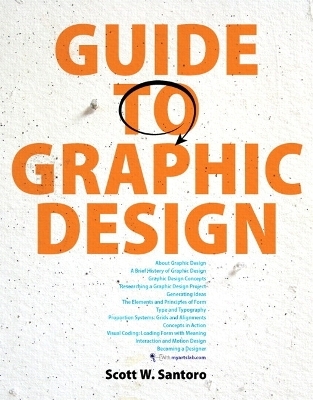
Guide to Graphic Design Plus NEW MyArtsLab with eText -- Access Card Package
Pearson
978-0-205-95922-8 (ISBN)
- Titel ist leider vergriffen;
keine Neuauflage - Artikel merken
Packages
Access codes for Pearson's MyLab & Mastering products may not be included when purchasing or renting from companies other than Pearson; check with the seller before completing your purchase.
Used or rental books
If you rent or purchase a used book with an access code, the access code may have been redeemed previously and you may have to purchase a new access code.
Access codes
Access codes that are purchased from sellers other than Pearson carry a higher risk of being either the wrong ISBN or a previously redeemed code. Check with the seller prior to purchase.
-- Learn to Conceptualize, Create, and Communicate in Graphic Design
An exciting first edition, Guide to Graphic Design helps readers learn the mechanisms used to convey information, integrate ideas into full concepts, but most importantly, to think like a graphic designer. Scott W. Santoro focuses on the principle that design is a layered and evolving profession. The text highlights step-by-step design processes and illustrates how to build good work habits.
Creations from top design firms and design school programs are presented in each chapter engaging readers through the book. Designers have contributed short essays on their work style, their studio habits, and their inspirations. Each designer, showing a passion for design and communication, offers a new perspective and approach to possible working methods.
MyArtsLab is an integral part of the Santoro, program. Key learning applications include, Closer Look tours, 12 Designer Profile videos and Writing About Art.
BRIEF TABLE OF CONTENTS: Preface. Virtual Crit Wall, Dear Reader and Features. Chapter 1 About Graphic Design. Chapter 2 A Brief History of Graphic Design. Chapter 3 Graphic Design Concepts. Chapter 4 Researching a Graphic Design Project
Chapter 5 Generating Ideas. Chapter 6 The Elements and Principles of Form. Chapter 7 Type and Typography
Chapter 8 Proportion Systems: Grids and Alignments. Chapter 9 Concepts in Actions. Chapter 10 Visual Coding: Loading Form with Meaning. Chapter 11 Interactions and Motions Design. Chapter 12 Becoming a Designer.
A better teaching and learning experience
This program will provide a better teaching and learning experience—for you and your students. Here’s how:
Personalize Learning— MyArtsLab is an online homework, tutorial, and assessment program. It helps students prepare for class and instructor gauge individual and class performance.
Improve Critical Thinking – Exercises throughout the texthelp readers to make decisions and understanding the connection between an idea and its execution.
Engage Students– Each chapter presents quick, in-class exercises and longer, more involved projects.
Support Instructors – Instructor recourses are available in one convenient location. Figures, videos and teacher support materials create a dynamic, engaging course.
0205959229 / 9780205959228 Guide to Graphic Design Plus NEW MyArtsLab with eText -- Access Card Package
Package consists of:
0132300702 / 9780132300704 Guide to Graphic Design Textbook
0205206565 / 9780205206568 NEW MyArtsLab with Pearson eText -- Valuepack Access Card
Scott W. Santoro is principal of Worksight, a New York graphic design studio. He holds graphic design degrees from Pratt Institute (BFA) and Cranbrook Academy of Art (MFA). He is also a graphic design professor at Pratt Institute in Brooklyn, New York, and is an active speaker on graphic design issues. Scott has served as vice president of the New York Chapter of the American Institute of Design (AIGA) and as a national screening committee member for design as part of the Fulbright program.
In this Section:
1) Brief Table of Contents
2) Full Table of Contents
BRIEF TABLE OF CONTENTS:
Preface. Virtual Crit Wall, Dear Reader and Features
Chapter 1. About Graphic Design
Chapter 2. A Brief History of Graphic Design
Chapter 3. Graphic Design Concepts
Chapter 4. Researching a Graphic Design Project
Chapter 5. Generating Ideas
Chapter 6. The Elements and Principles of Form
Chapter 7. Type and Typography
Chapter 8. Proportion Systems: Grids and Alignments
Chapter 9. Concepts in Actions
Chapter 10. Visual Coding: Loading Form with Meaning
Chapter 11. Interactions and Motions Design
Chapter 12. Becoming a Designer
FULL TABLE OF CONTENTS:
Chapter 1. About Graphic Design
Graphic Design’s Heritage
Graphic Design Categories
Being a Graphic Designer
Influences in Graphic Design
The Nuts and Bolts Process of Graphic Design
Chapter 2. A Brief History of Graphic Design
Industrial Expansion
A Turn-of-the-Century Response to Industrialization
Moving towards a Modern Sensibility
The Modern World
Designing Utopia
Ideological Independents and the New Typography
Modernism in America
Advertising Design and the New York School
Conceptual Image-Makers
Postmodernism and the Digital Age
Chapter 3. Graphic Design Concepts
From Ideas to Concepts
Concepts Go Further
Metaphoric Concepts
Analytic Concepts
Meta Concepts
Applying Conceptual Approaches
Chapter 4. Researching a Graphic Design Project
Gathering Information
Defining the Problem
Techniques for Visualizing Research
The Saturation Point
Chapter 5. Generating Ideas
Making a Creative Work Environment
Actively Generating Ideas
Generating Montaged Ideas
Benefitting from Playful Accidents
Refreshing Your Vision
Chapter 6. The Elements and Principles of Form
Form and Function
Compositional Elements
Compositional Principles
Chapter 7. Type and Typography
Speaking with Type
Historical Type
Type Classifications
Typeface Anatomy
Typeface Families and Fonts
Analytic Typography
Readable Texture
Metaphoric Typography
Vernacular Inspiration
Recontextualizing Type
Type in the Third Dimension
Chapter 8. Proportion Systems: Grids and Alignments
Defining a Grid
Developing Modular Grids
Developing Modular Patterns
Typographic Grids
Freestyle Alignments
Exploiting the Grid
The Golden Ratio
Paper Formats
Paper-Fold Formats
The Rule of Thirds
Chapter 9. Concepts in Actions
Concepts Inspired by a Subject’s Location
Analytic-Based Concepts
Using Research as a Conceptual Approach
Bringing a Bigger Idea to a Concept
Chapter 10. Visual Coding: Loading Form with Meaning
Visual Codes Do Send Messages
Tools for Visual Coding
Gestalt Perception
Design Using Gestalt Perception
Semiotics
Icon, Index, and Symbol
Visually Coded Identities
Logo Application
Why Create Meaning in a Design
Chapter 11. Interactions and Motions Design
Designing for a Virtual Space
Interaction and Motion Concepts
Digital Storytelling
The Design of Sound
The Expanding Realm of Graphic Design
Chapter 12. Becoming a Designer
Getting a Job in Graphic Design
Personal Website and Design Blog
Interviewing
The Business of Design
The You in Your Work
Design and Technology
Design and the Fine Arts
| Erscheint lt. Verlag | 28.2.2013 |
|---|---|
| Sprache | englisch |
| Themenwelt | Kunst / Musik / Theater ► Design / Innenarchitektur / Mode |
| Mathematik / Informatik ► Informatik ► Grafik / Design | |
| ISBN-10 | 0-205-95922-9 / 0205959229 |
| ISBN-13 | 978-0-205-95922-8 / 9780205959228 |
| Zustand | Neuware |
| Informationen gemäß Produktsicherheitsverordnung (GPSR) | |
| Haben Sie eine Frage zum Produkt? |
aus dem Bereich