


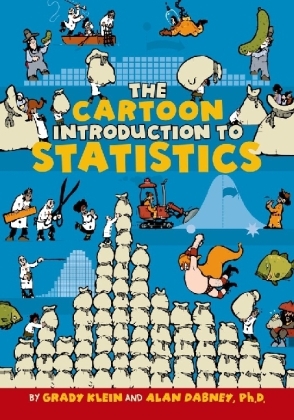
The Cartoon Introduction to Statistics
Seiten
2013
Hill & Wang Inc.,U.S. (Verlag)
978-0-8090-3359-1 (ISBN)
Hill & Wang Inc.,U.S. (Verlag)
978-0-8090-3359-1 (ISBN)
Statistics help us create Internet technologies, develop medicines, win elections, invest in stocks, predict the weather, and more. But the methods that produce important numbers remain beyond many of us. This book take us on a tour of this subject. It explores the key foundational concepts of statistics and the perils of improper methods.
Statistics help us create Internet technologies, develop medicines, win elections, invest in stocks, predict the weather, and much more. But the methods that produce important numbers remain beyond many of us. How do we determine the proper size of a sample? How, exactly, do we calculate standard deviation? And just what is the central limit theorem? In The Cartoon Introduction to Statistics, Grady Klein and Alan Dabney cut through the confusion and take us on a tour of this dynamic subject, helping us stay afloat on the sea of data that is our increasingly complex world. Separating the book into two main parts (hunting statistics and gathering parameters) for readers both in and outside the classroom, they explore the key foundational concepts of statistics and the perils of improper methods. They round out the book with the "Math Cave," which provides easy access to the formulas every student will want to have close at hand. Through cheeky and irreverent examples bound to engage anyone grappling with the difference between histograms and boxplots, Klein and Dabney have created a rollicking narrative about the best ways to make confident statements based on limited information.
Timely, authoritative, and a pleasure to read, The Cartoon Introduction to Statistics is an essential guide for students and for curious readers who want to better understand the world around them.
Statistics help us create Internet technologies, develop medicines, win elections, invest in stocks, predict the weather, and much more. But the methods that produce important numbers remain beyond many of us. How do we determine the proper size of a sample? How, exactly, do we calculate standard deviation? And just what is the central limit theorem? In The Cartoon Introduction to Statistics, Grady Klein and Alan Dabney cut through the confusion and take us on a tour of this dynamic subject, helping us stay afloat on the sea of data that is our increasingly complex world. Separating the book into two main parts (hunting statistics and gathering parameters) for readers both in and outside the classroom, they explore the key foundational concepts of statistics and the perils of improper methods. They round out the book with the "Math Cave," which provides easy access to the formulas every student will want to have close at hand. Through cheeky and irreverent examples bound to engage anyone grappling with the difference between histograms and boxplots, Klein and Dabney have created a rollicking narrative about the best ways to make confident statements based on limited information.
Timely, authoritative, and a pleasure to read, The Cartoon Introduction to Statistics is an essential guide for students and for curious readers who want to better understand the world around them.
Grady Klein is a cartoonist, an illustrator, and an animator. He is the coauthor and illustrator of The Cartoon Introduction to Economics: Volume One: Microeconomics and The Cartoon Introduction to Economics: Volume Two: Macroeconomics, and the creator of the Lost Colony series of graphic novels. He lives in Princeton, New Jersey, with his wife and two children. Alan Dabney, Ph.D., is an award-winning associate professor of statistics at Texas A&M University. He lives in College Station, Texas, with his wife and three children.
| Zusatzinfo | black & white illustrations throughout |
|---|---|
| Sprache | englisch |
| Themenwelt | Literatur ► Comic / Humor / Manga ► Comic |
| Mathematik / Informatik ► Mathematik ► Statistik | |
| ISBN-10 | 0-8090-3359-3 / 0809033593 |
| ISBN-13 | 978-0-8090-3359-1 / 9780809033591 |
| Zustand | Neuware |
| Informationen gemäß Produktsicherheitsverordnung (GPSR) | |
| Haben Sie eine Frage zum Produkt? |
Mehr entdecken
aus dem Bereich



aus dem Bereich
League of Legends
Buch | Hardcover (2025)
Panini Verlags GmbH
CHF 68,90


