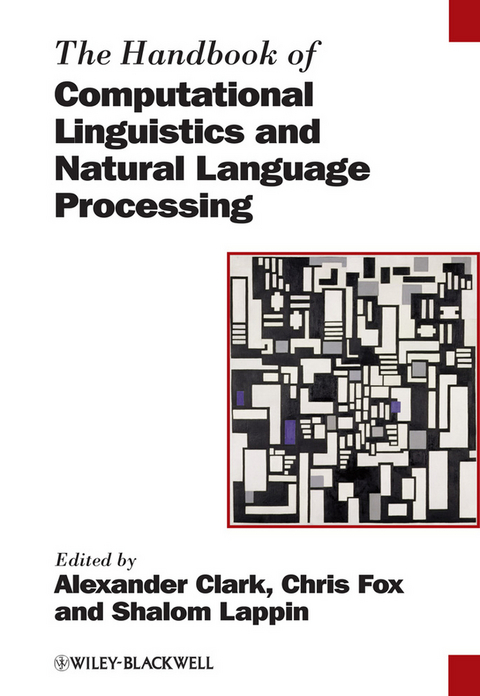
The Handbook of Computational Linguistics and Natural Language Processing (eBook)
Alexander Clark is a Lecturer in the Department of Computer Science at Royal Holloway, University of London. He is the co-author, with Shalom Lappin, of Linguistic Nativism and the Poverty of the Stimulus (Wiley-Blackwell, 2010). Chris Fox is a Reader in the School of Computer Science and Electronic Engineering at the University of Essex. He has also taught at Goldsmiths College, University of London, and King's College London. He is co-author, with Shalom Lappin, of Foundations of Intensional Semantics (Wiley-Blackwell, 2005). Shalom Lappin is Professor of Computational Linguistics at King's College London. He is editor of the Handbook of Contemporary Semantic Theory (1996); co-author, with Chris Fox, of Foundations of Intensional Semantics (2005); and, with Alexander Clark, co-author of Linguistic Nativism and the Poverty of the Stimulus (2010), all published by Wiley-Blackwell.
List of Figures ix
List of Tables xiv
Notes on Contributors xv
Preface xxiii
Introduction 1
Part I Formal Foundations 9
1 Formal Language Theory 11
Shuly Wintner
2 Computational Complexity in Natural Language 43
Ian Pratt-Hartmann
3 Statistical Language Modeling 74
Ciprian Chelba
4 Theory of Parsing 105
Mark-Jan Nederhof And Giorgio Satta
Part II Current Methods 131
5 Maximum Entropy Models 133
Robert Malouf
6 Memory-Based Learning 154
Walter Daelemans And Antal Van Den Bosch
7 Decision Trees 180
Helmut Schmid
8 Unsupervised Learning and Grammar Induction 197
Alexander Clark And Shalom Lappin
9 Artificial Neural Networks 221
James B. Henderson
10 Linguistic Annotation 238
Martha Palmer And Nianwen Xue
11 Evaluation of NLP Systems 271
Philip Resnik And Jimmy Lin
Part III Domains of Application 297
12 Speech Recognition 299
Steve Renals And Thomas Hain
13 Statistical Parsing 333
Stephen Clark
14 Segmentation and Morphology 364
John A. Goldsmith
15 Computational Semantics 394
Chris Fox
16 Computational Models of Dialogue 429
Jonathan Ginzburg And Raquel Fernández
17 Computational Psycholinguistics 482
Matthew W. Crocker
Part IV Applications 515
18 Information Extraction 517
Ralph Grishman
19 Machine Translation 531
Andy Way
20 Natural Language Generation 574
Ehud Reiter
21 Discourse Processing 599
Ruslan Mitkov
22 Question Answering 630
Bonnie Webber And Nick Webb
References 655
Author Index 742
Subject Index 763
"The overall evaluation is therefore definitely very good:
the work is solid, complete and definitely an important reference
for NLP and CL." (Linguistlist, 14 January
2014)
"Altogether, this Handbookcovers a wide variety of topics
in NLP and CL and, is of particular use to researchers in the field
of MT. On a more general note, graduate students or novice
researchers can utilise this book as a comprehensive starting point
for their area of interest within NLP or CL ... All in all,
this is very well compiled book, which effectively balances the
width and depth of theories and applications in two very diverse
yet closely related fields of language research."
(Machine Translation, 18 March 2012)
This Handbook is exceptionally broad and exceptionally deep in its
coverage. The contributions, by noted experts, cover all aspects of
the field, from fundamental theory to concrete applications.
Clark, Fox and Lappin have performed a great service by compiling
this volume.
Richard Sproat, Oregon Health & Science University
| Erscheint lt. Verlag | 17.6.2010 |
|---|---|
| Reihe/Serie | Blackwell Handbooks in Linguistics |
| Blackwell Handbooks in Linguistics | Blackwell Handbooks in Linguistics |
| Sprache | englisch |
| Themenwelt | Geisteswissenschaften ► Sprach- / Literaturwissenschaft ► Sprachwissenschaft |
| Informatik ► Theorie / Studium ► Künstliche Intelligenz / Robotik | |
| Schlagworte | Computational Linguistics • Computerlinguistik • Linguistics • Linguistik • NLP, language technology, speech sciences, memory, formal language theory, machine translation • Sprachwissenschaften |
| ISBN-13 | 9781444324051 / 9781444324051 |
| Informationen gemäß Produktsicherheitsverordnung (GPSR) | |
| Haben Sie eine Frage zum Produkt? |
 PDF (Adobe DRM)
Kopierschutz: Adobe-DRM
Adobe-DRM ist ein Kopierschutz, der das eBook vor Mißbrauch schützen soll. Dabei wird das eBook bereits beim Download auf Ihre persönliche Adobe-ID autorisiert. Lesen können Sie das eBook dann nur auf den Geräten, welche ebenfalls auf Ihre Adobe-ID registriert sind.
Details zum Adobe-DRM
Dateiformat: PDF (Portable Document Format)
Mit einem festen Seitenlayout eignet sich die PDF besonders für Fachbücher mit Spalten, Tabellen und Abbildungen. Eine PDF kann auf fast allen Geräten angezeigt werden, ist aber für kleine Displays (Smartphone, eReader) nur eingeschränkt geeignet.
Systemvoraussetzungen:
PC/Mac: Mit einem PC oder Mac können Sie dieses eBook lesen. Sie benötigen eine
eReader: Dieses eBook kann mit (fast) allen eBook-Readern gelesen werden. Mit dem amazon-Kindle ist es aber nicht kompatibel.
Smartphone/Tablet: Egal ob Apple oder Android, dieses eBook können Sie lesen. Sie benötigen eine
Geräteliste und zusätzliche Hinweise
Buying eBooks from abroad
For tax law reasons we can sell eBooks just within Germany and Switzerland. Regrettably we cannot fulfill eBook-orders from other countries.
aus dem Bereich