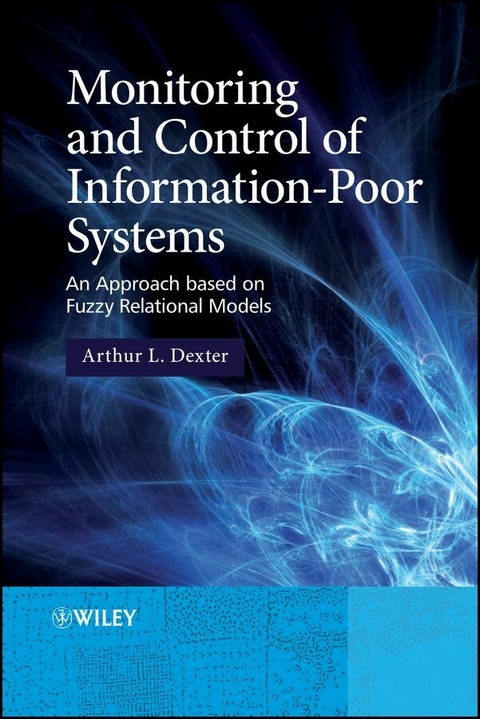
Monitoring and Control of Information-Poor Systems (eBook)
John Wiley & Sons (Verlag)
978-1-119-94587-1 (ISBN)
The first part of Monitoring and Control of Information-Poor Systems aims to clarify why design decisions must take account of the uncertainty associated with optimal choices, and to explain how a fuzzy relational model can be used to generate a fuzzy output, which reflects the uncertainties associated with its predictions. Part two gives a brief introduction to fuzzy decision-making and shows how it can be used to design a predictive control scheme that is suitable for controlling information-poor systems using inaccurate measurements. Part three describes different ways in which fuzzy relational models can be generated online and explains the practical issues associated with their identification and application. The final part of the book provides examples of the use of the previously described techniques in real applications.
Key features:
- Describes techniques applicable to a wide range of engineering, environmental, medical, financial and economic applications
- Uses simple examples to help explain the basic techniques for dealing with uncertainty
- Describes a novel design approach based on the use of fuzzy relational models
- Considers practical issues associated with applying the techniques to real systems
Monitoring and Control of Information-Poor Systems forms an invaluable resource for a wide range of graduate students, and is also a comprehensive reference for researchers and practitioners working on problems involving mathematical modelling and control.
Arthur L. Dexter, Department of Engineering Science, University of Oxford, UK
Arthur Dexter is Professor of Engineering Science at the University of Oxford where his research focuses on the design and implementation of intelligent control schemes for heating, ventilating and air-conditioning (HVAC) plants in commercial buildings. Having been the principal research investigator on 17 research contracts, he has also had over 100 research papers published in many journals including: Journal of Process Control, Fuzzy Sets & Systems, and Building and Environment, and has been a speaker at multiple international conferences. He is considered to be one of the most important researchers in this area today.
Professor Dexter has co-authored two books on the design of microcomputers and co-edited a third book on automated fault detection and diagnosis in buildings.
The monitoring and control of a system whose behaviour is highly uncertain is an important and challenging practical problem. Methods of solution based on fuzzy techniques have generated considerable interest, but very little of the existing literature considers explicit ways of taking uncertainties into account. This book describes an approach to the monitoring and control of information-poor systems that is based on fuzzy relational models which generate fuzzy outputs. The first part of Monitoring and Control of Information-Poor Systems aims to clarify why design decisions must take account of the uncertainty associated with optimal choices, and to explain how a fuzzy relational model can be used to generate a fuzzy output, which reflects the uncertainties associated with its predictions. Part two gives a brief introduction to fuzzy decision-making and shows how it can be used to design a predictive control scheme that is suitable for controlling information-poor systems using inaccurate measurements. Part three describes different ways in which fuzzy relational models can be generated online and explains the practical issues associated with their identification and application. The final part of the book provides examples of the use of the previously described techniques in real applications. Key features: Describes techniques applicable to a wide range of engineering, environmental, medical, financial and economic applications Uses simple examples to help explain the basic techniques for dealing with uncertainty Describes a novel design approach based on the use of fuzzy relational models Considers practical issues associated with applying the techniques to real systems Monitoring and Control of Information-Poor Systems forms an invaluable resource for a wide range of graduate students, and is also a comprehensive reference for researchers and practitioners working on problems involving mathematical modelling and control.
Arthur L. Dexter, Department of Engineering Science, University of Oxford, UK Arthur Dexter is Professor of Engineering Science at the University of Oxford where his research focuses on the design and implementation of intelligent control schemes for heating, ventilating and air-conditioning (HVAC) plants in commercial buildings. Having been the principal research investigator on 17 research contracts, he has also had over 100 research papers published in many journals including: Journal of Process Control, Fuzzy Sets & Systems, and Building and Environment, and has been a speaker at multiple international conferences. He is considered to be one of the most important researchers in this area today. Professor Dexter has co-authored two books on the design of microcomputers and co-edited a third book on automated fault detection and diagnosis in buildings.
| Erscheint lt. Verlag | 1.2.2012 |
|---|---|
| Sprache | englisch |
| Themenwelt | Mathematik / Informatik ► Informatik ► Web / Internet |
| Technik ► Elektrotechnik / Energietechnik | |
| Technik ► Maschinenbau | |
| Wirtschaft ► Betriebswirtschaft / Management ► Unternehmensführung / Management | |
| Schlagworte | Control Process & Measurements • Control Systems Technology • Electrical & Electronics Engineering • Elektrotechnik u. Elektronik • Fuzzy-Systeme • Fuzzy Systems • Maschinenbau • mechanical engineering • Mess- u. Regeltechnik • Monitoring Information-Poor Systems, blast furnaces, container cranes, distillation columns, NOx emissions from gas turbines, rotary kilns, wood pulp production plant, fuzzy random variable, monte carlo methods, fuzzy neural networks, fuzzy rules, non-linear uncertain systems, FRM-based fault diagnosis, • Regelungstechnik |
| ISBN-10 | 1-119-94587-9 / 1119945879 |
| ISBN-13 | 978-1-119-94587-1 / 9781119945871 |
| Informationen gemäß Produktsicherheitsverordnung (GPSR) | |
| Haben Sie eine Frage zum Produkt? |
 PDF (Adobe DRM)
Kopierschutz: Adobe-DRM
Adobe-DRM ist ein Kopierschutz, der das eBook vor Mißbrauch schützen soll. Dabei wird das eBook bereits beim Download auf Ihre persönliche Adobe-ID autorisiert. Lesen können Sie das eBook dann nur auf den Geräten, welche ebenfalls auf Ihre Adobe-ID registriert sind.
Details zum Adobe-DRM
Dateiformat: PDF (Portable Document Format)
Mit einem festen Seitenlayout eignet sich die PDF besonders für Fachbücher mit Spalten, Tabellen und Abbildungen. Eine PDF kann auf fast allen Geräten angezeigt werden, ist aber für kleine Displays (Smartphone, eReader) nur eingeschränkt geeignet.
Systemvoraussetzungen:
PC/Mac: Mit einem PC oder Mac können Sie dieses eBook lesen. Sie benötigen eine
eReader: Dieses eBook kann mit (fast) allen eBook-Readern gelesen werden. Mit dem amazon-Kindle ist es aber nicht kompatibel.
Smartphone/Tablet: Egal ob Apple oder Android, dieses eBook können Sie lesen. Sie benötigen eine
Geräteliste und zusätzliche Hinweise
Buying eBooks from abroad
For tax law reasons we can sell eBooks just within Germany and Switzerland. Regrettably we cannot fulfill eBook-orders from other countries.
aus dem Bereich