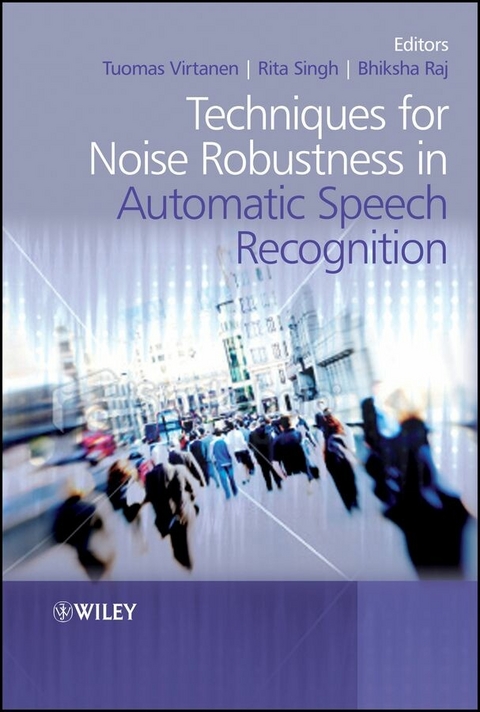
Techniques for Noise Robustness in Automatic Speech Recognition (eBook)
John Wiley & Sons (Verlag)
978-1-118-39266-9 (ISBN)
Automatic speech recognition (ASR) systems are finding increasing use in everyday life. Many of the commonplace environments where the systems are used are noisy, for example users calling up a voice search system from a busy cafeteria or a street. This can result in degraded speech recordings and adversely affect the performance of speech recognition systems. As the use of ASR systems increases, knowledge of the state-of-the-art in techniques to deal with such problems becomes critical to system and application engineers and researchers who work with or on ASR technologies. This book presents a comprehensive survey of the state-of-the-art in techniques used to improve the robustness of speech recognition systems to these degrading external influences.
Key features:
- Reviews all the main noise robust ASR approaches, including signal separation, voice activity detection, robust feature extraction, model compensation and adaptation, missing data techniques and recognition of reverberant speech.
- Acts as a timely exposition of the topic in light of more widespread use in the future of ASR technology in challenging environments.
- Addresses robustness issues and signal degradation which are both key requirements for practitioners of ASR.
- Includes contributions from top ASR researchers from leading research units in the field
Automatic speech recognition (ASR) systems are finding increasing use in everyday life. Many of the commonplace environments where the systems are used are noisy, for example users calling up a voice search system from a busy cafeteria or a street. This can result in degraded speech recordings and adversely affect the performance of speech recognition systems. As the use of ASR systems increases, knowledge of the state-of-the-art in techniques to deal with such problems becomes critical to system and application engineers and researchers who work with or on ASR technologies. This book presents a comprehensive survey of the state-of-the-art in techniques used to improve the robustness of speech recognition systems to these degrading external influences. Key features: Reviews all the main noise robust ASR approaches, including signal separation, voice activity detection, robust feature extraction, model compensation and adaptation, missing data techniques and recognition of reverberant speech. Acts as a timely exposition of the topic in light of more widespread use in the future of ASR technology in challenging environments. Addresses robustness issues and signal degradation which are both key requirements for practitioners of ASR. Includes contributions from top ASR researchers from leading research units in the field
Tuomas Virtanen, Tampere University of Technology, Finland Dr . Virtanen is a senior researcher at Tampere University of Technology. Previously, he has worked at Cambridge University, UK as a research associate. His main research contributions are in sound source separation and its application to robust speech recognition, audio content analysis, and music information retrieval. He is well-known for his work on non-negative matrix factorization based source separation, which is currently widely used in the field. He has published numerous journal and conference articles related to above topics. Rita Singh, Carnegie Mellon University, USA Dr. Singh is the CEO of a speech-technology startup but remains an adjunct faculty of the Language Technologies Institute at Carnegie Mellon University. She has been a major contributor to the open-source CMU sphinx and is one of the main architects of the popular Sphinx4 java-based open-source speech recognition system. In addition to her work on core speech recognition technology, she has also developed several algorithms for noise compensation, and was the prime architect of CMU's award-winning submission to the 2001 Naval Research Lab's challenge on automatic recognition of speech in noisy environments (SPINE). Bhiksha Raj, Carnegie Mellon University, USA Dr. Raj is an associate professor in the Language Technologies Institute and in Electrical and Computer Engineering at Carnegie Mellon University. He has worked extensively on robustness algorithms for speech recognition, and is very well-known for his contributions to the highly-popular VTS approach for noise compensation, as well as his contributions to missing-feature-based techniques for noise compensation. He has published extensively on and holds patents for algorithms for microphone array processing and signal separation.
| Erscheint lt. Verlag | 19.9.2012 |
|---|---|
| Sprache | englisch |
| Themenwelt | Informatik ► Theorie / Studium ► Künstliche Intelligenz / Robotik |
| Technik ► Elektrotechnik / Energietechnik | |
| Schlagworte | ASR • ASR systems • Audio & Speech Processing & Broadcasting • Audio-, Sprachverarbeitung u. Ãbertragung • Audio-, Sprachverarbeitung u. Übertragung • Automatic • Busy • Cafeteria • Commonplace • Critical • Electrical & Electronics Engineering • Elektrotechnik u. Elektronik • Environments • Everyday • Example • increases • increasing • Life • many • Noisy • Performance • Recognition • recognition systems • Search • Speech • Spracherkennung • System • Systems • use • Users • Voice |
| ISBN-10 | 1-118-39266-3 / 1118392663 |
| ISBN-13 | 978-1-118-39266-9 / 9781118392669 |
| Informationen gemäß Produktsicherheitsverordnung (GPSR) | |
| Haben Sie eine Frage zum Produkt? |
 EPUB (Adobe DRM)
Kopierschutz: Adobe-DRM
Adobe-DRM ist ein Kopierschutz, der das eBook vor Mißbrauch schützen soll. Dabei wird das eBook bereits beim Download auf Ihre persönliche Adobe-ID autorisiert. Lesen können Sie das eBook dann nur auf den Geräten, welche ebenfalls auf Ihre Adobe-ID registriert sind.
Details zum Adobe-DRM
Dateiformat: EPUB (Electronic Publication)
EPUB ist ein offener Standard für eBooks und eignet sich besonders zur Darstellung von Belletristik und Sachbüchern. Der Fließtext wird dynamisch an die Display- und Schriftgröße angepasst. Auch für mobile Lesegeräte ist EPUB daher gut geeignet.
Systemvoraussetzungen:
PC/Mac: Mit einem PC oder Mac können Sie dieses eBook lesen. Sie benötigen eine
eReader: Dieses eBook kann mit (fast) allen eBook-Readern gelesen werden. Mit dem amazon-Kindle ist es aber nicht kompatibel.
Smartphone/Tablet: Egal ob Apple oder Android, dieses eBook können Sie lesen. Sie benötigen eine
Geräteliste und zusätzliche Hinweise
Buying eBooks from abroad
For tax law reasons we can sell eBooks just within Germany and Switzerland. Regrettably we cannot fulfill eBook-orders from other countries.
aus dem Bereich