Theory of Lift (eBook)
John Wiley & Sons (Verlag)
978-1-118-34628-0 (ISBN)
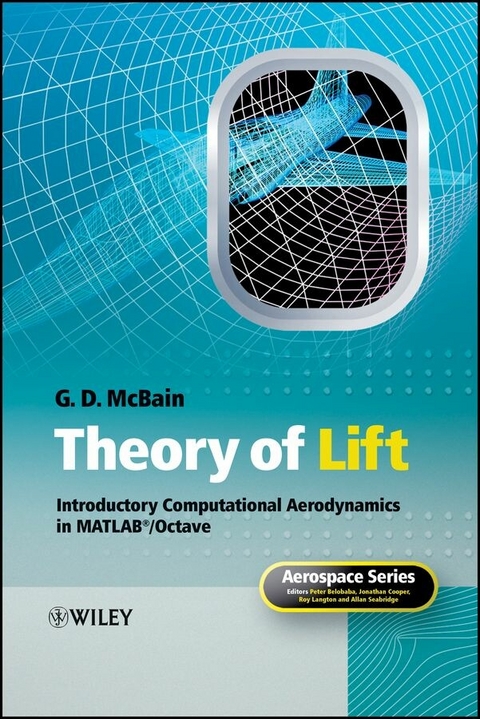
Starting from a basic knowledge of mathematics and mechanics gained in standard foundation classes, Theory of Lift: Introductory Computational Aerodynamics in MATLAB/Octave takes the reader conceptually through from the fundamental mechanics of lift to the stage of actually being able to make practical calculations and predictions of the coefficient of lift for realistic wing profile and planform geometries.
The classical framework and methods of aerodynamics are covered in detail and the reader is shown how they may be used to develop simple yet powerful MATLAB or Octave programs that accurately predict and visualise the dynamics of real wing shapes, using lumped vortex, panel, and vortex lattice methods.
This book contains all the mathematical development and formulae required in standard incompressible aerodynamics as well as dozens of small but complete working programs which can be put to use immediately using either the popular MATLAB or free Octave computional modelling packages.
Key features:
- Synthesizes the classical foundations of aerodynamics with hands-on computation, emphasizing interactivity and visualization.
- Includes complete source code for all programs, all listings having been tested for compatibility with both MATLAB and Octave.
- Companion website (www.wiley.com/go/mcbain) hosting codes and solutions.
Theory of Lift: Introductory Computational Aerodynamics in MATLAB/Octave is an introductory text for graduate and senior undergraduate students on aeronautical and aerospace engineering courses and also forms a valuable reference for engineers and designers.
Dr. Geordie Drummond McBain, Australia
Geordie McBain is an engineering consultant based in Sydney, Australia. In 1995 he graduated top of his class from James Cook University with first class honours in mechanical engineering, earning him the Faculty Medal, and went on to receive his PhD there in 1999. In 2002 he was awarded a Sesquicentennial Postdoctoral Fellowship at the University of Sydney, researching fluid dynamics. During this period, he taught aerodynamics to students on the Aeronautical and Aerospace Engineering degree programmes.
Starting from a basic knowledge of mathematics and mechanics gained in standard foundation classes, Theory of Lift: Introductory Computational Aerodynamics in MATLAB/Octave takes the reader conceptually through from the fundamental mechanics of lift to the stage of actually being able to make practical calculations and predictions of the coefficient of lift for realistic wing profile and planform geometries. The classical framework and methods of aerodynamics are covered in detail and the reader is shown how they may be used to develop simple yet powerful MATLAB or Octave programs that accurately predict and visualise the dynamics of real wing shapes, using lumped vortex, panel, and vortex lattice methods. This book contains all the mathematical development and formulae required in standard incompressible aerodynamics as well as dozens of small but complete working programs which can be put to use immediately using either the popular MATLAB or free Octave computional modelling packages. Key features: Synthesizes the classical foundations of aerodynamics with hands-on computation, emphasizing interactivity and visualization. Includes complete source code for all programs, all listings having been tested for compatibility with both MATLAB and Octave. Companion website (www.wiley.com/go/mcbain) hosting codes and solutions. Theory of Lift: Introductory Computational Aerodynamics in MATLAB/Octave is an introductory text for graduate and senior undergraduate students on aeronautical and aerospace engineering courses and also forms a valuable reference for engineers and designers.
Dr. Geordie Drummond McBain, Australia Geordie McBain is an engineering consultant based in Sydney, Australia. In 1995 he graduated top of his class from James Cook University with first class honours in mechanical engineering, earning him the Faculty Medal, and went on to receive his PhD there in 1999. In 2002 he was awarded a Sesquicentennial Postdoctoral Fellowship at the University of Sydney, researching fluid dynamics. During this period, he taught aerodynamics to students on the Aeronautical and Aerospace Engineering degree programmes.
"This book is a very useful digest of key points from the
literature, carefully structured and presented with helpful
pointers as to how the successive aerodynamical models can be
implemented in the 'now so readily available interactive
matrix computation systems."
(Aeronautical Journal, 1 August
2013)
| Erscheint lt. Verlag | 22.5.2012 |
|---|---|
| Reihe/Serie | Aerospace Series |
| Aerospace Series (PEP) | Aerospace Series (PEP) |
| Mitarbeit |
Herausgeber (Serie): Peter Belobaba, Jonathan Cooper, Roy Langton, Allan Seabridge |
| Sprache | englisch |
| Themenwelt | Mathematik / Informatik ► Mathematik ► Computerprogramme / Computeralgebra |
| Technik ► Fahrzeugbau / Schiffbau | |
| Technik ► Luft- / Raumfahrttechnik | |
| Technik ► Maschinenbau | |
| Schlagworte | Aerodynamik • Aeronautic & Aerospace Engineering • Boundary Layer Equations • circulation and lift • Compressibility • conformal mapping • Electrical & Electronics Engineering • Elektrotechnik u. Elektronik • finite wings and three-dimensional flow • flat plate aerodynamics • Laminar Boundary Layers • lifting line theory • Linearized Compressible Flow • Luft- u. Raumfahrttechnik • Lumped Horseshoe Elements • lumped vortex elements • Maschinenbau • mechanical engineering • Nonelliptic Lift Loading • Octave programming • panel methods for plane flow • plane ideal aerodynamics • plane ideal flow • Systems Engineering & Management • Systemtechnik u. -management • Theory of Lift • thin wing sections • three-dimensional ideal aerodynamics • Viscous Flow • Vortex Lattice Method • vorticity and vortices |
| ISBN-10 | 1-118-34628-9 / 1118346289 |
| ISBN-13 | 978-1-118-34628-0 / 9781118346280 |
| Informationen gemäß Produktsicherheitsverordnung (GPSR) | |
| Haben Sie eine Frage zum Produkt? |
 EPUB (Adobe DRM)
Kopierschutz: Adobe-DRM
Adobe-DRM ist ein Kopierschutz, der das eBook vor Mißbrauch schützen soll. Dabei wird das eBook bereits beim Download auf Ihre persönliche Adobe-ID autorisiert. Lesen können Sie das eBook dann nur auf den Geräten, welche ebenfalls auf Ihre Adobe-ID registriert sind.
Details zum Adobe-DRM
Dateiformat: EPUB (Electronic Publication)
EPUB ist ein offener Standard für eBooks und eignet sich besonders zur Darstellung von Belletristik und Sachbüchern. Der Fließtext wird dynamisch an die Display- und Schriftgröße angepasst. Auch für mobile Lesegeräte ist EPUB daher gut geeignet.
Systemvoraussetzungen:
PC/Mac: Mit einem PC oder Mac können Sie dieses eBook lesen. Sie benötigen eine
eReader: Dieses eBook kann mit (fast) allen eBook-Readern gelesen werden. Mit dem amazon-Kindle ist es aber nicht kompatibel.
Smartphone/Tablet: Egal ob Apple oder Android, dieses eBook können Sie lesen. Sie benötigen eine
Geräteliste und zusätzliche Hinweise
Buying eBooks from abroad
For tax law reasons we can sell eBooks just within Germany and Switzerland. Regrettably we cannot fulfill eBook-orders from other countries.
aus dem Bereich