


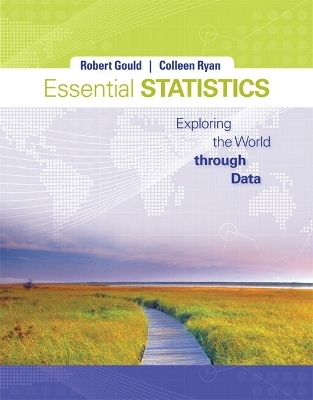
Essential Statistics Plus NEW MyStatLab with Pearson eText -- Access Card Package
Pearson
9780321876232 (ISBN)
- Titel ist leider vergriffen;
keine Neuauflage - Artikel merken
Packages
Access codes for Pearson's MyLab & Mastering products may not be included when purchasing or renting from companies other than Pearson; check with the seller before completing your purchase.
Used or rental books
If you rent or purchase a used book with an access code, the access code may have been redeemed previously and you may have to purchase a new access code.
Access codes
Access codes that are purchased from sellers other than Pearson carry a higher risk of being either the wrong ISBN or a previously redeemed code. Check with the seller prior to purchase.
--
We live in a data-driven world, and this is a book about understanding and working with that data. In order to be informed citizens, authors Rob Gould and Colleen Ryan believe that learning statistics extends beyond the classroom to an essential life skill. They teach students of all math backgrounds how to think about data, how to reason using data, and how to make decisions based on data.
Robert L. Gould (Ph.D., University of California, San Diego) is a leader in the statistics education community. He has served as chair of the American Statistical Association’s Committee on Teacher Enhancement, has served as chair of the ASA’s Statistics Education Section, and was a co-author of the Guidelines for Assessment in Instruction on Statistics Education (GAISE) College Report. As the associate director of professional development for CAUSE (Consortium for the Advancement of Undergraduate Statistics Education), he has worked closely with the American Mathematical Association of Two-Year Colleges (AMATYC) to provide traveling workshops and summer institutes in statistics (he also presented an AMATYC summer institute in 2009). For over ten years, he has served as Vice-Chair of Undergraduate Studies at the UCLA Department of Statistics, and he is Director of the UCLA Center for the Teaching of Statistics. In 2009, Rob was elected president of the Southern California Chapter of the American Statistical Association. Colleen N. Ryan has taught statistics, chemistry, and physics to diverse community college students for decades. She taught at Oxnard College from 1975 to 2006, where she earned the Teacher of the Year Award. Colleen currently teaches statistics part-time at California Lutheran University. She often designs her own lab activities. Her passion is to discover new ways to make statistical theory practical, easy to understand, and sometimes even fun. Colleen earned a B.A. in physics from Wellesley College, an M.A.T. in physics from Harvard University, and an M.A. in chemistry from Wellesley College. Her first exposure to statistics was with Frederick Mosteller at Harvard. In her spare time, she sings with the Oaks Chamber Singers, has been an avid skier in the past, and enjoys time with her family.
1. Introduction to Data
1.1 What Are Data?
1.2 Classifying and Storing Data
1.3 Organizing Categorical Data
1.4 Collecting Data to Understand Causality
2. Picturing Variation with Graphs
2.1 Visualizing Variation in Numerical Data
2.2 Summarizing Important Features of a Numerical Distribution
2.3 Visualizing Variation in Categorical Variables
2.4 Summarizing Categorical Distributions
2.5 Interpreting Graphs
3. Numerical Summaries of Center and Variation
3.1 Summaries for Symmetric Distributions
3.2 What's Unusual? The Empirical Rule and z-Scores
3.3 Summaries for Skewed Distributions
3.4 Comparing Measures of Center
3.5 Using Boxplots for Displaying Summaries
4. Regression Analysis: Exploring Associations between Variables
4.1 Visualizing Variability with a Scatterplot
4.2 Measuring Strength of Association with Correlation
4.3 Modeling Linear Trends
4.4 Evaluating the Linear Model
5. Modeling Variation with Probability
5.1 What is Randomness?
5.2 Finding Theoretical Probabilities
5.3 Associations in Categorical Variables
5.4 The Law of Large Numbers
6. Modeling Random Events: The Normal and Binomial Models
6.1 Probability Distributions Are Models of Random Experiments
6.2 The Normal Model
6.3 The Binomial Model
7. Survey Sampling and Inference
7.1 Learning about the World through Surveys
7.2 Measuring the Quality of a Survey
7.3 The Central Limit Theorem for Sample Proportions
7.4 Estimating the Population Proportion with Confidence Intervals
8. Hypothesis Testing for Population Proportions
8.1 The Main Ingredients of Hypothesis Testing
8.2 Characterizing p-values
8.3 Hypothesis Testing in Four Steps
8.4 Comparing Proportions from Two Populations
8.5 Understanding Hypothesis Testing
9. Inferring Population Means
9.1 Sample Means of Random Samples
9.2 The Central Limit Theorem for Sample Means
9.3 Answering Questions about the Mean of a Population
9.4 Comparing Two Population Means
9.5 Overview of Analyzing Means
10. Associations between Categorical Variables
10.1 The Basic Ingredients for Testing with Categorical Variables
10.2 Chi-Square Tests for Associations between Categorical Variables
10.3 Reading Research Papers
| Erscheint lt. Verlag | 14.3.2013 |
|---|---|
| Sprache | englisch |
| Gewicht | 1089 g |
| Themenwelt | Mathematik / Informatik ► Mathematik ► Statistik |
| ISBN-13 | 9780321876232 / 9780321876232 |
| Zustand | Neuware |
| Informationen gemäß Produktsicherheitsverordnung (GPSR) | |
| Haben Sie eine Frage zum Produkt? |
aus dem Bereich


