


Unified Computational Intelligence for Complex Systems
Seiten
2012
Springer Berlin (Verlag)
9783642263958 (ISBN)
Springer Berlin (Verlag)
9783642263958 (ISBN)
This is the first book to present a computational intelligence architecture capable of learning in unsupervised, supervised, or reinforcement learning modes. It is also the first to cover applications of time scales mathematics to engineering applications.
Computational intelligence encompasses a wide variety of techniques that allow computation to learn, to adapt, and to seek. That is, they may be designed to learn information without explicit programming regarding the nature of the content to be retained, they may be imbued with the functionality to adapt to maintain their course within a complex and unpredictably changing environment, and they may help us seek out truths about our own dynamics and lives through their inclusion in complex system modeling. These capabilities place our ability to compute in a category apart from our ability to erect suspension bridges, although both are products of technological advancement and reflect an increased understanding of our world. In this book, we show how to unify aspects of learning and adaptation within the computational intelligence framework. While a number of algorithms exist that fall under the umbrella of computational intelligence, with new ones added every year, all of them focus on the capabilities of learning, adapting, and helping us seek. So, the term unified computational intelligence relates not to the individual algorithms but to the underlying goals driving them. This book focuses on the computational intelligence areas of neural networks and dynamic programming, showing how to unify aspects of these areas to create new, more powerful, computational intelligence architectures to apply to new problem domains.
Computational intelligence encompasses a wide variety of techniques that allow computation to learn, to adapt, and to seek. That is, they may be designed to learn information without explicit programming regarding the nature of the content to be retained, they may be imbued with the functionality to adapt to maintain their course within a complex and unpredictably changing environment, and they may help us seek out truths about our own dynamics and lives through their inclusion in complex system modeling. These capabilities place our ability to compute in a category apart from our ability to erect suspension bridges, although both are products of technological advancement and reflect an increased understanding of our world. In this book, we show how to unify aspects of learning and adaptation within the computational intelligence framework. While a number of algorithms exist that fall under the umbrella of computational intelligence, with new ones added every year, all of them focus on the capabilities of learning, adapting, and helping us seek. So, the term unified computational intelligence relates not to the individual algorithms but to the underlying goals driving them. This book focuses on the computational intelligence areas of neural networks and dynamic programming, showing how to unify aspects of these areas to create new, more powerful, computational intelligence architectures to apply to new problem domains.
Introduction.- The Unified Art Architecture.- An Application of Unified Computational Intelligence.- The Time Scales Calculus.- Approximate Dynamic Programming on Time Scales.- Backpropagation on Time Scales.- Unified Computational Intelligence in Social Science.
| Erscheint lt. Verlag | 5.9.2012 |
|---|---|
| Reihe/Serie | Adaptation, Learning, and Optimization |
| Zusatzinfo | 150 p. 9 illus. in color. |
| Verlagsort | Berlin |
| Sprache | englisch |
| Maße | 155 x 235 mm |
| Gewicht | 205 g |
| Themenwelt | Informatik ► Theorie / Studium ► Künstliche Intelligenz / Robotik |
| Technik | |
| Schlagworte | Adaptive Resonance Theory • Agent-Based Computational Social Science • Approximate Dynamic Programming • backpropagation • Backpropogation • Clustering • Complexity • Computational Intelligence • Dynamic Equations • Game Theory • learning • Modeling • neural network • Neural networks • Reinforcement Learning • supervised learning • Time Scales Calculus • Unsupervised Learning |
| ISBN-13 | 9783642263958 / 9783642263958 |
| Zustand | Neuware |
| Informationen gemäß Produktsicherheitsverordnung (GPSR) | |
| Haben Sie eine Frage zum Produkt? |
Mehr entdecken
aus dem Bereich


aus dem Bereich
Eine praxisorientierte Einführung
Buch | Softcover (2025)
Springer Vieweg (Verlag)
CHF 53,15
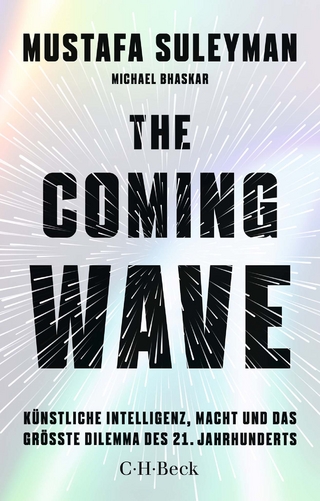
Künstliche Intelligenz, Macht und das größte Dilemma des 21. …
Buch | Softcover (2025)
C.H.Beck (Verlag)
CHF 25,20
Buch | Softcover (2025)
Reclam, Philipp (Verlag)
CHF 11,20


