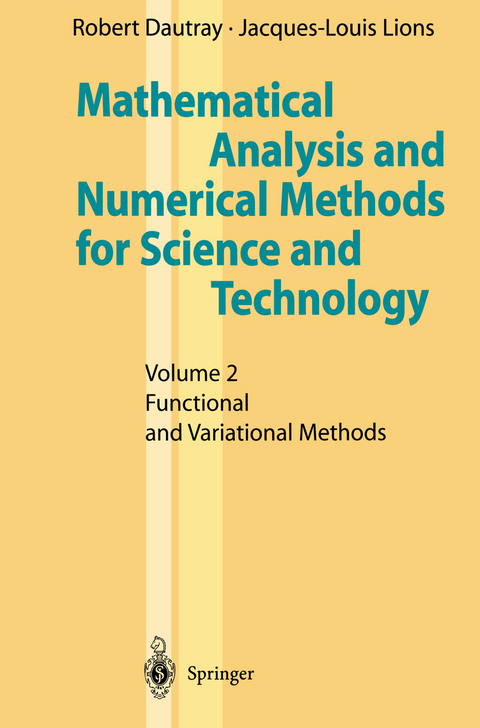
Mathematical Analysis and Numerical Methods for Science and Technology
Springer Berlin (Verlag)
978-3-540-66098-9 (ISBN)
- Titel ist leider vergriffen;
keine Neuauflage - Artikel merken
III. Functional Transformations.- A. Some Transformations Useful in Applications.- §1. Fourier Series and Dirichlet’s Problem.- 1. Fourier Series.- 1.1. Convergence in L2 (T).- 1.2. Pointwise Convergence on T.- 2. Distributions on T and Periodic Distributions.- 2.1. Comparison of D’(T) with the Distributions on ?.- 2.2. Principal Properties of D’(T).- 3. Fourier Series of Distributions.- 4. Fourier Series and Fourier Transforms.- 5. Convergence in the Sense of Césaro.- 6. Solution of Dirichlet’s Problem with the Help of Fourier Series.- 6.1. Dirichlet’s Problem in a Disk.- 6.2. Dirichlet’s Problem in a Rectangle.- §2. The Mellin Transform.- 1. Generalities.- 2. Definition of the Mellin Transform.- 3. Properties of the Mellin Transform.- 4. Inverse Mellin Transform.- 5. Applications of the Mellin Transform.- 6. Table of Some Mellin Transforms.- §3. The Hankel Transform.- 1. Generalities.- 2. Introduction to Bessel Functions.- 3. Definition of the Hankel Transform.- 4. The Inversion Formula.- 5. Properties of the Hankel Transform.- 6. Application of the Hankel Transform to Partial Differential Equations.- 6.1. Dirichlet’s Problem for Laplace’s Equation in?+3. The Case of Axial Symmetry.- 6.2. Boundary Value Problem for the Biharmonic Equation in ?+3, with Axial Symmetry.- 7. Table of Some Hankel Transforms.- Review of Chapter III A.- B. Discrete Fourier Transforms and Fast Fourier Transforms.- §1. Introduction.- §2. Acceleration of the Product of a Matrix by a Vector.- §3. The Fast Fourier Transform of Cooley and Tukey.- §4. The Fast Fourier Transform of Good-Winograd.- §5. Reduction of the Number of Multiplications.- 1. Relation Between the Discrete Fourier Transform and the Problem of Cyclic Convolution.- 2. Complexity of the Product of Two Polynomials.- 3. Application to the Cyclic Convolution of Order 2.- 4. Application to the Cyclic Convolution of Order 3.- 5. Application to the Cyclic Convolution of Order 6.- §6. Fast Fourier Transform in Two Dimensions.- §7. Some Applications of the Fast Fourier Transform.- 1. Solution of Boundary Value Problems.- 2. Regularisation and Smoothing of Functions.- 3. Practical Calculation of the Fourier Transform of a Signal.- 4. Determination of the Spectrum of Certain Finite Difference Operators and Fast Solvers for the Laplacian.- Review of Chapter III B.- IV. Sobolev Spaces.- §1. Spaces H1(?), Hm(?).- §2. The Space Hs(?n).- 1. Definition and First Properties.- 2. The Topological Dual of Hs(?n).- 3. The Equation (-? + k2)u = f in ?n
, k ? ?/z0{.- §3. Sobolev’s Embedding Theorem.- §4. Density and Trace Theorems for the Spaces Hm(?), (m ? ? * = ?/z0{).- 1. A Density Theorem.- 2. A Trace Theorem for H1 (?+n).- 3. Traces of the Spaces Hm(?+n) and Hm(?).- 4. Properties of m-Extension.- §5. The Spaces H-m(?) for all m ? ?.- §6. Compactness.- §7. Some Inequalities in Sobolev Spaces.- 1. Poincaré’s Inequality for H01(?) (resp. H0m(?)).- 2. Poincaré’s Inequality for H1(?).- 3. Convexity Inequalities for Hm(?).- §8. Supplementary Remarks.- 1. Sobolev Spaces Wm, p(?).- 1.1. Definitions.- 1.2. Sobolev Injections.- 1.3. Trace Theorems for the Spaces Wm, p(?).- 2. Sobolev Spaces with Weights.- 2.1. Unbounded Open Sets.- 2.2. Polygonal Open Sets.- Review of Chapter IV.- Appendix: The Spaces Hs(?) with ? the “Regular” Boundary of an Open Set ? in ?n.- V. Linear Differential Operators.- §1. Generalities on Linear Differential Operators.- 1. Characterisation of Linear Differential Operators.- 2. Various Definitions.- 2.1. Leibniz’s Formula.- 2.2. Transpose of a Linear Differential Operator.- 2.3. Order of a Linear Differential Operator.- 3. Linear Differential Operator on a Manifold.- 4. Characteristics.- 4.1. Concept of Characteristics.- 4.2. Bicharacteristics.- 5. Operators with Analytic Coefficients. Theorems of Cauchy-Kowalewsky and of Holmgren.- §2. Linear Differential Operators with Constant Coefficients.- 1. Study of a l.d.o. with Constant Coefficients by the Fourier Transform.- 1.1. Existence of a Solution of Pu = f in the Space of Tempered Distributions.- 1.2. Example 1: The Laplacian.- 1.3. Elliptic and Strongly Elliptic Operators.- 1.4. Hypo-Elliptic and Semi-Elliptic Operators.- 1.5. Examples.- 1.6. Reduction of Operators of Order 2 in a Homogeneous, Isotropic “Medium”.- 2. Elementary Solutions of a l.d.o. with Constant Coefficients.- 2.1. Introduction.- 2.2. Elementary Solutions in S’ Examples.- 2.3. Elementary Solution with Support in a Salient Closed Convex Cone: Hyperbolic Operator.- 3. Characterisation of Hyperbolic Operators.- 3.1. Characteristics of a l.d.o. with Constant Coefficients.- 3.2. Algebraic Characterisation of Hyperbolic Operators.- 3.3. Hyperbolic Operators of Order 2.- 4. Parabolic Operators.- §3. Cauchy Problem for Differential Operators with Constant Coefficients.- 1. Cauchy Problem and the Elementary Solution in D’(?n× ?+).- 2. Propagation in Hyperbolic Cauchy Problems.- 3. Choice of a Functional Space: Well-Posed Cauchy Problem.- 4. Well-Posed Cauchy Problem in S’.- 5. Parabolic and Weakly Parabolic Operators.- 6. Study of the Particular Case P = ?/?t + P0.- 6.1. Analysis of One-Dimensional Case.- 6.2. Case in which P0 is Strongly Elliptic.- 6.3. Schrödinger Operator.- 7. Well-Posed Cauchy Problem in D’: Hyperbolic Operators.- §4. Local Regularity of Solutions*.- 1. Characterisation of Hypo-Ellipticity.- 1.1. Necessary Condition for Hypo-Ellipticity.- 1.2. Algebraic Transformation of the Necessary Condition for Hypo-Ellipticity.- 1.3. The Principal Result.- 2. Analyticity of Solutions.- 2.1. Statement of Results.- 2.2. Estimates of Analyticity.- 2.3. Generalisation: Gevrey Classes.- 3. Comparison of Operators.- 4. Local Regularity for Operators with Variable Coefficients and of Constant Force.- 5. Construction of an Elementary Solution.- §5. The Maximum Principle *.- 1. Prerequisites.- 2. Parabolic Maximum Principle and Dissipativity.- 3. Characterisation of Operators P Satisfying Maximum Principles.- 3.1. The Weak Maximum Principle.- 3.2. The Comparison Principle.- 3.3. The Strong Maximum Principle.- 3.4. The Principle of the Strong Parabolic Maximum.- Review of Chapter V.- VI. Operators in Banach Spaces and in Hilbert Spaces.- §1. Review of Functional Analysis: Banach and Hilbert Spaces.- 1. Locally Convex Topological Vector Spaces. Normed Spaces and Banach Spaces.- 2. Linear Operators.- 3. Duality.- 4. The Hahn-Banach Theorem and its Applications.- 4.1. Problems of Approximation.- 4.2. Problems of Existence.- 4.3. Problems of Separation of Convex Sets.- 5. Bidual, Reflexivity, Weak Convergence, Weak Compactness.- 5.1. Bidual.- 5.2. Reflexivity.- 5.3. Weak Convergence.- 5.4. Weak Compactness.- 5.5. Weak-Star Convergence.- 6. Hilbert Spaces.- 6.1. Definitions.- 6.2. Projection on a Closed Convex Set.- 6.3. Orthonormal Bases.- 6.4. The Riesz Representation Theorem. Reflexivity.- 7. Ideas About Functions of a Real or Complex Variable with Values in a Banach Space.- 7.1. Weak Topology.- 7.2. Weak Differentiability.- 7.3. Weak Holomorphy.- §2. Linear Operators in Banach Spaces.- 1. Generalities on Linear Operators.- 1.1. Domain, Kernel and Image of a Linear Operator.- 1.2. Nullity and Deficiency Indices.- 1.3. Basic Properties of Linear Operators.- 2. Spaces of Bounded Operators.- 2.1. Introduction.- 2.2. Various Concepts of Convergence of Operators.- 2.3. Composition and Inverse of Bounded Operators.- 2.4. Transpose of a Bounded Operator.- 2.5. Some Classes of Bounded Operators.- 2.6. Some Ideas on Functions of a Real or Complex Variable with Operator Values; Families of Operators.- 3. Closed Operators.- 3.1. Definition and Examples.- 3.2. Basic Properties.- 3.3. The Set ?(X, Y) of Closed Operators from X into Y.- 3.4. Transpose of a Closed Operator.- 3.5. Operators with Closed Image.- §3. Linear Operators in Hilbert Spaces.- 1. Bounded Operators in Hilbert Spaces.- 1.1. Adjoint Sesquilinear Form.- 1.2. Hermitian Operators.- 1.3. Orthogonal Projectors.- 1.4. Isometries and Unitary Operators.- 1.5. Hilbert-Schmidt Operators.- 2. Unbounded Operators in Hilbert Spaces.- 2.1. Adjoint of an Unbounded Operator.- 2.2. Symmetric Operators.- 2.3. The Cayley Transform.- 2.4. Normal Operators.- 2.5. Sesquilinear Forms and Unbounded Operators.- Review of Chapter VI.- VII. Linear Variational Problems. Regularity.- §1. Elliptic Variational Theory.- 1. The Lax-Milgram Theorem.- 2. First Examples.- 2.1. Example 1. Dirichlet Problem.- 2.2. Example 2. Neumann Problem.- 3. Extensions in the Case in which V and H are Spaces of Distributions or of Functions.- 4. Sesquilinear Forms Associated with Elliptic Operators of Order Two.- 5. Sesquilinear Forms Associated with Elliptic Operators of Order 2m.- 6. Miscellaneous Remarks.- 7. Application to the Solution of General Elliptic Problems (of Dirichlet Type).- §2. Examples of Second Order Elliptic Problems.- 1. Generalities.- 2. Examples of Variational Problems.- 2.1. Mixed Problem.- 2.2. Non-Local Boundary Conditions.- 3. Problems Relative to Integro-Differential Forms on ? + ?.- 3.1. Problem of the Oblique Derivative.- 3.2. Robin’s Problem.- 4. Transmission Problem.- 5. Miscellaneous Remarks.- 6. Application: Stationary Multigroup Equation for the Diffusion of Neutrons.- 7. Application: Statical Problems of Elasticity.- 7.1. Introduction.- 7.2. Variational Formulation.- 7.3. Korn’s Inequality.- 7.4. Application to Problem (2.39).- 7.5. Inhomogeneous Problem.- 8. Statical Problems of the Flexure of Plates.- §3. Regularity of the Solutions of Variational Problems.- 1. Introduction.- 2. Interior Regularity.- 3. Global Regularity of the Solutions of Dirichlet and Neumann Problems for Elliptic Operators of Order 2.- 4. Miscellaneous Results on Global Regularity.- 5. Green’s Functions.- 5.1. Case of the Laplacian in a Bounded Open Set ? with Dirichlet Condition.- 5.2. Some Other Particular Examples.- 5.3. Green’s Functions in a More General Setting.- Review of Chapter VII.- Appendix. “Distributions”.- §1. Definition and Basic Properties of Distributions.- 1. The Space D(?).- 1.1. Definition.- 1.2. Elementary Properties of the Convolution Product of Two Functions.- 1.3. A Procedure for the Construction of Functions of D(?).- 1.4. The Notion of Convergence in D(?).- 1.5. Some Inclusion and Density Properties.- 2. The Space D’(?) of Distributions on ?.- 2.1. Definition of Distributions and the Concept of Convergence in D’(?).- 2.2. First Examples of Distributions: Measures on ?.- 2.3. Differentiation of Distributions. Examples.- 2.4. Support of a Distribution. Distributions with Compact Support.- 3. Some Elementary Operations on Distributions.- 3.1. Product by a Function of Class ??.- 3.2. Primitives of a Distribution on a Interval of ?.- 3.3. Tensor Product of Two Distributions.- 3.4. Direct Image and Inverse Image of a Function and of a Distribution by a Function of Class ??.- 4. Some Examples.- 4.1. Primitives of the Dirac Measure.- 4.2. A Division Problem (Case n = 1).- 4.3. Derivative of a Function of ?n Discontinuous on a Surface.- 4.4. Distributions Defined by Inverse Image from Distributions on the Real Line.- §2. Convolution of Distributions.- 1. Convolution of a Distribution on ?n and a Function of D(?n).- 2. Convolution of Two Distributions of Which One (at Least) is with Compact Support.- 3. Distributions with Convolutive Supports.- 4. Convolution Algebras.- §3. Fourier Transforms.- 1. Fourier Transform of L1-Functions.- 2. The Space L(?n).- 3. Fourier Transform in L2.- 4. Fourier Transforms of Tempered Distributions.- 5. Fourier Transform of Distributions with Compact Support.- 6. Examples of the Calculation of Fourier Transforms.- 7. Partial Fourier Transform.- 8. Fourier Transform and Automorphisms of ?n: Homogeneous Distributions.- 8.1. Fourier Transform and Automorphisms of ?n.- 8.2. Homogeneous Distributions.- 9. Fourier Transform and Convolution. Spaces OM(?n) and O’C(?n).- 9.1. The Space OM(?n) ( = OM).- 9.2. The Space O’C.- 10. Fourier Transform of Tempered Measures.- 11. Distribution of Positive Type. Bochner’s Theorem.- 11.1. Functions of Positive Type.- 11.2. Distributions of Positive Type.- 12. Schwartz’s Theorem of Kernels.- 13. Some Distributions and Their Fourier Transforms.- Table of Notations.- of Volumes 1, 3–6.
| Erscheint lt. Verlag | 23.11.1999 |
|---|---|
| Co-Autor | M. Artola, M. Authier, P. Benilan, M. Cessenat, J.-M. Combes, H. Lanchon, B. Mercier, C. Wild, C. Zuily |
| Übersetzer | I.N. Sneddon |
| Zusatzinfo | XVI, 590 p. |
| Verlagsort | Berlin |
| Sprache | englisch |
| Maße | 155 x 235 mm |
| Gewicht | 776 g |
| Themenwelt | Mathematik / Informatik ► Mathematik ► Analysis |
| Schlagworte | Analysis; Handbuch/Lehrbuch • Boundary value problem • CON_D038 • differential equation • Differential operator • Distribution • Fourier series • Inequality • manifold • Mathematica • Mathematical Analysis • Modeling • numerical method • Numerische Analysis • Numerische Mathematik; Handbuch/Lehrbuch • Operator • partial differential equation • Sobolev Space • Solution |
| ISBN-10 | 3-540-66098-4 / 3540660984 |
| ISBN-13 | 978-3-540-66098-9 / 9783540660989 |
| Zustand | Neuware |
| Informationen gemäß Produktsicherheitsverordnung (GPSR) | |
| Haben Sie eine Frage zum Produkt? |
aus dem Bereich