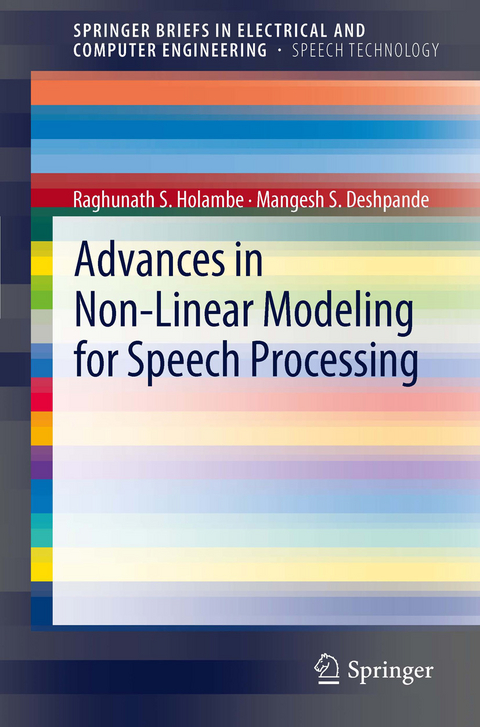
Advances in Non-Linear Modeling for Speech Processing (eBook)
XIII, 102 Seiten
Springer New York (Verlag)
9781461415053 (ISBN)
Advances in Non-Linear Modeling for Speech Processing includes advanced topics in non-linear estimation and modeling techniques along with their applications to speaker recognition.
Non-linear aeroacoustic modeling approach is used to estimate the important fine-structure speech events, which are not revealed by the short time Fourier transform (STFT). This aeroacostic modeling approach provides the impetus for the high resolution Teager energy operator (TEO). This operator is characterized by a time resolution that can track rapid signal energy changes within a glottal cycle.
The cepstral features like linear prediction cepstral coefficients (LPCC) and mel frequency cepstral coefficients (MFCC) are computed from the magnitude spectrum of the speech frame and the phase spectra is neglected. To overcome the problem of neglecting the phase spectra, the speech production system can be represented as an amplitude modulation-frequency modulation (AM-FM) model. To demodulate the speech signal, to estimation the amplitude envelope and instantaneous frequency components, the energy separation algorithm (ESA) and the Hilbert transform demodulation (HTD) algorithm are discussed.
Different features derived using above non-linear modeling techniques are used to develop a speaker identification system. Finally, it is shown that, the fusion of speech production and speech perception mechanisms can lead to a robust feature set.
Advances in Non-Linear Modeling for Speech Processing includes advanced topics in non-linear estimation and modeling techniques along with their applications to speaker recognition. Non-linear aeroacoustic modeling approach is used to estimate the important fine-structure speech events, which are not revealed by the short time Fourier transform (STFT). This aeroacostic modeling approach provides the impetus for the high resolution Teager energy operator (TEO). This operator is characterized by a time resolution that can track rapid signal energy changes within a glottal cycle. The cepstral features like linear prediction cepstral coefficients (LPCC) and mel frequency cepstral coefficients (MFCC) are computed from the magnitude spectrum of the speech frame and the phase spectra is neglected. To overcome the problem of neglecting the phase spectra, the speech production system can be represented as an amplitude modulation-frequency modulation (AM-FM) model. To demodulate the speech signal, to estimation the amplitude envelope and instantaneous frequency components, the energy separation algorithm (ESA) and the Hilbert transform demodulation (HTD) algorithm are discussed. Different features derived using above non-linear modeling techniques are used to develop a speaker identification system. Finally, it is shown that, the fusion of speech production and speech perception mechanisms can lead to a robust feature set.
From the Contents: Speech production mechanism.- Linear speech production model.- Nonlinearity in speech production.- Nonlinear dynamic system model.- Speech perception mechanism.- Summary.- Autoregressive models.- Linear autoregressive model.- Nonlinear autoregressive model.- Nonlinear measurement and modeling using Teager energy operator.- Teager energy operator (TEO).- Vocal tract aeroacoustic flow.- Energy measurement.- Energy separation.- Noise suppression using TEO.
| Erscheint lt. Verlag | 21.2.2012 |
|---|---|
| Reihe/Serie | SpringerBriefs in Speech Technology | SpringerBriefs in Speech Technology |
| Zusatzinfo | XIII, 102 p. 32 illus. |
| Verlagsort | New York |
| Sprache | englisch |
| Themenwelt | Informatik ► Theorie / Studium ► Künstliche Intelligenz / Robotik |
| Technik ► Elektrotechnik / Energietechnik | |
| Schlagworte | Aeroacoustic modeling approach • AM-FM model • Glottal cycle • Non-linear modeling techniques • Speech production mechanism • speech signal processing • Teager energy operator |
| ISBN-13 | 9781461415053 / 9781461415053 |
| Informationen gemäß Produktsicherheitsverordnung (GPSR) | |
| Haben Sie eine Frage zum Produkt? |
 PDF (Wasserzeichen)
DRM: Digitales Wasserzeichen
Dieses eBook enthält ein digitales Wasserzeichen und ist damit für Sie personalisiert. Bei einer missbräuchlichen Weitergabe des eBooks an Dritte ist eine Rückverfolgung an die Quelle möglich.
Dateiformat: PDF (Portable Document Format)
Mit einem festen Seitenlayout eignet sich die PDF besonders für Fachbücher mit Spalten, Tabellen und Abbildungen. Eine PDF kann auf fast allen Geräten angezeigt werden, ist aber für kleine Displays (Smartphone, eReader) nur eingeschränkt geeignet.
Systemvoraussetzungen:
PC/Mac: Mit einem PC oder Mac können Sie dieses eBook lesen. Sie benötigen dafür einen PDF-Viewer - z.B. den Adobe Reader oder Adobe Digital Editions.
eReader: Dieses eBook kann mit (fast) allen eBook-Readern gelesen werden. Mit dem amazon-Kindle ist es aber nicht kompatibel.
Smartphone/Tablet: Egal ob Apple oder Android, dieses eBook können Sie lesen. Sie benötigen dafür einen PDF-Viewer - z.B. die kostenlose Adobe Digital Editions-App.
Buying eBooks from abroad
For tax law reasons we can sell eBooks just within Germany and Switzerland. Regrettably we cannot fulfill eBook-orders from other countries.
aus dem Bereich